Showing posts with label books. Show all posts

2024/07/07

Five books: Asia

Once in a while, I notice in my unplanned readings a cluster, theme. When this happens, it's time for a "five books" blog post. So here we are.  Asia. Not a very coherent theme. But I recently read five books connected to that continent. 

The Cowshed: memories of the Chinese cultural revolution by Ji Xianlin

An extraordinary book. This episode of history is strange but at the same time a bit familiar.  Marxism puts "class struggle" as one of the foundations of politics. That makes class labels an extremely powerful weapon. Whether it is at the top of the national party or in the smallest village committees, all it takes is a tiny minority of sociopaths to figure out this weapon will get them power, and it leads to inevitable escalations of ostracism: capitalists, bourgeois, petit bourgeois, kulaks, liberals, the list of enemy classes always grows. The rituals become crazier, the language itself becomes insane, and the violence extreme. The Chinese cultural revolution is perhaps the largest ever version of this process.  The "cancel culture" of western society in the 2010s is almost harmless by comparison but it is a prototype of this process. If you can imagine it raised to the n-th power, multiplied by a lot of cruelty and sadism, growing for a couple of decades of political madness, you can maybe get a sense of what it might have been like in China from the mid 60s to the mid 70s. Or you can just read this book.  

As I write this, for some reason I'm reminded of a book by Elie Wiesel, which I read years ago, I can't remember what the title is, but it's not one of his famous one, maybe Paroles d'étranger? They are not similar, Wiesel talking about the Holocaust is much more emotional and philosophical, while Ji has a very matter-of-fact style, almost journalistic. But deep down, it kind of makes me feel the same way. Shudder.

The Anarchy: The East India Company, Corporate Violence, and the Pillage of an Empire by William Dalrymple

Everyone knows that India was a British colony. This book is about what happened before that, long before the administrators in khaki shorts and funny hats etc. A few random observations: 
  • At the beginning, in the year 1600, it was not the British government, but a private company with shareholders in London, equipped with a "charter" from the King (basically a business license), that decided to go trade in India.  I am against the idea of business licensing in general, and reading this book didn't change my mind about that to say the least!
  • During most of this time, the British could not even imagine controlling India. On the contrary, they were in awe of the wealth and power of India. They had to curry favor, and beg for permission from the Mughal  authorities. Their focus was to compete with other Europeans especially the French, and make money by connecting the wealth of India with Europe.  If you went back to say 1700 and told a British guy in India that his successors would rule the country, it would seem completely ridiculous.
  • Over 250 years, through incredible ups and downs, the company evolved from simply trading, to participating in the politics of the empire, to  eventually dominating the country militarily, and then gradually being replaced by the British government. The more famous period of colonialism as we know it was less than 100 years, from 1858, when the British government nationalized the company, until 1947. 
  • Nowadays, the biggest companies in the global stock market are 20 to 50 years old. But the British East India Company occupied an  equivalent position for over 200 years! 
  • Interestingly, the British started dominating India politically right around the time when they started losing their colonies in North America which became the USA. There are actually quite a few people who fought in the American war of independence, the conquest of the Mughal Empire in India, and the Napoleonic wars in Europe. Can you imagine? Pretty dramatic couple of decades.
From Third World to First: The Singapore Story: 1965-2000 by Lee Kuan Yew

Which country had the best economy of the last 150 years? The USA is obviously the undisputed heavyweight champ over this period. But if you wanted to make a pound for pound argument? Singapore is definitely in the conversation. The title of this book is literally true, in 1965 it was an underdeveloped economy, poorer than many African countries. Today it boasts some of the highest GDP/capita figures in the world. 

Singapore has no oil, nor gold. No forests, no farmland. They barely even have enough fresh water to drink. Their biggest neighbors, Malaysia, Indonesia or China were hostile to them most of this time. How did they pull off this miracle?  They do have a pretty great location for trade. But then again so does Djibouti. Much of their population came through the Darwinian process of migration. But same can be said for many other countries. Will this book give you the "one weird trick to go from third world to first world"?  No. There are a lot of factors. Many of them kind of boring. And some the choices the government made are questionable, some policies are bad. And a lot are good. You have to read the whole story to get it.    

There is however one implicit meta-lesson:  sometimes history hinges on exceptional individuals.  Reading this book, you can't help but realize just how bad most political leaders are compared to Lee Kwan Yew. Lee may very well embody the best combination of intelligence, wisdom, integrity and competence found in any political leader of the 20th century. 

Billion Dollar Whale: The Man Who Fooled Wall Street, Hollywood, and the World by Tom Wright and Bradley Hope

This book is the bizarro world  complement to the story Lee Kwan Yew's Singapore. Set in neighboring Malaysia in the early 21st century, it is also a true story. But there's no wisdom, no integrity. No long term vision. Just the opposite. But it is a fascinating story of a young guy who managed to skillfully tap into the veins of corruption at the highest levels of finance and politics, swindle his way to billions, and briefly reach the very top of the strange world of obscene consumption. Lots of huge deals, celebrities, yachts, that kind of stuff. The book is not just entertaining, it is also well researched and does a good job of explaining the financial mechanics of the story.

Remembrance of Earth's Past (aka The Three Body Problem trilogy) by Liu Cixin

OK I'm cheating here, since this entry is three books not one.  But I'll count them as one to fit into my "five books" series of blog posts. 

This is quite simply one of the best works of science fiction I've ever read. Of course it has excellent  technological imagination, but is also precise scientifically, and really deep philosophically.  The human story is really good too. It starts right where this post started, in the cultural revolution of China of the 1960s. I don't want to give too much away, but the space and time scale of the story is just about as big as it can be without exploding your head. 

2021/05/20

Five books: Pandemic Pentateuch

During the last 12 months,  I read quite a few books that I really liked.  I doubt my overall reading volume increased during the pandemic (more time at home, but also less time in trains and planes), but for some reason, the past year yielded a memorable crop of books. Here are five of them: 

  • Apocalypse Never, an interesting and timely book, with solid coverage of the fundamentals of climate change. Besides being full of information, as I wrote in a previous blog post, it helps you think more clearly about what is good for the environment.
  • Apollo's Arrow  a very good book about the topic of the year: Coronavirus.  It covers all dimensions and is very educational on how to understand the pandemic in terms of medicine, epidemiology, sociology, evolutionary biology, public policy, history, etc. Lots of interesting details about how the pandemic unfolded in different places from  Wuhan to New York City.   It also helps to understand how things might evolve going forward.  For example, are future mutations of SARS-CoV-2  likely to be more lethal or less lethal? I won't tell you the answer because you should really read this book!
  • The Shadow King: "Fiction is a shadow of real life, great fiction is Truth! Furious, illuminating, warm, fantastic, can't say enough about this book. Highly recommended",  I  tweeted.  The author is a childhood family friend, and I was really happy to see it short-listed for the Booker Prize. But I can honestly say that was not at all on my mind while engrossed in the story.  
  • The Plot to Kill Graziani. "Deeply researched, meticulously sourced, highly readable account", was my brief review on goodreads.   This real life historical thriller would be fascinating to anyone interested in Ethiopia, Fascism, etc.  As a personal bonus,  I was able to use this book to fill in  a few specific details in my family tree. Interestingly I read both Shadow King and this book before the current war in Ethiopia started in Nov 2020.  Having the 1930s fresh on our minds is helpful  perspective on the current crisis. In the darkest hours, it helps to remember two thousand years of history, could not be wiped away so easily.
  • The Monk of Mokha, a real-life story of a guy who decides to make Yemeni coffee "great again" (my silly choice of phrase).  Nice deep dives into the ancient history of coffee,   the technicalities of high quality coffee in the modern world. A real tragic, dramatic and hilarious story, brilliantly  told.  If Shadow King shows how fiction can be very real, the Monk of Mokha is the converse, it shows how non-fiction can be as good as a novel. 
As usual with my "five books" -- not definitive. If I did it again, I'd likely come up with a different list. Some honorable mentions:   The Master and Margarita, an absolute classic; and  Le naufrage des civilisations a poignant personal view of history from one of my favorite authors, who has appeared a few times on this blog. 

2020/12/24

Five books: historical fiction

By historical fiction, here I don't just mean novels that are set in the past, but more specifically, accounts of actual events and people, but that are not strictly historical. While the main story is real, the author takes the liberty of imagining the details like thoughts, conversations, relationships, even some side characters. These details of course can't be known for sure but imagining them allows us to access a deeper truth. Here are some of my favorites in the genre:

  • Mémoires d'Hadrien by Marguerite Yourcenar. A brilliant imagining of the inner thoughts of the great Roman emperor. I read it a pretty young age, having found it while browsing the bookshelf out of sheer boredom. At the time I didn't really read this kind of stuff but to my surprise I ended up completely engrossed.  Much later in life, I came to appreciate stoic tradition, which makes me appreciate it even more in hindsight.
  • Léon l'Africain by Amin Maalouf.  Imaginary "auto-biography" of Ibn Battuta aka Leo Africanus. A great explorer who traveled a huge part of the Africa, Europe, and Asia, and had many incredible adventures. Everyone learns about Marco Polo and Christopher Columbus etc. But this guy should really be covered more.
  • Samarcande by Amin Maalouf. Another fantastic book by Maalouf, describes the life and times of Omar Khayyam, a great poet of the middle ages.  The city of Samarkand still exists, in present day Uzbekistan. It's fascinating to think that this place,  which we think of as so remote nowadays, was once a major world city, the equivalent of Paris or New York today.
  • Burr by Gore Vidal. The story of Aaron Burr, the second vice-president of the US, famous for having killed Alexander Hamilton in a duel. I read this a long time ago, before the current Hamilton craze, and never formally studied American history in school, so  knowing more about Burr than Hamilton gives me an unusual perspective.  Very vivid description of life in the early 19th century New York. Every time I pass by  Jumel Mansion, I remember this book.
  • Siddartha by Herman Hesse. Imagine real life in the times of Buddha, how people lived and what they thought. Very wise book, historical, spiritual, took me a while to appreciate this gem.


2020/08/25

What is "good for the environment"?

Consider two pretty obvious statements. First, living in dense cities is much more energy efficient than living in rural areas, especially in cold places where you need heating. Second if we had 1,000 cities the size of New York City, that would be all of humanity, and they would only occupy a small fraction of the earth's surface. A somewhat larger fraction would be used for producing food and extracting some resources but  the vast majority of land on earth could be devoid of humans.  Yet, for years, I've been surprised at how often people are surprised by these points. Somehow, people assume that cities are bad for nature and that living in a rustic rural cabin or hut, using wood fires for energy is more friendly toward nature. Obviously the flaw in such reasoning is that they are thinking not of humanity as it exists today or in the future, but subconsciously going back to a time when there were very few humans, and so it didn't matter if we were extremely wasteful of resources. Of course the reason there were few humans is that most of them died very quickly.  It's a  "wet streets cause rain" type of reasoning that is surprisingly prevalent.

Another bit of inanity is that many people believe using bio-fuels is "good for the environment". Indeed the US government mandates blending corn ethanol in gasoline.  This is good for corn farmers, and good for politicians who depend on them, and maybe even good if you think foreign oil is a problem.  But in fact, when compared to just using gasoline without corn ethanol,  it results in an increase in green house gas emissions, not a decrease.   Yet the belief that it's good for the environment persists.

A new book, Apocalypse Never, by Michael Shellenberger covers  these as well as many other such points, in making a very good case that the current global alarmism around climate change is doing more harm than good.  Normally, the title and the marketing of the book would have turned me off. The last thing I want is more political BS from climate change deniers.  But this book is not that at all. The author not only agrees with the conventional view that the climate is changing due to greenhouse gas emissions, but he's actually one of the pioneers in the space.  Second what actually made me notice the book in the first place was that people were trying to get it banned or de-platformed. Which naturally kind of proves the point that he's making. And it made me want to look into it. (So maybe giving it a provocative title is a good strategy after all!).  Which I don't regret.

He also does a good job debunking the idea of "extinction of humanity". Of course we won't go extinct because of global warming. Isn't it enough to say it will cause a huge problem and enormous suffering? Similarly "saving the planet" is misguided hyperbole. The planet will still exist, even if it's boiling hot or completely frozen, and certainly more CO2 in the atmosphere and temperature changes of a few degrees are no big deal on a geological timescale. So this is just misguided and confused language that is counter-productive. It's like when people scream about "genocide" whenever there's some political violence or war that is ethnically motivated.  Constantly calling everything a genocide is not helping the cause of peace.  Similarly saying that smoking a joint is exactly the same as a heroin overdose is not helping kids avoid drugs.   

If you care about solutions and the well-being of humanity, you should be more precise in your thinking. What we care about is how we live, and what we mean by "we" is critical. The book does a good job of explaining this and the underlying basic concepts, perhaps the most important of which is "energy transitions", and he generally summarizes the science and arguments pretty fairly 

Still there are a  few points where I disagree with it, three in particular.

First, in a section on the "Tragedy of the commons", a paper and concept with which I'm intimately familiar, he  seems to imply that the "tragedy" in the paper is uncontrolled breeding of humans, which is inaccurate. But the "tragedy" is that when shared pasture land (aka commons) is not properly managed to align incentives, that leads to over-grazing and destruction of the shared resource. The real legacy of that classic paper is about mechanism design, pricing, property rights etc. But Schellenberger seems to reduce this classic insight to just the Malthusian aspect. This is a rather small technicality and doesn't change the main point he's making so I can give it a pass.

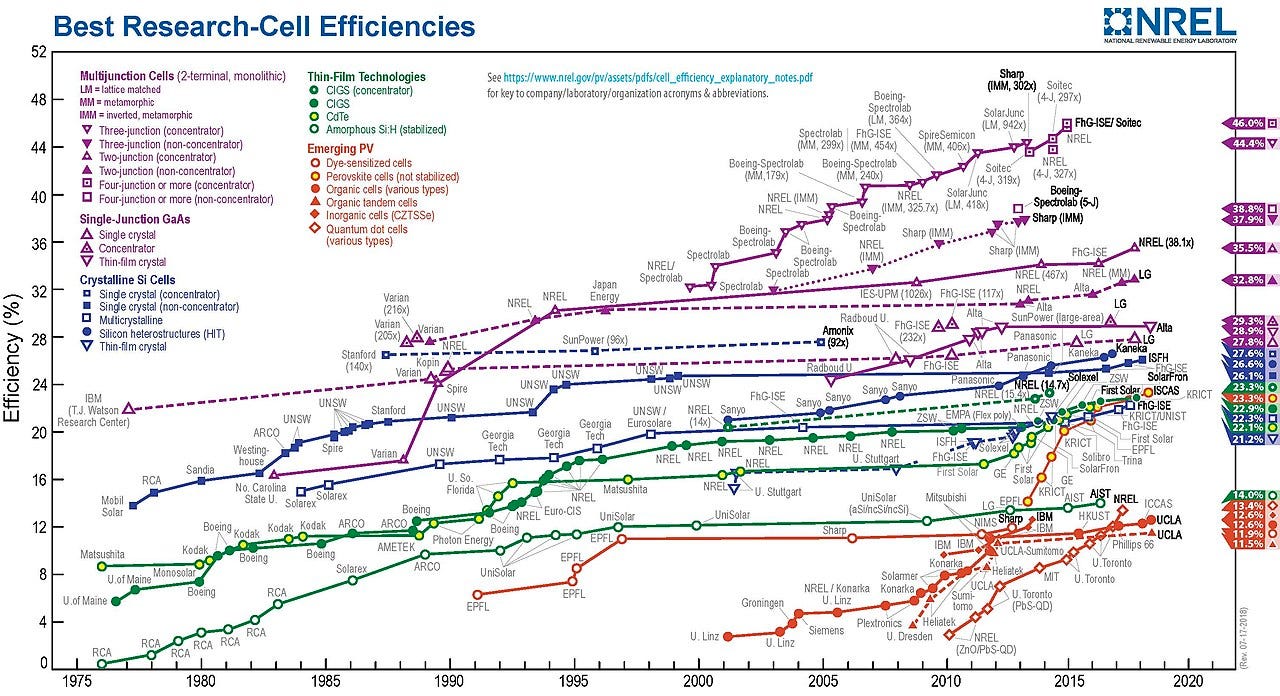
The second one is a much more serious problem. In discussing solar power he says "the achievable power density of a solar farm" is "up to" 50 watts/m2 (p. 188). But the solar constant is 1.37kw/m2 and the maximum solar energy on the surface of the earth is about 1,000 watts/m2. So he's assuming solar conversion achieves 5% efficiency at best. But this is not true, as we can see from this chart, we're at about 20-30% now and gaining about ten percentage points per decade, as I've written about before.  So his take is really unduly pessimistic about the future of  solar power.

Third, he makes a really good case for nuclear power for electricity generation. But he fails to address what to me is the strongest argument against it. Chernobyl and Fukushima are "supposed" to happen once every few hundreds of years.  But if we do a Bayesian update on those priors, the probabilities are much worse than advertised. Or to put it more simply: How come no nuclear power plant can get private insurance? If the risks are as low and manageable as he and other advocates claim, then one should be able to get free market insurance for it. But that has never happened.  I used to be pro-nuclear power, but I've become more skeptical over the years. And despite devoting a lot of the book to it, Schellenberger didn't quite convince me.

Overall, this is a good book, it helps the reader think of many of the questions in a more holistic way, and paints a coherent big picture of environmental humanism. Recommended reading.

2019/11/17

Five books: recently read biographies

In the last year or so, I've stumbled into an unusual streak of 5 really good biographical books.

1. Shoe Dog, by Phil Knight. Standing in an airport bookstore with a few minutes to kill, I saw this book and picked it up. I remembered an article I read years ago  in Wired about Nike's early days. For some reason I remember the phrase "halcyon days" being used. Such an interesting word. Halcyon. But I digress. Anyway I opened the book and read the first few sentences and it was surprisingly good. So I decided to buy it and was not disappointed.  It's well written, and focuses on the interesting early years rather than then better known recent history.  Does a great job of showing exactly how a tiny humble importer of Japanese sneakers born out of old school business hustle and a passion for running, grows into a manufacturing and branding icon.

2.  So much things to say, by Roger Steffens.  An "oral history" of Bob Marley. It's a collection of transcripts of people who were close to him talking about their memories of the singer.  Bob means a lot to me, I grew up with his music, I know the lyrics to even the most obscure unreleased songs, his biography in great detail etc. Still this book was enlightening and very deeply touching.  I happened to read it a unique time -- was it high tide or low tide? think of that song here -- in the late fall 2018 -- Bob was born in 1945, just like my mother. Possibly one of my favorite books of all time.

3. Lenin, by Victor Sebestyen. Really thorough book on the life of the revolutionary Soviet leader.  In our new world order, many old isms and schisms are coming back. Nationalism, mercantlism, Marxism. People see them and argue about them.  Leninism is different. It's meta. It's about the processes of ideology and power. And it is more relevant than ever. Osama bin Laden and Steve Bannon are Leninists. While this book is about none of that, simply reading the life and thought process of this man is worth it as, in a way, we still live in his world.

4. The First Tycoon, by TJ Stiles. A very solid biography of Cornelius Vanderbilt, well researched. Great window into US history. Through this one person’s life you learn a lot about (among other topics): steamboats in the early 19th century; railroads in the mid centurye; east-westtravel, the panama canal; and filibusters! woah. US-Nicaragua relations: this was perhaps the most surprising part,  it gives really really interesting context  to the US-Nicaragua problems of the last 30 years or so; the evolution of the modern corporation; the early stages of the stock market. Great read. My only criticism is that the author is a little too sympathetic to the subject. I prefer when a biographer is a bit more neutral, still this book is really a fountain of information.

5. Homage to Catalonia, by George Orwell. Excellent in every way.  One of the best writers in the english language: very precise, efficient, elegant, unpretentious style.  Very interesting story, important history and super relevant to what’s happening int he world today.  

2012/02/16

Five books: Non-fiction

A few months ago, the New York Times had an article on the greatest non-fiction books. They asked 33 people to list their top 5.  (To my dismay, Kapuscinski's "The Emperor", one of the worst books of all time in my opinion, came out tied for the best of the best. That book is so bad that, when I tried reading it, I couldn't help but physically throw it away in disgust. My hatred for that book deserves a whole blog post of it's own. But this is not that post.)  Inspired by that article, I thought I'd try to remember my some of my favorite non-fiction books of all time. It wouldn't be fair to call it a "top 5", since I am not being that thorough.  If I sat down to do this ten times, I'd probably end up with ten slightly different lists.

Rather here are 5 non-fiction books I really enjoyed, that had a deep influence on my world view, and that just happen to bubble to the surface at the moment:

  • Gödel, Escher, Bach: An Eternal Golden Braid, by Douglas Hofstadter. Absolutely brilliant exploration of logic.  Recursion is just so... fundamental. The human mind must be an instrument of God. Made me love J.S. Bach (and "Alice in Wonderland").  And a proof of Gödel's incompleteness theorem. 
  • Guns, Germs and Steel: The Fates of Human Societies, by Jared Diamond. Very ambitious, basically the history of civilization organized around a few very compelling ideas. Geography is very very important. Innovation diffuses latitudinally.
  • Seven Pillars of Wisdom, by T. E. Lawrence. Supremely elegant writing. Story of the middle east during the first world war. Essential reading if you want to understand a lot of international politics today.
  • Life is long if you know how to use it, by Seneca. Beautifully concise stoic philosophy. Don't sweat status. 
  • An Autobiography, or The Story of My Experiments with Truth, by M. K. Gandhi. The great man's early life and journey to satyagraha, truth through non-violence.
Hmm, clearly 5 is not enough. Here are a few more that would be included in different iterations of the "top 5".
  • The Discoverers, by Daniel Boorstin. A masterful, sweeping history of science. Extremely educational.
  • An anthropologist on Mars, by Oliver Sacks. The human brain is really really interesting.  It's easy to not realize how amazing our vision, memory, etc. are ....  until something goes wrong.
  • The Autobiography of Malcolm X as told to Alex Haley, by Malcolm X and Alex Haley. Powerful life story. I learned a lot about the USA in this one.
Oh what the hell, let's make it an even 10:
  • Zen and the Art of Motorcycle Maintenance, by Robert Pirsig.  Not the best writer of the bunch, but this book had a profound influence on me. Key word: Quality. What is good? What is not good? Also, I'm not sure if I learned it in this book, but I believe that you should never get upset by something that was predictable.
  • Titan: The Life of John D. Rockefeller, by Ron Chernow. Very thorough biography of a fascinating man in a fascinating time. Very relevant today. If you are thinking of pursuing an MBA, don't. Instead, read books like this one.

2008/04/25

Drexler redux: nanotech

Blog: noun, abbrev. Etymology: Web log.

A year ago, I logged a note to revisit Hanson & Drexler. One day, I was at The Strand, actually remembered and ended up picking up K. Eric Drexler's Engines of Creation (I now see there's a new edition that's even available as an e-book, but I didn't know that at the time, and just got the original edition). Incidentally, that event proves this blog is serving it's purpose! If it wasn't for this blog, my faint connection to that book might have gradually faded into the past. I also picked up Black Swan, which I ended up really enjoying but I digress...

Engines of Creation is pretty cool. First surprise: It is perhaps the seminal work in Nanotechnology. In fact, Drexler coined the term. I didn't know that. I found Drexler interesting because of a paper he wrote with Bernardo Huberman on agent/market-based computing systems. But it turns out he is the Godfather of nanotechnology. Wow indeed. Second observation: considering it's a book about future technology published in 1986, just the fact that I was able to read most of it says a lot. Usually non-fiction books about future technology don't age well: either they were right and so what they contain is now obvious, or they were wrong and are now useless, except for a few predictions that live on as comedy. But not this one. It is still absolutely readable. It does waste a bit too many words on appeasing fears of doomsday scenarios, and has a bit too much juvenile moralization. Just a bit. But the 2/3rds or so that I did read closely was fascinating stuff which hasn't aged a bit. It's great, the first time I got some clue about how nanotechnology might work.

Indeed, I had always had a hard time bridging the gap between the fictional nanotech that I found so brilliant in Diamond Age by Neal Stephenson, and anything I knew about science or technology. Not surprising since it's sci-fi, you might say, but my point is that "nanotech" exists in real science yet I don't see no microscopic helicopters and infinite-dimensional interactive books being talked about in the newspaper. What you hear about is relatively mundane "nanotech" ideas. Relatively of course, because by normal standards, even "boring" nanotech's promises are huge ... Microscopic "hard disks", or carbon nanotubes that conduct electricity much better than wires, or can support structures that are impossible with steel like space elevators!

But the Drexler vision is much bigger than better construction materials. He imagines actual nano-machines that build stuff, actual mechanical assembly of atoms and molecules. If you accept that premise, it leads to gigantic consequences, essentially limitless food, energy, all our material needs becoming ... immaterial, so to speak. This is a big idea. And it turns out Mr Drexler has made it the work of his life.

Which brings us to the question... So how come his book is not obsolete? After twenty years f being the breakthrough birth of a new field, why are those ideas still not well known to the general public, when the buzzword they created seems to now mean something much less. Well it turns out Wired magazine has answered this question in a 2004 article on K. Eric Drexler entitled "The Incredible Shrinking Man". You can read the details in the article, but in short there's a great ideological divide in nanotech, and it looks like the "incrementalists" who focus on new nano-materials and so on won the research politics battles over Drexler who wants to build nano-machines.

Now I feel for Drexler in a different way. Not just as a fascinating guy who I should follow-up on but as a human story too. Could he be like Edwin Armstrong, who invented FM radio and many other great things, but lost all the crucial battles in his life? Or is it going to be a classic story of early brilliance, fall from grace, long struggle, and ultimate righteous triumph... Hmm I think that's classic but I can't think of any examples right now. Anyway here's a possible triumphant ending: nanobots win the prize for removing carbon from the atmosphere. Imagine a little machine made of a few atoms of X that uses solar power to move around and grab CO2 from the air, and then attaches the C to some part of itself, releases the O2, and then falls to earth as XC dust. It could even be called something cool, like photosynthesis.. haha. Who knows, if X is right, that XC might even be a source of fuel! So in the end, our hero stops global warming and saves the world! Good night kids.