Showing posts with label climate. Show all posts

2024/04/25

Bitcoin mining in Ethiopia: the good, the bad and the ugly


In the last few months, media have been buzzing about Bitcoin mining in Ethiopia. For Bitcoiners, it is part of the story of Africa as the new frontier in the much desired geographic diversification of Bitcoin mining - a perspective I agree with. In mainstream Western media, it's sometimes framed as yet another example of China in Africa. That framing, while not inaccurate, I think casts a geopolitical shadow that obscures the national perspective. Others portray it as a desperate attempt by Africans for a "quick fix" to foreign currency shortages -- not false but a bit condescending and missing the bigger picture.  So, let's shine a bit more light on it from the Ethiopian point of view (Shadow, light... sorry I couldn't muster some "dark clouds" to complete the trifecta of clichés!) 

Full disclosure: I'm a co-founder of  QRB Labs, the first company to introduce Bitcoin mining to the country.  We've been quietly working since 2021 to do this the "right way" against tremendous odds.  But this post is not our company's story.  It's a skin-in-the-game opinion about how this industry should evolve for the benefit of the country. To highlight the good it can do. But also the risk of bad, and ugly.

The Good

First let's talk about the positive. Energy in Ethiopia and Bitcoin mining are a match made in heaven. 

In Ethiopia, electricity generation capacity is growing very rapidly. From 2GW in 2020 to over 10GW in the next couple of years. The Grand Ethiopian Renaissance Dam (which I've written about before) is the biggest and most famous step in that growth, but there are many projects contributing to it. All of course phenomenally good. Indeed, practically nothing is better for economic growth and broadly improving lives than electrification.  For comparison, the average Ethiopian has 1/50th the electricity of an American. So, until we get to 100GW at least, another 1000% growth, increasing generation is unquestionably necessary. 

But there's a catch. It is extremely difficult and expensive to deliver that energy to users. In the case of Ethiopia, some estimate that  $10B of investment and years of hard work are needed for transmission and distribution to catch up to generation. In the meantime, up to half of the generated energy remains unused. Which means the investment in generation takes longer to pay for itself. Meanwhile how do you finance the transmission and distribution? It's a huge chicken and egg problem, and it's unavoidable when there is rapid growth.  

In more developed countries, capacity may not be doubling or quadrupling but a similar problem exists with solar and wind power. Huge investments in supply are needed, but the demand may not match up with the supply, since consumption peaks don't line up perfectly with the times when the sun shines or the wind blows.  Whether caused by the difference between the time of generation and consumption, or by the distance, this is the problem of "stranded energy".

Now what if there was a way to make money from stranded energy? In Ethiopia, this revenue could help accelerate electrification! That's where Bitcoin comes in:   

"the competitive dynamics of Bitcoin mining are such that it shifts in time and space to the lowest available cost of electricity. This occurs not just by deploying hardware to various locations, but also by turning miners on or off instantly. This flexible demand-side support makes mining the ideal customer to balance variable supply...."  from "The Dynamics of Bitcoin Mining" by yours truly.

Thus the energy demand profile of data centers that host high energy computations makes them the perfect customer for Ethiopia's stranded energy. Bitcoin even more so than other data applications because: 

  • Bitcoin mining is location agnostic. It doesn't matter if it runs in Antarctica or the Sahara as long as it's connected to the Internet. 
  • It's also time agnostic.  Each hash computation is independent of the previous one. You can mine 24 hours a day, 12 hours a day, at random times. Of course miners, in order to be profitable, must be very good at making the complex trade offs between between energy cost and hardware utilization. But they don't inherently need 24x7 power. 
  • Further, contrary to common perception, it doesn't actually need very much bandwidth. The entire blockchain is still barely more than half a terabyte! 
  • And equally importantly, it's all public data. The entire world can see all the inputs to the miners. So there's no data sovereignty, legal information jurisdiction or cyber security issue.
  • Mining is purely infrastructure for running computers. There's no link between the locations of the miners and the users of Bitcoin. So Bitcoin mining doesn't depend on local regulations about money and financial services, legality of "cryptocurrencies" etc. 
For traditional data centers hosting say streaming video, social media or corporate IT,  cheap electricity is nice to have, but they also require some combination of high bandwidth, low latency, and a compatible legal system for privacy, copyright, finance etc. These are all areas where it is presently tough for Ethiopia to compete globally -- to put it mildly. But Bitcoin mining has in principle no disadvantage running in Ethiopia. 

Further, Ethiopia's electricity generation mix is over 98% renewable. And the other 2% is largely off-grid. So for a data center in Ethiopia, the energy is pretty much 100% "green" hydroelectricity. This is very desirable for the Bitcoin community. Bitcoin arguably doesn't have to be green, any more than ice cream or football. In fact proof of work is one of the most noble uses of energy in the world. But Bitcoin has a lot of enemies who, as I have written about before on this blog. hypocritically or ignorantly use energy as an attack vector.  So "greening" mining is good for Bitcoin globally, and Ethiopia is perfect for that.

So there you have it.  The good is amazing.  Accelerating electrification for economic development of Africa. Geographic diversification and greening of Bitcoin mining.  That is literally the mission statement of QRB Labs. And also why Ethiopia and Bitcoin mining are truly a match made in heaven.

The Bad

But an electricity grid is a very complex beast. You can have too much energy in one place and too little in another at the same time.  When you have too much, it's  a waste. And where there's too little, consumers suffer outages which have negative economic and other consequences. In addition, both excess and shortage can cause costly damage to infrastructure. The best way to balance that is to manage the demand, through price and quantity allocation.

In the case of Ethiopia, while the people at the power company are dedicated to doing the right thing, historically it has not had the independence to manage pricing and demand as it needs to. By contrast, the airline, even though it is also state owned, has a long history of independence, allowing it to mange routes, schedules and prices on a purely commercial basis. This allows it to succeed in an extremely competitive and complex international industry.  But electricity prices have historically been dictated by politics.  Thus, when it comes to the relationship between the energy producer and Bitcoin miners, they don't have the full flexibility to achieve true win-win pricing.  Consumer utility pricing is understandably more difficult to change. But at the wholesale level, the producer should be allowed to make stranded energy cheap, and conversely to charge higher prices where there's lots of demand, whether it is from data centers, factories or households.  

Without modernized pricing from the supplier, the risk is that Bitcoin miners who don't particularly care about the long term of the country can rush in  with demand in the wrong places, and destabilize the grid. Not because they are particularly evil or greedy. But just like water flows to the bottom of a valley, Bitcoin miners will go to where they can get energy at a good price. In this almost perfectly competitive industry, the purest embodiment of survival of the fittest, the typical buyer can't afford to think for the seller.

The only solution is incentive compatible pricing. Rational, non-political, and based on supply and demand. Further, it is crucial that the pricing not be based on the industry, or what the energy is being used for. Electricity is fungible. So price discrimination by type of application never works well. If one industry  gets lower rates than another, it creates perverse incentives, where one will disguise itself as the other, and cause complexity in enforcement. This is also true for Bitcoin mining. Instead, energy should be commercially  negotiated based on quantity, location and time. Let the buyers find their niche. In a fair rational environment, Bitcoin demand will naturally stabilize and benefit the grid, and  monetize excess capacity to help long term electrification. And when the country's transmission and distribution infrastructure is fully developed, when industrial and consumer demand can use all of the electricity being generated, then Bitcoin miners will not be able to pay the same price as factories or households. We should be happy to declare mission accomplished and look for cheap power somewhere else.

Another potential Bad is that Bitcoin mining can easily get politicized in Ethiopia. People who don't understand the subtle win-win dynamics may complain that Bitcoin is taking power from the people. Or based on superficial nonsense about "cryptocurrencies", especially in a bull market, assume Bitcoin miners are rich and should pay high prices. Such interference risks killing the goose that lays the golden egg. If handled correctly, mining is a tough global competition for miners but an easy win for local energy producers. But mishandling could very quickly kill a historic source of revenue.

Initially, the government made the mistake of temporarily blocking Bitcoin mining equipment imports in 2022 while it tried to come up with new regulations. Then in 2023, it implemented rules about Bitcoin mining as "cryptography" rather than "energy". But in fact, mining involves no encryption in the conventional sense of trying to keep information secret. The computation is basically just a hash function with public inputs and public outputs. It's just a race between miners to get the output faster.  (Even transaction validation, which usually is not even on the miner but in the pool, only involves checking signatures which anyone can do -- no secrets). At one point we were even told that only foreign companies could participate in this industry, which is unconstitutional! Fortunately, over the last couple of months, these errors are getting understood and things are moving in the right direction.

The Ugly

An unfortunate side effect of taking the wrong regulatory approach is potential for corruption.  Bitcoin miners are not all idealistic. Even when they are so inclined, competition is so fierce there's always a temptation to look for legal short cuts. On top of that, many foreigners come with a "this is Africa" attitude. Translation: corruption is a natural feature of the landscape. So they try bulldoze their way in with bribery. If it doesn't work, they try the next place. If it works, they exploit it as fast as possible, and when it inevitably blows up, just pack up and move to the next hunting grounds.

For many countries, oil wealth turned into the infamous "resource curse", undermining governance and even being negative for economic development. In the worst cases, it goes beyond bribery to outright theft: taking the energy and not paying for it. This is a danger with Bitcoin for electricity-rich countries too. Kazakhstan, Angola, and some other countries have experienced this ugly side. Fortunately, there's no evidence of this occurring in Ethiopia yet, but it is perhaps the greatest theoretical danger.

The best way to avoid this is for the government to eschew regulatory micromanagement. Rather than trying to control it through hardware imports, or make it political, or treat it as cryptography, or have too many stakeholders at the table, it should allow this industry to naturally find a win-win buyer-seller relationship with energy. This means allowing flexible electricity capacity allocation and pricing.  

The government's focus should be on monitoring the bigger picture: that the energy security of the country is not compromised. So rather than trying to regulate the details of what miners do, the government should require the power company to regularly report on overall high and medium voltage demand by region, generation and transmission capacity, and provide assurances that supply and demand are sustainably managed across all industries and regions.

Conclusion

So there are a few ways things could go wrong. It's important to understand them. But part of me fears that I have given ammunition to the haters. I hope I've struck the right balance.  Reviewing this post, I see I've devoted a lot more words to the good than to the bad and ugly. And that is as it should be.  We face a historic opportunity for two things I care deeply about: Ethiopia and Bitcoin. May both live long and prosper!

P.S. This post is months overdue! And it's too long. To quote Mark Twain: “I didn't have time to write a short letter, so I wrote a long one instead.”

2022/07/25

The case for GERD

As the third filling of the Grand Ethiopian Renaissance Dam (GERD) goes ahead, we should expect what is now becoming an annual uptick in media coverage and geopolitical controversy.  I've been thinking of writing a version of this blog post ever since the project started more than 10 years ago, but always ended up assuming this is adequately covered elsewhere. Years later, I'm still surprised by the frequency of incorrect assumptions dominating the discussion.  Not just in the media, but also in countless conversations. So it sounds like there might be some value in exposing the basic facts.

Power

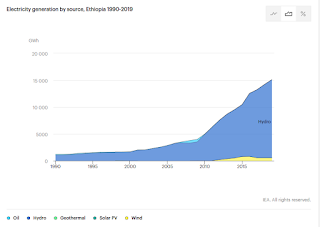
GERD will have the capacity to generate 6GW of power at peak. However, due to seasonal variations, the average is expected to be about 40% of the peak. So on average, it should generate about 80 million GJ or 20 billion kWh of energy per year. Electricity production in 2019 was about 15 billion kWh, so GERD will more than double the  country's capacity. 
Electricity generation by source, Ethiopia 1990-2019


Economic impact

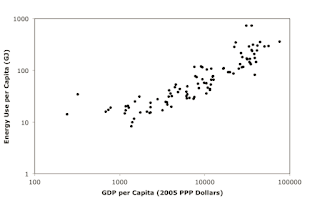
What is the economic value of this additional energy? Note that we are not asking what is the cost to produce it, nor the price at which it is sold. We are asking what is the economic value of consumer and industrial uses that it enables.  One way to estimate that is to look at the relationship between energy and GDP.  From a widely cited paper, "Energy and Economic Growth: The Stylized Facts",  we can deduce that each Gigajoule of energy corresponds to about $100 of GDP:  
Double checking with another source, "Our World in Data", gives us about $0.40 of GDP for every kWH.  This data has the added benefit that it shows a similar relationship, not just across countries but also on the same country over time: 


The two datasets are in almost perfect agreement. And they imply GERD's impact will be about $8B/year, or an increase of about 7% of GDP.[1] 

Considering the cost of the dam is about $5B, a return of $8B per year is great. Of course it will take a couple of more years for it to reach it's maximum generation capacity,  many years to develop the transmission and distribution of all this additional power to 100M consumers, and even more years for industries to grow that will take advantage of it. So the full impact is still far down the road, and depends on quite a few things happening correctly (not the least of which is finding ways to sell the "stranded" generated energy to finance the development of the distribution infrastructure, a topic which I will expand upon in the future). Still, the long term benefit is so large that there is no question the dam is a phenomenally good investment by Ethiopia.

You can also view it with a "social impact" lens if you are so inclined. Can you think of many projects where a one-time investment generates 160% return per year for many many years, increasing income by 7% for more than 100M people, most of whom are among the poorest in the world? Indeed GERD is possibly the biggest and perhaps most effective poverty reduction effort in the entire world today.


Climate impact

Of course, hydroelectric power is 100% renewable, and outside of the materials used in construction, the on-going operations have zero greenhouse gas emissions. Less obvious but also important is the fact that this electricity will displace current sources of energy which are dirtier. For example, millions of people in Ethiopia today often cook with wood charcoal, which from an emissions perspective, is worse than oil, let alone gas, or clean electricity. The amount is tiny on the scale of global emissions and climate change, but still moving from burning wood to electricity is a positive transition from dirty energy to clean energy. Further, the wood comes from cutting trees. Thus, electrification helps combat deforestation, and trees take CO2 out of the atmosphere through photosynthesis. For a good discussion on the relationship between electrification, deforestation and climate, I recommend the book "Apocalypse Never",  which explains this same point in detail using an example from the Democratic Republic of Congo. (As an aside, I also recommend my  review of that book on this blog).  So GERD not only does not emit, it reduces other carbon emissions, and saves trees which take carbon out of the atmosphere, a triple win in terms of reducing anthropogenic climate change. 


Water balance

Increased rainfall?

An additional argument, articulated by Ugandan president Museveni in this video, is that saving trees helps rainfall, which is a positive for total water balance of the overall Nile basin (water balance is a crucial point of contention as we shall see below).  
   
This particular argument is debatable since forests increase rainfall but trees also consume water. Here's a good paper on the links between forest cover and rainfall.  So it's probably a stretch to argue that water balance will increase. But hey, trees do enough for us even if they are neutral in the water balance equation. The overwhelming consensus is that preserving forests as much as possible is good, and electrification happens to help that.

No reduction in flow

The bigger question regarding water balance is of course whether the dam itself will reduce water availability downstream. This is where there is the biggest misunderstanding. Egyptians are extremely fearful that the dam will reduce the flow of the Nile, and they view it as an existential threat. But the reality is that the GERD will not reduce the amount of water that gets to Sudan and Egypt:
  1. Electricity generation doesn't consume water. As water, pulled by gravity, flows through turbines, the kinetic energy of the water becomes electric energy, and all the water comes out on the other side and flows downhill from there as always. 
  2. When there is loss of water from a dam, it is because it has a reservoir, a lake. The larger the area of the lake, the larger the loss due to evaporation. Indeed at the High Aswan Dam in Egypt, located more than a thousand kilometers downstream from the GERD in a flatter and hotter area, the reservoir (Lake Nasser) is large and shallow, causing a significant loss of water to evaporation. The GERD however is situated in a gorge, so the lake it creates is much narrower and deeper (about 1,900 km2 for GERD vs 5,250 km2 for Lake Nasser). It's also in a cooler area. Thus the evaporation impact of GERD is much less than Aswan's. Further, the purpose of the reservoir is to regulate the flow, like a battery. In theory, if you have a reservoir upstream, you can reduce the size of a reservoir downstream. So if we naively forget political boundaries for a second, and assume Egypt, Sudan and Ethiopia were 100% cooperative, to manage the total flow optimally, they would achieve the same magnitude of regulation by reducing the volume of Lake Nasser by the volume of GERD lake. Since GERD has relatively lower evaporation, this would be a net reduction in evaporation. But to keep things in perspective, evaporation accounts for less than 2 billion out of about 90 billion m3 /year of water flow on the Nile, so it's a minor issue.
  3. A much larger fear for downstream people is that the GERD might enable additional consumptive uses, like irrigation for agriculture. This is a legitimate general concern of course, and fairness and efficiency in consumptive uses is important. However, in the case of the GERD, its location at the most downstream point in Ethiopia, near the point where the river exits to Sudan, means that it would be infeasible to use any of the water from that point for agriculture, as you would have to pump it uphill to reach farms within Ethiopia. This effectively guarantees that GERD cannot physically be used for irrigation or any consumptive activity in Ethiopia.  
For more on this, see the seminar on 'The economic impacts of large dams: a comparative analysis of the Nile and Colorado Rivers' . In particular the evaporation question and non-consumptive nature of GERD are addressed at 1:09:23 in the video. 

Bottom line: GERD will not decrease the net amount of water that reaches Egypt and Sudan. Regardless of what you think about the historical sharing of water, the fear that it can harm downstream people is just not supported by facts.


Floods and drought mitigation

In fact it's actually beneficial to them. As I tweeted some time ago, this excellent paper entitled 'Understanding and managing new risks on the Nile with the Grand Ethiopian Renaissance Dam' explains it:
  1. "Sudan will clearly be better off ... because GERD operations will smooth Blue Nile flows, eliminating flood losses, increasing hydropower generation, decreasing sediment load to the reservoirs and canals, and, most importantly, increasing water for summer irrigation in the Gezira Scheme and other irrigated areas along the Blue Nile".  To get a sense of the magnitude of this benefit, consider that flooding in 2020 caused over 100,000 homes to collapse and Sudan to declare a 3-month state of emergency.
  2. During droughts, it is expected that the existence of the GERD will cause "decreased water deficits to Egypt and increased water availability". 
It is also extremely important to note that, as the paper explains, these benefits to Egypt and Sudan do not depend on generosity and goodwill from Ethiopia. Keeping the flow steady by boosting it during droughts and throttling it during floods is also necessary from the self-interested electricity generating perspective of GERD, so it's a win-win-win proposition even without explicit cooperation.  In other words, long term incentives are aligned between Ethiopia, Sudan and Egypt, which should offer the strongest reassurance to back whatever political understanding is (hopefully) reached.


Filling

Now besides the long-term incentives, there is a separate question of what happens during the initial filling of the GERD reservoir, which started in 2020 and is expected to last 4 to 7 years. Filling the reservoir obviously must temporarily decrease the downstream flow. But here two facts should be understood. First, filling takes place in the rainy season (July and August) each year, where typically there is "too much" flow, so there should be no detrimental effect downstream.  Second, by chance, the first and second fillings took place during above average rainfall years 2020 and 2021. It's almost as if nature decided to be pro-GERD at this most critical time!
It's possible that the filling has already helped reduce the severity of floods in Sudan, although that effect may be limited by the fact that filling stopped as scheduled halfway through the rainy season (the Sudanese irrigation minister even complained that the filling didn't go fast enough to help).


Geopolitics

That is not to say Egypt and Sudan don't have any legitimate concerns. Future upstream uses of the Nile water could reduce their supply. The total water flow, while abundant, is currently almost 100% consumed: no Nile water actually reaches the Mediterranean Sea, except what's needed to push back salinity. So, even though GERD itself is a win-win-win,  in the bigger picture, the Nile water use is a zero sum game.  Currently, Egypt consumes 79%, Sudan 18%, and the rest of the countries combined less than 3%.

But there is international law and precedent on how to share rivers between multiple countries. The right way to deal with this case is the Nile Basin Initiative's Cooperative Framework Agreement  (CFA) which should be able to handle the issues of the next few decades at least. Uganda, Ethiopia,  Rwanda, Tanzania, Kenya, Burundi and South Sudan are on board. Sudan and Egypt initially joined, then "froze" their participation, but from what I gathered at the aforementioned seminar, Sudan has recently rejoined.  

The main problem is the recalcitrance of the Egyptian government. Given that their country consumes 79% of the Nile's water, perhaps they feel that acceptance of any upstream change jeopardizes this entitlement. The military government of Egypt has taken a hard line and it seems like they fear any compromise abroad might weaken their political power at home. This political trap has far reaching consequences for the region's stability and peace. Very unfortunate. Let's hope reason beats politics for once and things work out rationally, since GERD itself is actually beneficial to Egypt. 

Part 2 of this post explores the longer term sharing of the Nile beyond GERD.

P.S. This post is dedicated to my dear friend Ahmed Amr. A brilliant and hyper-informed Egyptian who during a conversation last year, was surprised by some of these technical facts.  Sadly Ahmed passed away from a long illness a few months ago. Ahmed, wherever you are, I hope you enjoy this post and I look forward to chatting with you again in the afterlife!

[1]Another way of getting economic impact is to multiply production by average price to get the direct value of the energy, and then apply a GDP "multiplier" which estimates the downstream GDP impact (electricity enables goods and services, which in turn enable other goods and services etc.) The problem as you can imagine is that multipliers are very inexact. In a tweet on this topic a couple of years ago, I used the a multiplier of 1.6 which I now realize is too low. I also incorrectly used peak power instead of average. Coincidentally the two inaccuracies cancelled out and the GDP estimate was about the same.

2022/01/22

Doomsday argument

And now for something completely different: a fun little probability puzzle. 

What's the probability that the human race will end some time in the next 100 years? Surprisingly this question has a logical answer. And not because we have some magic crystal ball.  In fact, our puzzle  specifically assumes we have no information at all about the future.  

Here's how it goes.  Let's step out of time for a second, and consider the total number of humans who will ever exist. Let's say that number is N.  If you are of the Abrahamic faiths, you can call the first one Adam. But we're just having fun so we'll just number them from first to last: 1,2,3, ..., N.  Now let n be your number. So 1 <  n < N, you are somewhere between the first  and the last person ever.  Since we  have no information about the future, we have no clue if you are near the end or near the beginning or somewhere in the middle.  You just happened to land at some random position in the long line of  humans. So we have to assume that any position is equally likely, or technically that n is uniformly distributed between 1 and N. The chance that you are in a particular interval is equal to how big that interval is relative to the whole sequence. There's a 50% chance that you are in the first half and 50% chance that you are in the second half,  there's a 95% chance that you are in the first 95% and a 5% chance that you are in the last 5% of people, etc.  So P(n < f*N) = f and P(n>f*N)  = 1-f, for any fraction f between 0 and 1.  

We don't know N, but we can estimate n, because we can approximately calculate the cumulative population to date. This is more accurate  than you might think because the parts really long time ago where we have poor estimates are also the times where there were very few people.  The left tail is long but thin. Estimates now are around  n = 117 billion.

From the above, the distribution of N is P(N<n/f) = 1-f. That means there's a 5% chance that N < 123B i.e. that there are only 6 billion babies to go before the last one. If we translate that into time, using the current rate of 140M births per year,  it means there's a 5% chance that we have less than 43 years left! And a 50-50 chance that we'll be around for another 800 years. At the other end, a 5% chance that we have more than 16,000 years left, and so on.

I heard about this puzzle known as the "doomsday argument" about a year ago. Of course you can debate about whether this is a realistic model, but it's a cute way to provoke thought about all the minor risks we collectively worry about and the big ones we don't consider rationally. 

Reminds me of a few scenarios discussed in this blog a long time ago:  ineffective posturing on climate change, the asteroid lottery , political pandering in a pandemic... Ouch ouch ouch! Sadly humanity doesn't seem to have gotten wiser in the decade (!) since those posts... 43 years seems like an awfully short time. At least math is eternal!

2020/08/25

What is "good for the environment"?

Consider two pretty obvious statements. First, living in dense cities is much more energy efficient than living in rural areas, especially in cold places where you need heating. Second if we had 1,000 cities the size of New York City, that would be all of humanity, and they would only occupy a small fraction of the earth's surface. A somewhat larger fraction would be used for producing food and extracting some resources but  the vast majority of land on earth could be devoid of humans.  Yet, for years, I've been surprised at how often people are surprised by these points. Somehow, people assume that cities are bad for nature and that living in a rustic rural cabin or hut, using wood fires for energy is more friendly toward nature. Obviously the flaw in such reasoning is that they are thinking not of humanity as it exists today or in the future, but subconsciously going back to a time when there were very few humans, and so it didn't matter if we were extremely wasteful of resources. Of course the reason there were few humans is that most of them died very quickly.  It's a  "wet streets cause rain" type of reasoning that is surprisingly prevalent.

Another bit of inanity is that many people believe using bio-fuels is "good for the environment". Indeed the US government mandates blending corn ethanol in gasoline.  This is good for corn farmers, and good for politicians who depend on them, and maybe even good if you think foreign oil is a problem.  But in fact, when compared to just using gasoline without corn ethanol,  it results in an increase in green house gas emissions, not a decrease.   Yet the belief that it's good for the environment persists.

A new book, Apocalypse Never, by Michael Shellenberger covers  these as well as many other such points, in making a very good case that the current global alarmism around climate change is doing more harm than good.  Normally, the title and the marketing of the book would have turned me off. The last thing I want is more political BS from climate change deniers.  But this book is not that at all. The author not only agrees with the conventional view that the climate is changing due to greenhouse gas emissions, but he's actually one of the pioneers in the space.  Second what actually made me notice the book in the first place was that people were trying to get it banned or de-platformed. Which naturally kind of proves the point that he's making. And it made me want to look into it. (So maybe giving it a provocative title is a good strategy after all!).  Which I don't regret.

He also does a good job debunking the idea of "extinction of humanity". Of course we won't go extinct because of global warming. Isn't it enough to say it will cause a huge problem and enormous suffering? Similarly "saving the planet" is misguided hyperbole. The planet will still exist, even if it's boiling hot or completely frozen, and certainly more CO2 in the atmosphere and temperature changes of a few degrees are no big deal on a geological timescale. So this is just misguided and confused language that is counter-productive. It's like when people scream about "genocide" whenever there's some political violence or war that is ethnically motivated.  Constantly calling everything a genocide is not helping the cause of peace.  Similarly saying that smoking a joint is exactly the same as a heroin overdose is not helping kids avoid drugs.   

If you care about solutions and the well-being of humanity, you should be more precise in your thinking. What we care about is how we live, and what we mean by "we" is critical. The book does a good job of explaining this and the underlying basic concepts, perhaps the most important of which is "energy transitions", and he generally summarizes the science and arguments pretty fairly 

Still there are a  few points where I disagree with it, three in particular.

First, in a section on the "Tragedy of the commons", a paper and concept with which I'm intimately familiar, he  seems to imply that the "tragedy" in the paper is uncontrolled breeding of humans, which is inaccurate. But the "tragedy" is that when shared pasture land (aka commons) is not properly managed to align incentives, that leads to over-grazing and destruction of the shared resource. The real legacy of that classic paper is about mechanism design, pricing, property rights etc. But Schellenberger seems to reduce this classic insight to just the Malthusian aspect. This is a rather small technicality and doesn't change the main point he's making so I can give it a pass.

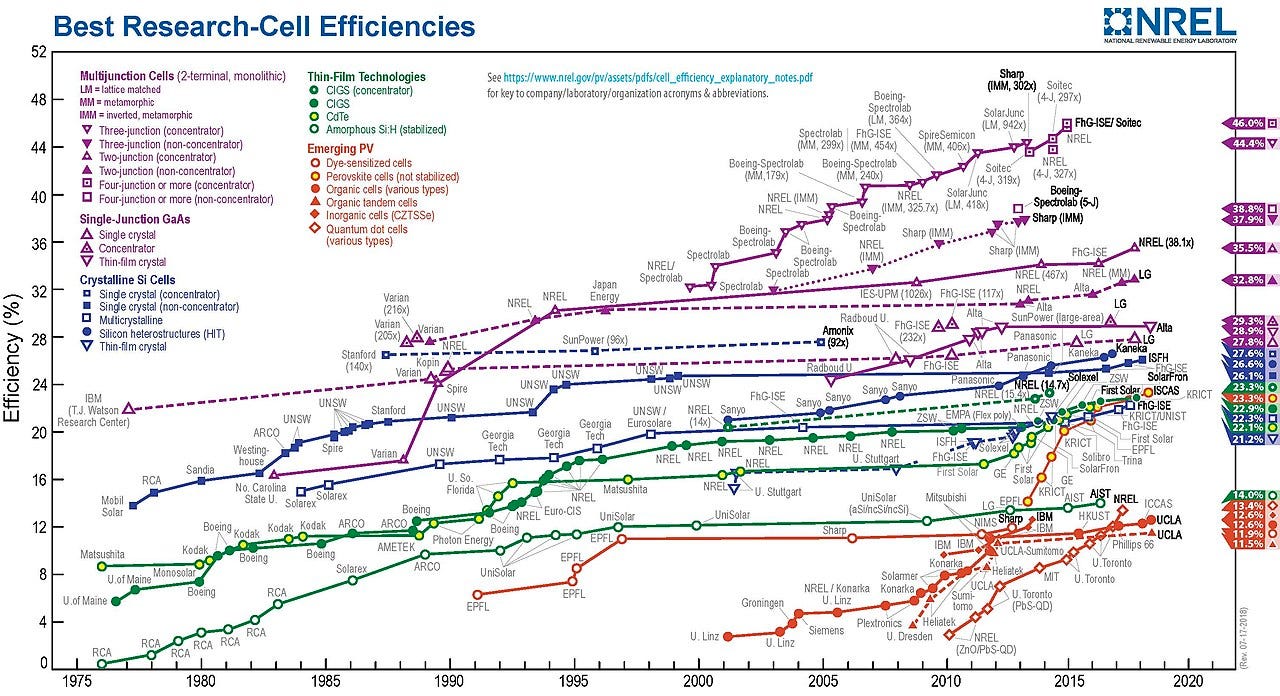
The second one is a much more serious problem. In discussing solar power he says "the achievable power density of a solar farm" is "up to" 50 watts/m2 (p. 188). But the solar constant is 1.37kw/m2 and the maximum solar energy on the surface of the earth is about 1,000 watts/m2. So he's assuming solar conversion achieves 5% efficiency at best. But this is not true, as we can see from this chart, we're at about 20-30% now and gaining about ten percentage points per decade, as I've written about before.  So his take is really unduly pessimistic about the future of  solar power.

Third, he makes a really good case for nuclear power for electricity generation. But he fails to address what to me is the strongest argument against it. Chernobyl and Fukushima are "supposed" to happen once every few hundreds of years.  But if we do a Bayesian update on those priors, the probabilities are much worse than advertised. Or to put it more simply: How come no nuclear power plant can get private insurance? If the risks are as low and manageable as he and other advocates claim, then one should be able to get free market insurance for it. But that has never happened.  I used to be pro-nuclear power, but I've become more skeptical over the years. And despite devoting a lot of the book to it, Schellenberger didn't quite convince me.

Overall, this is a good book, it helps the reader think of many of the questions in a more holistic way, and paints a coherent big picture of environmental humanism. Recommended reading.

2009/08/16

Do you feel lucky... punk?

Here are two reasons why humanity might soon go extinct, and why it wouldn't be such a big loss. As you can see, I am in a cheerful mood today. 

Big rock from outer space 

Last year, using the example of the asteroid Apophis that might destroy the world in 27 years, I made the point that human beings are sometimes astonishingly stupid when it comes to making decisions that involve low probability events. If we were rational mathematical creatures, humanity as a whole should be willing to spend billions of dollars to insure against that 0.0023% chance that we will all be wiped out. If you don't like my argument based on the present value of future GDP, here's another way of arriving at the same point. If you are willing to spend a trillion dollars say on nuclear weapons to defend against other humans, and say there's a 1 in 50 chance that you actually need them, logically, you should be willing to spend a billion dollars on threats that have a 1/50,000 chance of happening. (I am using conservative orders of magnitude here, obviously a nuclear war has less than 1/50 chance of happening, so that makes my point even stronger). Today, in this article from Ars Technica, I found out just how stupid we are.
Congress awarded NASA a $1.6 million grant in 1999 to put towards the NEO discovery program. Unfortunately, this was the only funding Congress gave to NASA to pursue this goal.
Yup, the US government allocated $1.6 million dollars to save all of human life from extinction... Total! And just in case you are inclined to blame "the Americans" for being so short sighted, consider that all the other countries in the world are allocating.. ZERO! (Ok maybe they have a couple of telescopes pointing at the sky but we need giant laser beams or something...) At this point, I am almost rooting for the asteroid to kick human ass. We deserve it. 

Small germs from inner space 

And of course, a big stone falling from the sky is not the only threat we face. Tiny germs are threatening us too. Let's take the H1N1 virus -- the swine flu of recent fame. You'd think that at least when it comes to human health, humanity can be rational, right? Not so quick. Let's see how are favorite mammal is dealing with this problem. Consider the following article from the Guardian (great newspaper btw): "Experts warned dispersal of Tamiflu would do more harm than good" about the debate on anti-virus treatments for H1N1. Here's the scientific view, summarized by one expert quoted in the article:
"Some people wanted to take a long-term view of the risk of resistance developing and to seek to preserve the effectiveness of antivirals for the next pandemic, which may be more severe."
"If you get a resistant strain that becomes dominant in the autumn, Tamiflu will then be useless."
And here's another scientist:
"I am concerned about the vast amount of Tamiflu that is going out almost unregulated," he told the Guardian. "We are increasing the possibility that the flu will become resistant sooner or later. At the moment there is no desperate need for Tamiflu. We should be reconsidering its issue, rather than encouraging its use. "I think we should stop the national pandemic flu service. It was put there for an outbreak of far higher mortality than we have. If you get a resistant strain that becomes dominant in the autumn, Tamiflu will then be useless."
Ok, thank God for all these smart scientists who have thought it through! The politicians should logically follow their advice right? Well actually
"It was felt ... it would simply be unacceptable to the UK population to tell them we had a huge stockpile of drugs but they were not going to be made available"
So they just decided to go ahead and do the wrong thing! It's like a parent saying: "If I told my 5 year old not to play with this loaded gun, he would have been upset, so I decided to let him play with it." Mind you we're not talking about some distant threat here. The next mutation of the virus could be this autumn. Granted there's a low probability that it will mutate into a real killer, but that's my whole point. It's a low probability but high impact threat. And faced with that, the British government is willingly increasing the probability of a pandemic that could kill hundreds of millions of people, because they are afraid of being unpopular for the next two months! Seriously! If this was a movie, whose side would you be on? I would be like: Humans suck! Go H1, Go N1, it's your birthday! 

No rare events in the savanna 

None of this is original of course. Evolutionary biologists will say it's because our brain evolved in an environment where we just never had to consider small probabilities. We have no problem dealing with quantities like "if I go left, I get 1 potato, if I turn right I get 12 eggs"... Our brain can compute those things even as a toddler. But things like "1 in 50,000 chance" just don't compute in ye olde wetware. It's only after years of formal schooling, e.g. by the high-school level, that we start to get intuition on really small numbers. Because until the modern age, we didn't need to! Sure there were rare things like being hit by lightning, or having an earthquake, but since there wasn't anything we could do about them, there was no evolutionary advantage to actually being able to reason logically about really small probabilities. Good old superstition would work just as well. You could say "I got hit by lightning because Zeus is angry at me because I didn't offer animal sacrifice". If you are a hunter gatherer living in the bush, that explanation is practically speaking, just as good as the scientific one. But now, by our own hands, we have a world where we do need to reason about small probabilities... Problem is, the brain hasn't caught up! Global warming is another example. Twenty years ago, it was a low probability but high impact threat, just like our two examples above. Scientists were running around screaming "There's a 1 in 100 chance that the polar ice caps will melt! That's huge!" But humanity just couldn't deal with it. People were like: "One in a hundred chance of extincttion? Pffft. I'm feeling lucky. Let me go buy a lottery ticket." 
   
Well now global warming is in the same range of probability as 1 potato and 12 eggs, so people are dealing with it, but it may be too late. Is this the end-game of evolution? Is this what the epitaph will say:
Here lies humanity. They became really good at reproduction -- 6 billion individuals! But not quite good enough at probability.
Maybe it's all part of a master plan. A conspiracy! Apophis contains some organic molecules which are distant relatives of the H1N1 virus. Together the asteroid and the swine flu are collaborating to take us out, and recolonize the planet with a new dominant species that they like better. After all, that could be how we got here too!

2008/11/14

Yin and yang of the greenback

China has a huge trade surplus with the US which has been growing since 1985. Normally, or in theory, exporters repatriate the money earned abroad, which makes their own currency rise and the importer's currency fall.

But in this case, for over 20 years, China has been keeping that money in dollars. Compare "Foreign Portfolio Holdings of U.S. Securities". Two countries stand out. Japan and China both hold huge amounts of US securities. (Actually the ones that really stand out are Cayman Islands and Luxembourg but that's another story!). Further down on the same page, see "U.S. Portfolio Holdings of Foreign Securities" which shows the US has a similar amount of Japanese securities. But that's not the case with China. There it's completely one-sided with China holding huge amounts of US debt. At some point they will need to sell those dollars right? That's the 1.4 Trillion dollar question. Basically China has been delaying its currency's rise in order to continue growing exports.

The current economic crisis changes things.
  1. As US and Europe imports slow down, China might shift away from exports and more towards infrastructure and internal consumption. This means their reserve strategy might change to bringing money back home. 
  2. A loss of confidence in the US financial system. 
  3. A huge increase in US public debt from the bailout and the stealth bailout.

All three things imply China will want to sell dollars and dollar assets.

What else can we imagine? Weakening dollar will help American exports. Which may be critical for new energy technology products (in solar, wind, hydrogen  and who knows what else) to develop and succeed.

So here 4 bold predictions for this different world:
  • USD vs CNY will go down,
  • the US dollar will no longer be the world's primary reserve currency, but 
  • America will do what it has historically done best -- create a new industry for the world,  meanwhile
  • China's billion people will get an accelerated rise in standard of living. 

2008/03/23

How can carbon-offsets work?

What do Norway and the New Jersey Nets have in common? They are among the myriad entities declaring that they are or will be carbon neutral. That's is great but it reminds of one thing that has been bothering me for a while now. In a lot of these cases, they rely on "carbon offsets". And to me, well I have an issue with carbon-offsets -- they can't work. Here's a rant expanded from an email exchange I had back in November 2007.

First of it's not that I'm not green -- far from it, I even joined Greenpeace way back! Second, it's not that I don't believe in markets -- far from it! So now let's back up for a second and consider the common "green market mechanisms". As far as I know (which is not much but hey, who else is around?), there are four types of incentive-based mechanisms being suggested in the world with the goal of reducing the amount of carbon in the atmosphere due to human activity. Do they work? And what's wrong with carbon-offsets in particular?

My favorite is the carbon removal X-prize. A prize is a very efficient way of funding R&D. Basically you put up a $25M prize, and it might lead to 10 teams spending $24,999,999 each in parallel, and then one or more of them would actually solve it, while creating many useful partial solutions and spin-offs along the way! So from society's point of view, you get up to $249,999,999 worth of R&D using just $25M to stimulate it. But it's a long shot approach, excellent return, but high risk. Clearly, the world needs incremental approaches as well to balance our species-survival portfolio.

The popular incremental approach is cap & trade. That seems to work.. Sounds like the incentives are right on. Those who can figure out ways to reduce emissions get rewarded, and those who can't, pay for it. Both sides work incrementally thus, without any huge disruptions to society, we get gradual improvements. The only problem is that the cap levels are kind of arbitrary and could be changed by fickle and/or corrupt politics which might distort the incentives. Still given some consistency across time and space, the incentives should work as expected because both the reward and the penalty happen at more or less the same time.

If you really think about it, carbon tax is a simpler better version. It has the advantages of cap and trade with fewer costs, and it can work more widely since it wouldn't only apply to specific industries. The only downside is that its' tough to get people to support anything with the word "tax" in it. (So the difference in cost between "carbon tax" and "cap & trade" is simply the cost of weak leadership in democracy.

But really maybe there's a magic solution? One with no new taxes! Yay! No caps or limits! Yay! A win-win solution! Maybe... carbon offsets. Are they too good to be true? Yes. Here's the problem as I see it: If I want to build a carbon-belching factory or travel on a carbon-spewing jet plane, and then offset it by paying someone to plant a forest of trees, what will prevent the trees from being cut down in the future? When that tree will be cut down or die -- after 5 years or 20 years or 500 -- really changes the value of the offset and whether it truly cancels out my plane trip or my factory.

And here securing the tree is not just another implementation detail. It's a central, fundamental flaw of the market. Because the incentives are not there. If I'm the polluter and you're the off-setter, once I pay for the right to pollute, I will happily pollute and I don't care anymore about whether you truly keep the tree alive, I've already gotten the credit for it. You the seller can take my money and still cut the tree. This is not like normal uncertainty/risk about the value of a product or service. In a normal market, the buyer wants to get the stuff they bought, which is what keeps the seller from cheating. But in the carbon offset, the buyer has no incentive to care once they got the credit, and the seller, once they are paid for planting, has a huge incentive to just chop the tree and use the wood.

Of course people cheat in all markets. But enforcement, regulations etc. can only work if the vast majority of buyers and sellers have the basic incentives to make it work, and the law only has to deal with a small minority of cheaters. For example in stock markets or commodity markets, the buyers and sellers police each other because if one cheats the other loses. In the carbon-offset market, they can both cheat and not tell anyone. SO enforcement is going to be prohibitively expensive. Basically you have to set up a well-meaning intermediary like a fund that receives the money from the offset buyers and pays out the planters over the lifetime of the tree... That's a huge problem.

My guess is the offset market is of purely psychological value... It's very much like Catholic "indulgences" that you could buy from the church to cancel out your sins in exchange for some money. Clearly a very profitable scheme. If you're the church, it's just free money. It's better than free money: they give you money and they thank you and you increase your power over them! Which begs the question... Who is the church of carbon-offsets?