Showing posts with label business. Show all posts

2025/01/23

Datacenter potential in Ethiopia

Where is Africa in this picture?  It's a fraction of the "rest of world" slice.  

A bit of history:  Until the late 2000s, data centers tended to be where the telecom cables were i.e. near big population centers with lots of Internet users. The important internet data center locations were NYC, Northern Virginia, SF bay area, Amsterdam, London, Hong Kong, etc. But as we approached the second decade of this century, energy gradually became a bigger cost than bandwidth so they started developing near power sources. Nowadays, Google and Facebook's datacenters are in places like Iowa and Oregon, far from cities and near abundant supplies of energy. 

This is an opportunity for Ethiopia.  (And it's what my company QRB Labs is focused on).

But two caveats: 
a) latency still matters so they can't be too far from the consumer for some applications like communications and live media. So in the short term, for content hosting, the focus will likely be regional rather than international.
b) for some applications, privacy, data security and intellectual property considerations are complicated, so the data centers need predictable and favorable legal environments. So Ethiopia has some catching up to do before it can really compete in hosting AI and other cloud computing services. But it remains an interesting potential area, especially for the model training portion of AI which is not latency sensitive.

There is one immediate application which is energy intensive, not very latency sensitive and completely location agnostic: Bitcoin mining.  I've written about it at length here, but let's put it in the context of data centers in general. The legal requirements are pretty simple as all the data involved is public and the algorithms are open source. And contrary to common misconceptions,  mining is purely infrastructure serving global users, it doesn't depend on local adoption of Bitcoin or the local financial regulations. So it can be anywhere in the world. The catch is, because it is location agnostic, miners are constantly seeking the cheapest power worldwide. Mining is globally hyper-competitive,  any miner that pays more than the other miners on average will immediately go out of business. So to attract miners power prices have to be very low. In the US, while AI data centers can pay up to $0.10/kWh, and households average around $0.15/kWh, and other industries such as manufacturing tend to be somewhere in between those two, big Bitcoin miners pay $0.02/kWh or less (total cost around $0.04 with half being energy). Of course, power providers will prioritize customers who can pay the higher prices. Thus, the natural equilibrium is that Bitcoin miners tend to buy power that no one else can use, also known as stranded power, and thus average lower price than any other users.

So with the right strategy, Ethiopia has a chance to benefit from the data center boom, selling stranded power to Bitcoin miners while working to develop the higher paying demand.  The highest priority should be for the power company to make electricity pricing be supply and demand-based, with aggressive location-based differentiation.

The second priority should be for the government  to radically reform the equipment import process. Currently this is a huge handicap. Importing data center equipment is a 9 step bureaucratic process. It takes on average more than 6 weeks to process each shipment, not including transportation time. 
  • Security clearance. Each piece of equipment goes through lengthy "pre-import" approval and post-arrival "import release" approval processes. But everyone involved knows that computer hardware doesn't pose any cyber-security threat. Cyber threats are generally software and network based. In fact it's difficult to think of a single example in the world of a national security problem which can be solved by controlling which computers are allowed into the country. To be blunt, it is a gigantic waste of time. The national security interest should be focused on the energy security of the country.  Is the power company planning  the supply and demand correctly? The current approach makes no more sense that limiting the number of light bulbs that enter the country. 
  • Import duty and investment incentives. Capital investments are charged lower import duties. This is an understandable objective. However, the process of qualifying is extremely onerous and often arbitrary. It requires an investment license which creates enormous complexity as I've written about before. Once you start operations you have to switch from an investment license to an expansion license, which has a new set of requirements like minimum payroll etc. Each shipment has to be gruelingly reviewed and approved by the investment commission, by the ministry of finance, as well as customs commission. Besides the inefficiency, the uncertainty is huge. Imagine importing equipment not knowing if the import duty will be 3% or 40% until after it arrives. Any misstep carries the risk of huge penalties, and at worst, the equipment can in theory be confiscated. For a data center, capex efficiency is a life or death matter, so the import risks are high enough to scare away most rational investors. It makes it very hard for a company to grow investment progressively. It would be much better to simply have a constant low import duty, say 5%,  for all equipment and get rid of the investment license. The businesses would be happier, and the government would likely make more revenue from the boom.
  • Customs. Besides security and investment approvals, you have to go through customs. These offices are notoriously inefficient and unfair. To make matters worse, the more they delay, the more revenue they generate. Conversely, if they clear stuff too fast and at a low price, the individual customs agent can be suspected of corruption. This creates a cruel incentive for them to become ever more inefficient. A crucial reform would be to a) introduce the following key performance indicator: total customs revenue divided by average time to clear shipments. Tie it to salaries and promotions of the customs officers and their managers. Those who get the most revenue in the least time would be rewarded. And b) create a public database of assessed value and duties paid for all shipments. (The public database shouldn't have the name of the importer, just the numbers). This combination would help eliminate unreasonable delays and  corruption, as both the importer and the customs agent would be incentivized to quickly agree on the correct value. 
For once, Ethiopia has something that the whole world really needs. It can be the Saudi Arabia of electricity.  (Ok the second time, if you count coffee. But as I've written about before a long time ago, it's tough for a producer to capture its fair share of the coffee value chain). Let's not mess it up! We need the best possible energy pricing and the best import process.

2024/04/25

Bitcoin mining in Ethiopia: the good, the bad and the ugly


In the last few months, media have been buzzing about Bitcoin mining in Ethiopia. For Bitcoiners, it is part of the story of Africa as the new frontier in the much desired geographic diversification of Bitcoin mining - a perspective I agree with. In mainstream Western media, it's sometimes framed as yet another example of China in Africa. That framing, while not inaccurate, I think casts a geopolitical shadow that obscures the national perspective. Others portray it as a desperate attempt by Africans for a "quick fix" to foreign currency shortages -- not false but a bit condescending and missing the bigger picture.  So, let's shine a bit more light on it from the Ethiopian point of view (Shadow, light... sorry I couldn't muster some "dark clouds" to complete the trifecta of clichés!) 

Full disclosure: I'm a co-founder of  QRB Labs, the first company to introduce Bitcoin mining to the country.  We've been quietly working since 2021 to do this the "right way" against tremendous odds.  But this post is not our company's story.  It's a skin-in-the-game opinion about how this industry should evolve for the benefit of the country. To highlight the good it can do. But also the risk of bad, and ugly.

The Good

First let's talk about the positive. Energy in Ethiopia and Bitcoin mining are a match made in heaven. 

In Ethiopia, electricity generation capacity is growing very rapidly. From 2GW in 2020 to over 10GW in the next couple of years. The Grand Ethiopian Renaissance Dam (which I've written about before) is the biggest and most famous step in that growth, but there are many projects contributing to it. All of course phenomenally good. Indeed, practically nothing is better for economic growth and broadly improving lives than electrification.  For comparison, the average Ethiopian has 1/50th the electricity of an American. So, until we get to 100GW at least, another 1000% growth, increasing generation is unquestionably necessary. 

But there's a catch. It is extremely difficult and expensive to deliver that energy to users. In the case of Ethiopia, some estimate that  $10B of investment and years of hard work are needed for transmission and distribution to catch up to generation. In the meantime, up to half of the generated energy remains unused. Which means the investment in generation takes longer to pay for itself. Meanwhile how do you finance the transmission and distribution? It's a huge chicken and egg problem, and it's unavoidable when there is rapid growth.  

In more developed countries, capacity may not be doubling or quadrupling but a similar problem exists with solar and wind power. Huge investments in supply are needed, but the demand may not match up with the supply, since consumption peaks don't line up perfectly with the times when the sun shines or the wind blows.  Whether caused by the difference between the time of generation and consumption, or by the distance, this is the problem of "stranded energy".

Now what if there was a way to make money from stranded energy? In Ethiopia, this revenue could help accelerate electrification! That's where Bitcoin comes in:   

"the competitive dynamics of Bitcoin mining are such that it shifts in time and space to the lowest available cost of electricity. This occurs not just by deploying hardware to various locations, but also by turning miners on or off instantly. This flexible demand-side support makes mining the ideal customer to balance variable supply...."  from "The Dynamics of Bitcoin Mining" by yours truly.

Thus the energy demand profile of data centers that host high energy computations makes them the perfect customer for Ethiopia's stranded energy. Bitcoin even more so than other data applications because: 

  • Bitcoin mining is location agnostic. It doesn't matter if it runs in Antarctica or the Sahara as long as it's connected to the Internet. 
  • It's also time agnostic.  Each hash computation is independent of the previous one. You can mine 24 hours a day, 12 hours a day, at random times. Of course miners, in order to be profitable, must be very good at making the complex trade offs between between energy cost and hardware utilization. But they don't inherently need 24x7 power. 
  • Further, contrary to common perception, it doesn't actually need very much bandwidth. The entire blockchain is still barely more than half a terabyte! 
  • And equally importantly, it's all public data. The entire world can see all the inputs to the miners. So there's no data sovereignty, legal information jurisdiction or cyber security issue.
  • Mining is purely infrastructure for running computers. There's no link between the locations of the miners and the users of Bitcoin. So Bitcoin mining doesn't depend on local regulations about money and financial services, legality of "cryptocurrencies" etc. 
For traditional data centers hosting say streaming video, social media or corporate IT,  cheap electricity is nice to have, but they also require some combination of high bandwidth, low latency, and a compatible legal system for privacy, copyright, finance etc. These are all areas where it is presently tough for Ethiopia to compete globally -- to put it mildly. But Bitcoin mining has in principle no disadvantage running in Ethiopia. 

Further, Ethiopia's electricity generation mix is over 98% renewable. And the other 2% is largely off-grid. So for a data center in Ethiopia, the energy is pretty much 100% "green" hydroelectricity. This is very desirable for the Bitcoin community. Bitcoin arguably doesn't have to be green, any more than ice cream or football. In fact proof of work is one of the most noble uses of energy in the world. But Bitcoin has a lot of enemies who, as I have written about before on this blog. hypocritically or ignorantly use energy as an attack vector.  So "greening" mining is good for Bitcoin globally, and Ethiopia is perfect for that.

So there you have it.  The good is amazing.  Accelerating electrification for economic development of Africa. Geographic diversification and greening of Bitcoin mining.  That is literally the mission statement of QRB Labs. And also why Ethiopia and Bitcoin mining are truly a match made in heaven.

The Bad

But an electricity grid is a very complex beast. You can have too much energy in one place and too little in another at the same time.  When you have too much, it's  a waste. And where there's too little, consumers suffer outages which have negative economic and other consequences. In addition, both excess and shortage can cause costly damage to infrastructure. The best way to balance that is to manage the demand, through price and quantity allocation.

In the case of Ethiopia, while the people at the power company are dedicated to doing the right thing, historically it has not had the independence to manage pricing and demand as it needs to. By contrast, the airline, even though it is also state owned, has a long history of independence, allowing it to mange routes, schedules and prices on a purely commercial basis. This allows it to succeed in an extremely competitive and complex international industry.  But electricity prices have historically been dictated by politics.  Thus, when it comes to the relationship between the energy producer and Bitcoin miners, they don't have the full flexibility to achieve true win-win pricing.  Consumer utility pricing is understandably more difficult to change. But at the wholesale level, the producer should be allowed to make stranded energy cheap, and conversely to charge higher prices where there's lots of demand, whether it is from data centers, factories or households.  

Without modernized pricing from the supplier, the risk is that Bitcoin miners who don't particularly care about the long term of the country can rush in  with demand in the wrong places, and destabilize the grid. Not because they are particularly evil or greedy. But just like water flows to the bottom of a valley, Bitcoin miners will go to where they can get energy at a good price. In this almost perfectly competitive industry, the purest embodiment of survival of the fittest, the typical buyer can't afford to think for the seller.

The only solution is incentive compatible pricing. Rational, non-political, and based on supply and demand. Further, it is crucial that the pricing not be based on the industry, or what the energy is being used for. Electricity is fungible. So price discrimination by type of application never works well. If one industry  gets lower rates than another, it creates perverse incentives, where one will disguise itself as the other, and cause complexity in enforcement. This is also true for Bitcoin mining. Instead, energy should be commercially  negotiated based on quantity, location and time. Let the buyers find their niche. In a fair rational environment, Bitcoin demand will naturally stabilize and benefit the grid, and  monetize excess capacity to help long term electrification. And when the country's transmission and distribution infrastructure is fully developed, when industrial and consumer demand can use all of the electricity being generated, then Bitcoin miners will not be able to pay the same price as factories or households. We should be happy to declare mission accomplished and look for cheap power somewhere else.

Another potential Bad is that Bitcoin mining can easily get politicized in Ethiopia. People who don't understand the subtle win-win dynamics may complain that Bitcoin is taking power from the people. Or based on superficial nonsense about "cryptocurrencies", especially in a bull market, assume Bitcoin miners are rich and should pay high prices. Such interference risks killing the goose that lays the golden egg. If handled correctly, mining is a tough global competition for miners but an easy win for local energy producers. But mishandling could very quickly kill a historic source of revenue.

Initially, the government made the mistake of temporarily blocking Bitcoin mining equipment imports in 2022 while it tried to come up with new regulations. Then in 2023, it implemented rules about Bitcoin mining as "cryptography" rather than "energy". But in fact, mining involves no encryption in the conventional sense of trying to keep information secret. The computation is basically just a hash function with public inputs and public outputs. It's just a race between miners to get the output faster.  (Even transaction validation, which usually is not even on the miner but in the pool, only involves checking signatures which anyone can do -- no secrets). At one point we were even told that only foreign companies could participate in this industry, which is unconstitutional! Fortunately, over the last couple of months, these errors are getting understood and things are moving in the right direction.

The Ugly

An unfortunate side effect of taking the wrong regulatory approach is potential for corruption.  Bitcoin miners are not all idealistic. Even when they are so inclined, competition is so fierce there's always a temptation to look for legal short cuts. On top of that, many foreigners come with a "this is Africa" attitude. Translation: corruption is a natural feature of the landscape. So they try bulldoze their way in with bribery. If it doesn't work, they try the next place. If it works, they exploit it as fast as possible, and when it inevitably blows up, just pack up and move to the next hunting grounds.

For many countries, oil wealth turned into the infamous "resource curse", undermining governance and even being negative for economic development. In the worst cases, it goes beyond bribery to outright theft: taking the energy and not paying for it. This is a danger with Bitcoin for electricity-rich countries too. Kazakhstan, Angola, and some other countries have experienced this ugly side. Fortunately, there's no evidence of this occurring in Ethiopia yet, but it is perhaps the greatest theoretical danger.

The best way to avoid this is for the government to eschew regulatory micromanagement. Rather than trying to control it through hardware imports, or make it political, or treat it as cryptography, or have too many stakeholders at the table, it should allow this industry to naturally find a win-win buyer-seller relationship with energy. This means allowing flexible electricity capacity allocation and pricing.  

The government's focus should be on monitoring the bigger picture: that the energy security of the country is not compromised. So rather than trying to regulate the details of what miners do, the government should require the power company to regularly report on overall high and medium voltage demand by region, generation and transmission capacity, and provide assurances that supply and demand are sustainably managed across all industries and regions.

Conclusion

So there are a few ways things could go wrong. It's important to understand them. But part of me fears that I have given ammunition to the haters. I hope I've struck the right balance.  Reviewing this post, I see I've devoted a lot more words to the good than to the bad and ugly. And that is as it should be.  We face a historic opportunity for two things I care deeply about: Ethiopia and Bitcoin. May both live long and prosper!

P.S. This post is months overdue! And it's too long. To quote Mark Twain: “I didn't have time to write a short letter, so I wrote a long one instead.”

2023/11/11

Startups in Ethiopia: 5 obstacles the government should remove

"Addis, we have a problem."

According to one report, the total venture capital invested in Ethiopia in 2022 was $4M. Less than a single startup does on average in a "series A" VC round:
Lest you think this is an unfair comparison with the rich world, in Africa, there are 21 countries with a smaller population but larger amount of venture investing. There are 15 countries with a smaller GDP and more investment. Within Africa, while Kenya, Senegal and Ghana are punching above their weight, Ethiopia is so far below it literally falls out of the picture:
To be sure, total VC investment is not the most important metric. Only a tiny minority of companies ever need professional early stage investment. Still, the absence of venture capital is a symptom of the broader reality. Another indicator is that all of the companies in Ethiopia with more than $1B/year in revenue are state owned (Ethiopian Airlines, Commercial Bank of Ethiopia, Ethio Telecom and Ethiopian Petroleum Supply Enterprise, etc.). More than three decades after the end of communism, there's still not a single company that began as a startup and ended up very big. 

There are many problems, like the foreign currency regime, war, politics fubar, and education, that go much beyond startups. Still, the GDP is growing! And you can't spend one day in Ethiopia without noticing huge opportunities for startups to address. There are so many things to do. So what is wrong when it comes to startups? Any entrepreneur in Ethiopia knows the answer first hand: Ethiopia is extremely unfriendly to startups.

Here are few examples, based on my experience, of obstacles the government could eliminate. I'm sure you could come up with a lot more. The key feature of my examples is that none of them require money or new technology or new powers to solve. They are just bureaucratic problems that in principle could be eliminated with the stroke of a pen.

Simplify company registration

To formally register a company you have to register the name at the Ministry of Trade. Then you to do a "Principal Registration". And third you have to do a tax registration.  While these are not the biggest problems, it could easily be made into a single step instead of three. 

Furthermore, in the registration process, the company address is a surprising complication. In most countries you can legally start a company with pretty much any valid address. It could be your house, your friend's apartment, a corporate agent or lawyer's office, a post office box, whatever.  Google started in a garage. Dell started in a college dorm. The vast majority of technology startups don't get a long term office until they have at least gotten some traction with a product or customers.  Nowadays, with the growth of remote work, it may be a long while before you need a traditional office. But in Ethiopia, you have to have a formal commercial lease in the company's name, and it can't be a residence. You have to make a legal long term real estate deal before you can do anything, even if the business doesn't actually need it nor can afford it.

Document authentication

Not only that, the lease has to be authenticated by the government. If the lease is signed by a building manager, you have to prove the manager has a power of attorney from the landlord. If the building has more than one owner, each owner must provide the power of attorney. If one of the owners is outside the country, the power of attorney must go through the "apostille" process, involving the ministry of foreign affairs of the other country, the Ethiopian embassy in the nearest country, and  the Ethiopian foreign ministry in Addis Abeba. The process takes weeks or months. 

The same process is required for many other company documents, like shareholder agreements, investment agreements, etc. It's hard for people from normal countries to even imagine this. It's absolutely insane.

In most countries, business agreements are mainly up to the parties involved. Whether they write their agreement from scratch, use templates,  hire lawyers, notarize etc. it's really up to the two parties to be as formal as they need. If there's a misunderstanding or dispute, the two parties negotiate a common understanding of what the agreement was and settle it. Very rarely, the dispute goes to court. But even then the court can interpret business agreements even if they weren't authenticated by the government. There's almost never any a priori authentication or approval by the government of a simple business agreement.

But in Ethiopia, one spends countless hours at the "Document Authentication and Registration Authority". This government office is often praised for being relatively well managed and efficient compared to most bureaucracies. So this is not a criticism of their performance. The issue is that too many other government functions require you to go there. Even the simplest deal that you could document on the back of a napkin has to be treated as if it's the last will and testament of Croesus. Why do so many business agreements have to be verified and approved by the government, even when the parties involved don't need that? This is ridiculously time and effort consuming. A burden that startups can ill afford. 

Business license 

A bigger issue is that every business requires a business license. In most countries, you can just register a company and get to work. You may need a license if you sell alcohol, or weapons, etc. You need a license to drive a car or to perform surgery.  But those are activities where there's a specific concern for the safety or health of others, and that justifies preemptive government control of that particular activity. Outside of those, in a normal country, by default things are allowed unless explicitly forbidden. In Ethiopia everything is forbidden unless explicitly allowed. You must get a license in a predefined category. If the right category doesn't exist, tough luck.  If you are expanding vertically, you need to get another license instead of just doing it. When you are doing something new, or growing, this is a real barrier.

Investment license 

There's a concept of "investment license". You need to ask permission from the government to invest! If you are used to a relatively free economy this is bizarre.  Why? There's already criminal law to prevent or punish specific things. Why should the act of investing in a completely legal activity require permission? Everyone will tell you investment licenses are very important in Ethiopia, but almost no one can explain why the concept exists. Like in the parable of the gorillas in a cage, that's just the way it's always been. 

If you are lucky enough to find a rare person who can explain it, you learn it was intended to encourage investment. And licensing was meant to regulate who can get tax breaks and other incentives. So it was supposed to be an optional positive incentive mechanism. But it has evolved into a barrier, you have to overcome it whether you want the incentives or not. Random government agencies routinely say: show me your investment license or else you can't do this or that.

To make matters worse, there are state and federal level investment licenses,  and maybe a dozen different commissions who give them. Which one do you go to? It is surprisingly difficult to get the answer.  It depends on whether you are classified as foreign or domestic investors, and on where your operations are. What if they are in more than one state? What if you are a person of Ethiopian origin but established abroad, are you domestic or foreign? It all depends. And making the wrong guess can be very dangerous. You have minimum investment amounts, in some cases it's US$150K, in others US$200K.  If you invest US$149K, could you be breaking the law? It is very hard to make sense of it all.

To get an investment license,  the company has to pass an audit by the ministry of revenue. Even if your company was founded yesterday and has zero revenue, you have to do this audit which can take weeks. In a normal country, you pay taxes once a year. If the government suspects the payment is incorrect, it does an audit after the fact. The principle is: If you cheat, you get caught and pay the penalties. In Ethiopia, investors are treated like they are cheating before they get started. Imagine if the police arrested you every morning because you might decide to commit a crime that day. And then you prove your future innocence and they let you go to work.

By the way, is the license for the company or for the investor or both? Most people can't even answer that.  It's very difficult to even find the right rules, let alone understand and obey them. 

Far from being a positive incentive mechanism, the investment license has become a Kafkaesque bureaucratic weapon. And when such a weapon is available, it creates a pockets of  bribe-seeking criminals in government.

Unrealized valuation increase may be taxed

Say you found a startup. You register the company with shares divided between you and your co-founders, with a nominal value like $1 per share. After some progress, an investor comes in with a $500K investment for new shares of the company at $10 per share. On paper, your founder shares increased in price from $1 to $10. But this gain is not "realized", no shareholders received any cash. The $500K goes to the company's expenses to help it grow. Of course, if there are salaries, every employee, founder or not, pays ordinary income tax. But no one pays capital gains taxes yet. It's only if the company succeeds and you sell your shares for more than the original price ($1 for founder, $10 for the investors) that you pay capital gains tax. If the company fails, there are no gains and no capital gains taxes. This is how it works in most places. 

In Ethiopia too, in theory, capital gains are only taxed when realized. But apparently the tax authorities sometimes demand that, when investors buy new shares for $10,  the company pay 30% tax on the capital gain from $1 to $10. And this payment is required up front. So $150K goes to the government, and the company only gets $350K to work with. Obviously no one wants to make an already risky investment where you lose 30% on day 1.

One solution is to simply not increase the share price. Keep it at $1. But that means the most basic mechanism of tech startups, which is that founders and employees get most of the value through their "sweat equity" doesn't work. 

What if you don't ask the government for permission? Investors could just do the stock purchase agreement and simply wire the money to the company? In the US, there is no government involvement, you just do it. It doesn't mean anything goes of course, you have to make sure your investors are accredited and that you are not misleading them or committing fraud. But all these are things that you can just do. There's no prior approval. In Ethiopia, that is very risky. If the investment money is given to the company without a government license, it may be treated as corporate income and taxed at 30%. Or worse, you could be accused of some kind of financial crime.

What is to be done?

Entrepreneurs love to take risks, to solve hard technical problems, build products, serve people, improve the world, make a small dent in the universe. And in Ethiopia, God knows there is so much to be done, it should be an entrepreneur's paradise. But what you end up working on are these pathetic artificial problems created by bad government. No one grows up dreaming of getting a license from the government or a letter from this bureaucrat or a stamp from that office. The striking thing when you talk to entrepreneurs in Ethiopia is how often you encounter dreams ground to dust.

But here's the silver lining. Solving these problems does not require any money. In fact, nothing here is asking for help or any favors from the government; every single idea here is about something the government should not do. Specifically 

  1. Delete the requirement for an office lease and combine the trade and finance ministry process into a single step. Let startups be startups. 
  2. Delete the requirement for document authentication for business agreements. The government has no business getting involved in private business agreements. 
  3. Abolish investment licenses. Convert the investment commissions into consulting bodies that the private sector can go to voluntarily for help. They should provide service and not have any power  to license, to permit or forbid. If that means tax incentives go away, so be it.  Don't let the tax tail wag the business dog. Real entrepreneurs don't do stuff for tax breaks. They do it because they want to do the thing.
  4. Abolish business licenses as the general case. Licensing should be limited to areas where there is a clear potential for harm to the public or third parties not involved in the business.  The government should be forbidden by law from imposing licensing requirements unless they can prove this potential harm.
  5. Eliminate pre-emptive audits, taxation, clearance etc. The tax authorities already have plenty of power to catch cheaters after the fact. There is no need to involve them in any aspect of gate keeping investment.

It's simple. But it is not easy. It requires a lot of courage and wisdom. The wisdom to understand that the government needs to do less and get out of the way. The courage and skill to implement reforms where special interests who benefit from inefficiencies will resist. DELETE is the missing key in Ethiopian bureaucracy.

P.S. Thanks to Tessema Getachew and Henok Assefa for feedback on a draft of this post. And to Addis Alemayehu and others for previous discussions (e.g. here and here).  All inaccuracies are my own. Comments and feedback welcome!

2023/06/03

The mother of all distortions: Ethiopia's foreign currency peg

Check your ideology at the door

Perhaps the biggest economic topic in Ethiopia today is foreign currency. Sadly, much of the discussion around it is low quality. Instead of reasoning from first principles, people drown in jargon and misunderstood theories: inflation, socialism, neoliberalism, colonialism, IMF,  China, bla bla bla. Whether the motivations are naivete or special interests, the result is many strongly held but incoherent beliefs. To navigate this, let's be guided by this (perhaps apocryphal) quote from the great physicist Richard Feynman: "If you can't explain something to a child, there's a chance you don't understand it well". So don't let any expert tell you: "it's too complex, don't try to understand, just believe my prediction". In that spirit, dear reader, please leave your isms and schisms at the door and join me in this ELI5 version of the problem of foreign currency in Ethiopia.

Notes: 
  1. In this post, we will talk about US Dollars as the "foreign" currency, but all of it applies equally to  Euros or any freely exchanged and widely used currency.
  2. Feedback is welcome. If there are factual errors, please let me know and I will correct them. If you have a solid counter-argument to any point made herein, feel free to comment here or contact me on Twitter, and I will respond and update the post (with credit!).

Two markets

How much is one US Dollar worth in Ethiopian Birr? Officially the price is pegged, currently at around 55 ETB per USD. But if an ordinary person, let's call him Abebe, simply goes to his bank and asks to buy 1 dollar for 55 birr, they will say no. There is a limited supply of dollars.  Ok how about 56, 57, ...? Nope. Now what if at the same time, another customer, let's call her Berhane, has a dollar and she's willing to sell it for 56? Naturally, the bank should be happy to buy that dollar at 56 and sell it to Abebe at 57. The buyer, the seller, and the bank would be happy. Problem solved! Actually no, by law, the bank is not allowed to do that. It must sell only to approved buyers at the official price and if that means those two customers go home unsatisfied, so be it. 

So what is the alternative? Abebe and Berhane could meet privately, find a mutually agreeable price and exchange. This is called the parallel market (also known as the "black" market).   Of course, even though it's a private transaction, just like when people buy and sell eggs or bread or whatever, information gets around and a market price emerges. These days it is apparently around 105 ETB per USD. No one is forcing this price, it's just a rough average of a lot of private transactions. In each case,  the buyer and seller get what they need. Problem solved! Actually no, by law Abebe and Berhane are not allowed to do that.

So we have two markets: the official one where the price is pegged by law, and relatively few people can transact.  And the "parallel" market where the price is voluntary but it is illegal.   

Mind the gap

Having two markets would be no big deal if they were reasonably close. Even in free market prices, there are gaps due to distance, convenience, time delays, etc.  But in this case, one price is almost double the other! This is an extreme gap by historical standards, a structural gap created by a legal barrier between the two markets. Let's examine how this barrier affects different people.  

There are two groups, buyers (who have birr and want dollars) and sellers (who have dollars and want birr). 

First consider the sellers. What brings dollars into Ethiopia? Roughly: 

  • Remittances: $6B/yr
  • Foreign investment: $4B/yr
  • Exports: $4B/yr
  • International aid: $3B/yr
  • Tourism: $0.4B/year
So anyone involved in those activities using the peg is getting 55 instead of 105. If an exporter sells coffee abroad, and brings back $1, they are getting half as many birr that trickle back to pay farmers, transportation etc. In other words, it's like there's a 50% tax on exports. Similarly if an investor wants to bring $1M into Ethiopia they are getting the equivalent of 50% tax on their investment before they even hire their first employee or lay the first brick.  Ditto for remittances, if a diaspora Ethiopian sends money to family in Ethiopia at the official rate, 50% tax. For visitors, it's like they are paying double for everything they consume in Ethiopia. Of course, it's not literally a tax. But with the peg, the only choice is to pay 50% or not do the activity at all. In other words it's just like a tax. And whenever something is taxed, at the margin, the tax can be the difference between an activity being feasible or not, which means the volume of that activity is less than it would be without the tax.

Now, having left ideology at the door, we won't assume taxes are automatically good or bad. Instead, let's ask what are the costs and benefits. We know the cost: it reduces legal exports, investment, remittances and to a lesser extent tourism. What or who does it benefit? 

The buyers of course. Those who get dollars at the pegged rate. To get legal dollars, you need a "letter of credit", which allows the bank to take your birr and give you dollars to use abroad. This permission goes to the government itself and to private imports prioritized by the government.

Debatable priorities and the problem of central planning

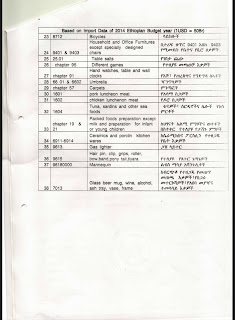
This leaves the Ministry of Finance the unenviable task of deciding the relative importance of hundreds or thousands of things, and deciding which ones should get higher priority for letters of credit, lower priority or none at all. Last October, the government decided to ban letters of credit for 38 items. 

 

The list includes oddly specific items like "Vimto", impossibly vague categories like "Different games", and hilarious ones like "Artificial and Human hairs" and "tiaras".  Comedy aside, some choices are really sad.  "Bicycles"! That one really broke my heart.  

Oil gets a double subsidy: first from foreign currency priority, and second from getting explicit subsidies of the price at the fuel pump.  Believe it or not, in Ethiopia which doesn't produce any oil, has a foreign currency crisis, and where less than 1% of the population has cars, the price of gasoline is half of the price in neighboring Kenya! Fuel subsidies may be one thing that is even crazier than the foreign currency nightmare, but let's leave that for another post.

Meanwhile, businesses are suffocating because they can't get foreign currency. If you make electrical equipment, you can't get the dollars to import copper, so you stop and wait. If you are constructing a building, you can't get dollars to buy steel, so you stop. Over 200 business ceased operations because of lack of foreign currencies. Manufacturers are getting less than 15% of the foreign currency they need for raw materials, according to the Ministry of Finance. A common sight around Addis Abeba is unfinished buildings, sitting half-built for months or years, a constant demonstration of wasted land, wasted capital, lost opportunities. If you talk to anybody in manufacturing, you will be overwhelmed with stories of dying companies.  Companies fail all the time of course, that's the nature of business. But the heartbreaking thing is they are not failing for business reasons. Imagine you  have the right idea, you invest lots of money, hire the right employees, make the right product, find the right customers.  You are willing to pay for inputs at market value, but, understandably, you don't want to go to the black market.  So you just sit and wait for permission to buy your inputs. And eventually close up shop. That is the tragic fate of many many businesses that could help the livelihood of  millions, dying because of this foreign currency policy.

Perhaps the starkest illustration of the failure of this central planning approach to prioritization is: "Lack of forex to import fertilizer threatens agricultural output". Nothing is more important than agricultural production, and the government understands that. So they planned ahead and allocated $1B for fertilizer,  much more than last year. But due to global market changes, the need is $1.2B. So here we are with a shortage of fertilizer.  

In short what we have is the classic "economic calculation problem" which forever plagues central planning. The problem is not that the planners have bad intentions, nor that they are not smart enough, nor that they don't have the right data, nor that they need more powerful computers. It's more fundamental. In a large economy, the full information to make the optimal allocations simply does not exist in one place at one time no matter how much you try. You cannot sit at a desk and decide for 100M people whether steel is more or less important than copper, or whether aspirin is more important than fertilizer. The information is distributed in the subjective values and decisions of thousands of different actors, and when they act locally on their specific problems, their collective intelligence is much greater than even the best possible central planner.

Inefficiency of indirect subsidies

Further, even if we assume the priorities are perfectly correct and everyone agrees, there is another basic problem. Who pays for them? The cost is of course being born by the sellers we identified above: exporters, people receiving remittances, etc. And the benefit goes to specific imports. Which raises the question: why should coffee exporters or remittances carry the cost of gasoline for car owners? Why shouldn't plumbers, teff farmers or real estate businesses share the burden? A society may decide the rich should subsidize the poor, or some things should have punitive taxes, etc. But implicitly making one sector pay for another specific sector is unfair and inefficient, and leads to many unintended consequences. If the society wants something to be subsidized, then it's better for the government to spend money directly on that thing, using money that it collects through normal explicit taxes. The optimal mix of taxes (VAT, duties, income tax, etc.) is a separate debate the society can have. But whatever the specific combination of taxes, explicit taxes are better than an implicit tax via currency controls.

Corruption

Another problem is that access to foreign currency becomes an exorbitant privilege, so there's an extreme incentive for corruption. Common sense says that when there's a magic way of doubling your money, there's bound to be some cheating. The people who are most adept at playing the privilege game will get more of it, while those who are politically naive  get less. To think otherwise is to ignore human nature.  Cronyism and corruption is rewarded and productive work is penalized. This is of course extremely damaging to the economic and moral health of the society.

The grey zone

Inevitably, many of those who can't get this privilege resort to the parallel market. Indeed, the black market has become mainstream. Increasingly this is not just individuals like Abebe and Berhane in our story above, but also in business. Research shows that prices of imported commodities are tracking the parallel market rather than the peg. Banks too are flirting with the black market, by adding transaction fees as high as 60% to bridge the gap. Even parts of government are resorting to the black market. For example, earlier this year, there was a huge public bus procurement scandal. The Addis Abeba city government paid 19 million birr per bus, which according to the peg, is about $350K. Critics screamed that those same buses cost less than $150K internationally, so surely someone pocketed the difference! But an alternative explanation soon emerged: the importer had to get their foreign currency at the parallel market rate. Using that rate, and adding the cost of shipping etc., the price seems more reasonable. Should you praise the importer for creative problem-solving (after all the city does need more public buses!), or condemn them for price gouging? You decide. It is a bit like the debate about "illegal" vs "undocumented" immigrants in the US, but much worse. Exploiter and exploited start to blur into an unhappy grey zone. Huge swaths of society are operating outside the law. The hypocrisy is staggering. People will publicly defend the peg and privately use the black market. That's not only legally risky for everyone involved, it's deeply corrosive to the rule of law. Ethiopia is becoming a mafia state.

The solution

The polite economist word for this nightmare is "distortion".  And while the consequences are very wide and complicated, there is a simple and narrow solution.  The government could simply revoke the law that says Abebe, Berhane and the banks are not allowed to exchange their USD for ETB at whatever price they agree to. That's what is meant by jargon like "float" or "unification", "liberalization",  etc.  Just let the two parties agree on a price. No other laws need to change. Any product that is illegal can remain illegal. Banking licenses don't need to change. Just decriminalize voluntary price. That's it.  

And, surprise! That is actually the current Ethiopian government's position.  Don't take my word for it. It said so in 2019:  Ethiopia: Central Bank announces floating exchange rate regime. And again in 2020: Ethiopia Plans New Key Rate, Floating Currency to Boost Economy. Even now in 2023, exchange rate unification remains the goal. But the policy is "gradual", and 4 years in, the peg remains and the gap is growing. So what are we waiting for? Why don't they just waive this magic wand today? 

The reasons for this inability to execute the change fall in two categories. First, this inefficiency benefits some special interests, even if it hurts the majority. And multi-billion dollar special interests, both within and outside government, are tough get rid of. The second set of reasons is many sincere but misguided fears, both within and outside the government, of what would happen with such a change. Let's examine them.

Inflation: the map and the territory

The most common fear is: if the currency is floated, inflation will go up. But this is due to a misunderstanding. Let's say the international price of copper is $0.10 per gram. And the local competition is such that  importers can't make more than 10% profit. If copper is a priority and importers get letters of credit allowing them to buy dollars at 55 ETB/USD, they can import it for 5.50 birr and sell it to you for 6 Birr. Ok great. But if the importers can't get foreign currency, what is the price? It's as if the price is infinity. You could go bankrupt while waiting for copper to be available. Or go to jail buying it from smugglers. Now suppose the importers can get dollars at a market rate legally, they will bring it in at a cost of 10 birr and sell it for 11. The naive academic might say there is inflation because the price went up from 6 to 11.  But people in the real world realize that 11 is less than infinity! Scarcity is a form of inflation. Focusing only on official prices while ignoring scarcity is mistaking the map for the territory, or mistaking the thermometer for the temperature. 

Of course inflation is a serious problem so it's easy to fall for this fallacy. But would you trust a doctor using a broken thermometer who says: if we fix the thermometer, you will develop a fever? No, you want a practical one who sees the thermometer is broken and that you already have a fever. So while academics and commentators talk about potential inflation, people who provide real goods and services know that the inflation they fear is already happening. 

Exchange rate

A closely related concern is that if the exchange rate is floated, then the currency will rapidly lose value. There are three versions of this worry.

Some think that, by some unexplained law of nature, the black market has to remain more expensive than the official market. So if the official market is floated and ETB/USD goes from 55 to 100, then the black market price will go to 200. That is nonsense The black market responds to supply and demand. If there is a functioning legal market, then there's no reason for anyone to pay a higher price and also take the risk of doing something illegal! It's just human nature, people prefer to pay less, and people don't like going to jail.

A more sophisticated version of this worry is the following: in the black market, both supply of and demand for foreign currency are suppressed, and if you legalize free exchange, the demand might increase more than the supply so the market price will be higher.  But this is also incorrect. Usually, when there's prohibition, supply is more suppressed than demand. Or to be technical, the elasticity of supply is greater than the elasticity of demand. Without prohibition, all else being equal, the price is lower.

Another variant of the same fear is based on historical examples. In a recent discussion on this topic this example came up: once upon a time, Sudan floated their currency. At the time of the change of policy, the USD on the black market was at 550 SDP. After the float, the market price rose to 600 SDP/USD.  So proponents of currency control claim that getting rid of it caused the SDP to lose 10% of its value. But they should note that in the preceding decade, the black market price of USD had risen 5000%! The currency was losing value very fast. And floating it, if anything, slowed it down. Similarly in the case of Ethiopia, I wouldn't say that if the exchange rate is allowed to float today, the price of foreign currency will go down tomorrow! Most likely it will continue to rise but it will slow down.  Here's a picture to illustrate the point (the dots represent real values of the black market as reported in news articles over the last 5 years): 

In short, the black market price is the free market plus a risk premium. If it is decriminalized, the risk premium goes away. So the black market is an upper bound on what the natural market price would be.  

Speculative attacks

A closely related fear is that if the currency is freely exchanged, international currency traders would swoop in and wreak havoc by "speculating". It is true that financial markets can be volatile but let's put that in perspective. That volatility is much less than the brutality of the practical forex market as currently experienced by Ethiopians today. The random shocks of getting or not getting a letter of credit are much worse. You can go for arbitrary length periods with an effective price of infinity and volume of zero! 

Sure, if the currency was freely traded, the National Bank of Ethiopia (the central bank) and the Ministry of Finance may make monetary or fiscal policy errors, reserves might run low, etc. But all that would be child's play compared to the devastation the current currency regime is inflicting on the real economy.  That said, the government can and should shore up reserves. Two obvious moves: stop fuel subsidies; sell off non-strategic and poorly-performing state enterprises (of which there are many).

Sequencing reforms

A related point often made by academics and commentators is: yes the parallel market should be decriminalized, but first the economy must be strengthened, productivity must increase etc. This argument is a bit like sitting in a burning house and saying: yes the fire is bad, but first let's invest in non-flammable furniture and curtains. It's missing the burning issue. The currency not being freely exchangeable is suffocating the very things that make the economy more productive.

Upside down tiger

Another argument given against free exchange is that some countries, like the so-called Asian Tigers and China, grew their economies while controlling their currencies. The irony is that in those cases, the control consisted of under-valuing their currencies, to promote exports and investments, while suppressing imports and domestic consumption. They essentially delayed the rise in standard of living in exchange for faster industrialization. But what we have in Ethiopia is the exact opposite: the peg over-values the currency, which subsidizes selected imports, while lowering investment, domestic production and exports! You might call this the "upside down tiger" de-industrialization strategy. No country has grown out of poverty this way. 

Brace for media impact

If the peg is abandoned, we can be almost sure that a lot of the commentariat will miss these two points:

  1. they will compare the new free market price to the old peg, instead of comparing it to the old black market price, falling for the map and territory fallacy;
  2. they will comment on the increase of foreign currency exchange rate, rather than the fact that the rate of increase declines.  

Even economics professors confuse a decline in the rate of change with an actual decline in the price! So what are the chances journalists and social media activists will be rational? Low. They will probably scream bloody murder.  And governments know that. Hence the "gradual" policy. To be blunt, the political cost of doing the right thing is very high.  

Deva!uyashun!1!?

It's amazing how many people think the strength or weakness of a currency is determined by a government simply deciding on a price. And they talk about "devaluation" as if it is a matter of just typing in a larger number. Their concept is: the bad guys will force African countries to use a larger number! Oh no, devaluation! We must fight the IMF! Neocolonialism! Bla bla bla. I'm very critical of the IMF and the current international financial order, but this conception of "devaluation" is complete nonsense. But it is political dynamite and a lot of energy is spent trying to defuse it. Here's how I would respond to it. If you think "government type big number = bad", then ask yourself do you believe that "type small number= good"? If it's that easy, do you think that, tomorrow, the Ethiopian government could set the peg at 50 ETB/USD instead of 55 ETB/USD and all imports would automatically be 10% cheaper? If they peg it at 0.01 ETB/USD would imports suddenly be 5000 times cheaper, and the average Ethiopian would afford a Ferrari? Of course not.

Root cause of currency strength or weakness

From a policy making perspective, the exchange rate is an effect not a cause. It's an output signal, not an input variable. The real price (which is approximated by the black market not the peg) is a reflection of a basic reality: how many dollars are coming, and how many dollars are going out. This is called the balance of payments. The birr gets weaker if the economy is not bringing in enough dollars. Exports and foreign investments are too little compared to the consumption of imports. And this imbalance can only improve if a) the economy produces more things the rest of the world wants, and b)  the country is more attractive for investment.

Now as we saw earlier, the first order victims of the peg overvaluing ETB are exporters, investors, and remittance recipients. The gap between the market and the peg is a de facto tax on them so it directly reduces their volume. Fewer dollars come in.  At the same time, it's a de facto subsidy of specific imports, which means more dollars go out. Which makes the currency weaker. Which increases the gap. That's the death spiral of a weakening currency.  The second order victims are manufacturers and producers more generally; even if they are not exporters, they help the balance of payments by creating products that would otherwise have to be imported. Plus they are part of making the society more productive which improves chances that the society will make stuff the rest of the world wants. Thus, by choking producers, the peg further increases the imbalance, another vicious cycle.

There is no solution that doesn't include facing reality. Recognize that 55 ETB is just not worth 1 USD. The peg doesn't make the currency stronger. A broken thermometer does not cure fever! The cure starts by getting rid of the peg, which will

  1. in the short term, eliminate the risk premium, improve availability of consumer goods, eliminate an unfair de-facto tax and subsidy, reduce corruption, and stop a major cause of socio-economic rot;
  2. and in the longer term, increase exports, foreign investments, and productivity of the society, which will help fix the structural weakness of the currency.

People voluntarily exchanging things at prices they agree on is not a neo-colonial imperialist capitalist evil that needs to be forbidden. It's what humans have always done naturally everywhere, including in Ethiopia.


2013/06/25

Optimism

A few months ago, I stumbled across a business card left behind on a table. Under the name of the company, it had three words, each followed by a period,  representing, I guess, the three pillars of their "corporate values".  One word struck me: Optimism.   I must have snickered,  because someone asked what was up. I instinctively thought "optimism" was a silly value, but it dawned on me that I had never thought about it explicitly. IMG_5158

Is optimism good?

The question sounds strange because Optimism, today, in American culture, is automatically assumed to be A Good Thing. Like "pro-active". People use that word as if it's synonymous with "good".  E.g. Person A: "Don't do this bad thing." Person B: "It's not bad, it's pro-active!"  Noooo....  Just like sometimes, being pro-active is evil, being optimistic is not automatically good.

Let's define optimism as follows: Having high expectations for a positive outcome. That is to say, compared to most "normal" people's probability distribution of outcomes, yours has more weight on the positive side. Say we both bet on the same horse, and one of us thinks we'll lose and one thinks we'll win.  So when is it good to be the optimist?  I would slice it on three levels:
  1. Of course if you turn out to be right, then great... But that just means you got lucky.
  2. What if you had to make the same choice over and over again, and on average the optimistic view is more accurate? Great, but that's not really optimism, it's having a better probabilistic model, better foresight.
  3. Now what if you believe the same probabilities as everyone else, but you are more willing to take the risky choices and eventually you're better off? You are good at taking the right amount of risk for reward, and if in the long run you are better off (technically i.e. if you are on the efficiency frontier in the risk, reward plane),  then ... well that's good judgement. 
But in all these forms, the optimism is situational! The are plenty of situations where the wise person would take the "pessimistic" position.   Thus, as a fundamental value to live by, "optimism" is actually orthogonal to the things we consider good, truthful etc.

People (including Corporations!) of the world, listen to me: Value luck, foresight or judgement.  Not optimism.  That's just silly.


2010/10/16

Design bugs in everyday life: hall of fame

Revisiting the subject of design bugs in everyday life, there really ought to be a "Hall of Fame" for such things, which I hereby inaugurate.

As first inductee, I nominate the typical North American cable TV remote control, like the one from Time Warner shown here. It's design is so atrocious it defies comprehension.

What is it about this object that I find so contemptible? Consider two operations on a TV remote that you really want to be quick and effortless. One is "mute"... When you need it, you need it fast. Another is "previous channel" -- probably the most frequently used button. In any sensible design, these two buttons would be large and as distinct as possible. Here they are the exact opposite, they are the tiny gray dots below the blue and red buttons. They are in fact the least distinct buttons on the whole thing!

This leads to the type of thing we've all experienced: you are watching TV, the phone rings,  your focus shifts completely to the phone call and with the little attention that you have left ofter, you fumble with the remote, trying to find the $*@%! mute button, meanwhile the TV volume seems to get louder, the phone call becomes more urgent, stress rises.... You get the picture.

On the other hand, the two largest and most visible buttons on the remote are "list" (to access DVR), bright green one, and "on demand" (to access video on demand), the big white square. But neither of those features, by definition, requires any speed... In fact they are meant to be accessed at a leisurely pace, that's the whole point of them! Perfect candidates for attractive but discreet buttons. But no, they get to jump out the most, screaming at you.

Why does this object have exactly the opposite of what you'd want in a good design? There is not even a lock-in effect, as described in the previous post, to excuse it. Maybe there's a less naive reason. The "on demand" button generates additional revenue for the cable company, so that could be why it gets featured strongly. But really, it can't make that much difference. How many times will someone order movie just because they saw the button? Once? For that tiny bit of incremental revenue they are willing to get in the way of the most essential functionality? It's like giving limousines priority over fire trucks and ambulances on the road!

But let's apply Hanlon's razor: Never attribute to malice that which is adequately explained by stupidity. They probably just don't give much importance to design at all. Recall these cable TV folks are the same people who, as I've noted before on the subject of the mythical DVR+P2P, seem completely capable of suicidally stupid fear and paralysis in the face of potential innovation.

The essence of good design is to deliver functionality efficiently, and from that the aesthetic flows naturally. Form following function and all that. For committing the most egregious violation of that principle that I can find, I hereby induct the Time Warner cable remote control to the Design Bugs Hall of Fame.

While we're at it, I might as well give them the second induction as well. Just look at the program menu on your typical TV. Why doesn't it have your most frequently used channels, like bookmarks, easily accessible at all times? Most people watch a handful of channels vast majority of the time. Does it make sense to have them scroll around or enter numbers every single time to find the same few needles in the huge haystack of 500 channels, over and over again? Why not present an automatically generated list of your most frequently visited channels, like the Firefox and Chrome browsers do with web pages? It would be a huge time saver, enormous usability win, a no brainer. They haven't thought of doing that, in the decades that cable TV has existed?  Contrast that with innovation in web browsers....

Cable TV subscribers.....  which I am not one of by the way,  imagine how much more I would complain if I actually used it!  But I digress. Fortunately, Cable TV subscribers can now root for the brave new world of software-driven television. Tivo, Boxee, Apple TV, Google TV, Netflix, et al, whatever they end up becoming, let's hope they manage to wrest the user experience from the sclerotic grip of the cable TV monopolies and their business model demons.

2009/08/11

Mark Cuban's advice to Myspace

I made what turned out to be a rather lengthy comment on the latest post at blogmaverick.com wherein Mark Cuban gives advice to Rupert Murdoch. A quick survey of my readers (hey me!) indicated that close to 100% would like to have that insightful comment right here on their favorite blog. Hence this post.

The first part of Cuban's advice is kind of crazy. He wants news sites to block incoming links from aggregators. Block links! That's a surprising level of cluelessness from our good friend, who is getting all the flack he deserves for that idea from other people so I won't add to it.

The more interesting part of the post is on Myspace's potential future business model... I really think he's on to something. Here's what I had to say about it (Since Wave is not integrated with Blogger yet, I can only cut & paste):

Excellent advice for Myspace, Mark! I think being a music platform is the best business plan for them. They have the audience with the right demographics, and the artists. For now… But they can’t pull it off with the website they have today. So the big question is, do they have the technical capability to support that business plan?

It would take a significant breakthrough, a next generation web application. It would have streaming, download and playback, syncing with devices, all better or at least as good as todays iTunes client/server combo. It would also have to be a great authoring/publication tool for artists to easily create a good looking online presence, perhaps even some actual post-production music features to create special samples and mixes…

In short, they need a site that is as different from today’s Myspace pages as, let’s say, Gmail in 2009 is different from Hotmail of 1999. The ingredients are available and ripe: after years of stagnation, browsers and web languages are in a period of intense innovation. But can Myspace pull them together to create a cool and, as Steve Jobs would say, “insanely great” technology for the new web-based music universe? I doubt it. I just don’t see any evidence whatsoever, at Myspace or anywhere else at News corp, of the level of technical depth required to lead the world into this new — dare I say it? — “web 3.0″ music world. Still, you are right IMHO, it’s their best bet and they should at least try rather than wither away.


2009/07/29

Chronicle of a death foretold

Sometimes little things are very telling. In the case of Facebook, one of those things is "Reply-to:"... or rather three of those things. To wit:
  • When you receive a message on Facebook, it sends you a notification by email. Great. But then you can't reply! Why? Why don't they just set the reply-to in the email header to an address that will send it back to the person's inbox in Facebook? That way you and your friend are still communicating through Facebook but with the added convenience of email e.g. on your mobile. But no, they force you to login to the Facebook website to reply.
  • Similarly, suppose you are logged in to Facebook, and you want to email your friend. You go to you friends profile, and guess what, you can't click on the email address to send them email! Why? Why can't they just make it a mailto link?
  • So ok, you decide to just copy and paste the address, of course. But you can't -- it's an image! Why? Whyyyyy? Why can't they just leave it in plain text, why do they want to go through the extra expense of converting everyone's email into an image?
In short, they are really really going out of their way to discourage you from using your friend's email address. Why? Fear of spam is not the reason, we're talking about authenticated contacts. Obviously the reason is that their business model is such that when you visit their website, they make (or at least hope to make) money from advertising.

The technical ideal here is obviously flexibility: let users exchange emails, SMSes, IMs, everything they want with their friends, with Facebook being the hub of their online universe. Instead of re-inventing separate and more primitive versions of email and IM inside their closed world, they could inter-connect and inter-operate. They could also for example enable you to chat with your Facebook contacts directly even if only one of you is logged in to Facebook and the other is on AIM, Yahoo Messenger, MSN messenger, or Google Talk... If Gaim and Trillian could do that years ago, surely Facebook can. They could effectively unify all the existing message systems into a grand Facebook Open Overlay IM ("FOO IM"). It would be a great service to their users, and a manifestation of the core raison d'être of a social network. And of course, they already have plenty of employees there who are very smart and experienced with this kind of stuff, so they definitely could. But, instead of doing the right thing, their business model is forcing them to instead handicap their users' communications!

Every company must have a way to make money of course. Through some combination of good ideas, timing, environment, luck etc. companies end up with very different business models. Here it looks like Facebook is trending toward one which requires an "adversarial" relationship with the user. We're seeing hints that their need to reach profitability is starting to go against the best interest of their users. Sure you can still make money that way. But that road is ugly. Down that road you end up with health insurance companies whose profits rely on denying coverage to people who tought they had paid for it. Shady calling cards where they put obstacles in your way so you can't fully use the advertised number of minutes. Sleezy subscription schemes that generate profits by making it difficult to cancel even when you are entitled to. Everyone knows that world, those businesses you just hate, the ones you complain about. Those are simply businesses where the company's incentives are not aligned with the users'.

In that sense, Facebook today is eerily reminiscent of AOL in the late 1990s. Facebook is the king of social networks with something like 300 million users. AOL was the king of Internet access providers, with 30 million users paying $20/month! (Here's an interesting side question: I wonder how Facebook users as a percentage of total Internet users today, compares to AOL subscribers as a percentage of total Internet population in 1999? I wouldn't be surprised if it's roughly the same.) And at the very peak of its dominance, AOL was showing the same signs. Instead of letting their users just go to any website directly, they had this limited proprietary system with "rooms", "keywords", "channels", their own content, their own applications, etc. The reason was because they were stuck in a business model of a closed online service from the 1980s. So even though they knew the open network was infinitely better, they were devoted to a doomed goal of keeping the users inside their own closed world. Inevitably their users realized they could get more for less: pay $10/month to a no-name ISP, use a free browser and just surf the web... ("surf the web" sounds so quaint doesn't it?) And they started leaving AOL in droves. Even after merging with Time Warner, AOL couldn't capitalize on the shift to broadband. They remained desperately focused on trying to keep subscribers from leaving the old "America On Line", they became a monster that took adversarial customer relations to a whole new level, before finally giving up in 2006. (By the way all this has little to do with what AOL is today in 2009).

To be sure.... Wow for a long time, I've wanted to start a paragraph with "To be sure ...", and this is the first! But I digress.

To be sure, despite the dramatic title of this post, and despite the fact that I've picked on them once before, it's far from over for Facebook. They may yet decide to give the users the obvious flexibility, and make enough money with higher quality ad targetting when the users naturally come to the site anyway. Maybe they will find new ways to advertise as messages flow openly in and out of their network, or maybe they will figure out brand new business models. Whatever the case is, they do have one great thing going for them. Execution. They know how to get things done. You don't get to 300 million users by being stupid or lazy. They just need to make sure they are not smartly and expertly marching off a cliff.

Ornella Muti, isn't she beautiful?
The title of this post by the way is from a novel by one my favorite authors. Not his best novel, but a great title. And a pretty good movie too.


2009/03/14

Trouble in (AAPL) paradise?

Henri Rousseau, Le reve (de Yadwiga?)
Last year my beloved blackberry was stolen... at gunpoint! That was the single most lopsided cost and benefit equation (for all involved) I have ever been a part of in my life... but that's not today's story. The story is, I decided to replace it with a second generation iPhone (with 3G and GPS), which had just come out. I'm not about to write a product review, God knows enough has been written about the iPhone. I'll just sya it's a really cool device.

But there's one aspect that doesn't seem to be talked about at all. A few weeks later I went to Ethiopia, and coincidentally again, I got one of the very first 3G SIM cards in the country. Amazing, the coolest phone and the fastest wireless network, woohoo. Except... there was no crack to unlock the 3G iPhone! So I had to carry two phones, one to make calls, and the iPhone for my address book etc. Second, my MacBook pro doesn't have a modem! And of course, who remembers to take an extra modem with them? Thankfully I had an old IBM Thinkpad, which has a built-in modem, so I could get on the Internet. The point is that the two Apple products I had were unusable in the third world. Whereas their competitors products (IBM and Blackberry in this case) are perfectly usable in those same conditions.

When I came back, a few weeks later, I was given an HTC G1 Android. Again many people have written comparing the two, but the thing that immediately struck me as the most important in comparing the two is a very basic point. The Android doesn't assume you have a computer. Everything is over the air, your contacts, applications, OS updates etc. are all updated/synced wirelessly. Whereas the iPhone requires that you have a computer, and a pretty powerful one at that (it has to be able to run iTunes on Windows or Mac OS X). To use an iPhone, you have to not only buy the phone, you must also already have a $1,000-$2,000 computer at home. If you live in the first world, that's a perfectly valid assumption, no problem. But it means that Apple's total market is a few hundred million people in the first world. This is true of Apple products in general, but is even more true of the iPhone which is a hugely important piece of that company's future. For comparison, Android's market is those people, plus the other 3 billion people in the world who can afford a $200 phone but not a $2,000 computer.

Then few months ago I read a great blog post (unfortunately I can't find the url to link) which argued that because Apple's marketing has been based on "coolness" and "exclusivity", once a device reaches a critical mass of users, the marketing starts defeating itself. Same psychology which limits the lifespan new fashion or of "hip" nightclubs: exclusivity is key to success, and eventually when the B & T crowd can get in, it's no longer cool.

Add to that the phenomenal success of iPhone sales so far, and you can only conclude that pretty soon, it might, just might saturate its potential market, much sooner than you would expect. There's some evidence this is already happening with the iPod. And the iPhone has more formidable competitors and more complicated market dynamics than the iPod.

Recall what happened with personal computers, Apple invented the category and dominated it with a unique approach until the mid 80s. But as the overall market grew from millions to billions of users, they peaked and ended up stuck at well under 5% market share, as cheaper and uglier IBM PC clones took the other 95+%. On the other hand, in the last 10 years, Apple has pulled off several bet-the-farm miracles. Not just the invention of the iPhone, and the iPod, but also two earlier huge gambles: switching from PowerPC to Intel CPUs in the Mac, and switching from the old Mac OS to Unix-based OS-X, both were incredible successes of business and engineering that defied the conventional wisdom completely.

So this is a tricky one. It could go either way. But I'm going to go out and a limb and predict that 2008 was the year of Apple's peak. Short AAPL.

2009/02/14

What happened to Kavo, Tizaa?

I want my
I want my
I want my DVRP2P


From the first time I heard about Tivo, I expected the obvious next step, which would be gargantuan, the biggest thing since the web browser. It was obvious; Tivo + Napster! But Napster was already dead so I started saying: Tivo + Kazaa! Kazaa just happened to be the hot P2P file sharing network at the time (circa 2002). It's not necessarily Tivo anymore either, now it's DVR a whole category. So to update the idea let's call it DVR+P2P.

It's obvious. The DVR is basically a computer with a big hard drive, and a fancy video decoder/tuner card. Tivo is essentially an application that runs on Linux, I believe. Moreover DVRs connect to the Internet. So if they just added a P2P software client on it, boom! Suddenly not only can you record your own TV programs, you can also search every other user's recorded programs. This means almost anything that has ever been on TV on any channel is accessible for viewing on demand by everyone! The benefit to users would be ... I can't find a strong enough superlative. It'd obviously be HUGE. And incredibly easy to do.

So why hasn't it happened yet?

  • Copyright infringement? This is running on a closed device so they could easily restrict the software to only search "legal" videos from the same cable or satellite provider only.
  • Advertising? They already allow fast-forwarding through commercials, it doesn't seem to have killed the ad revenue. In any case they could disable ffwd if they wanted to.
  • Revenue? DVR+P2P would be so great they could charge any price for the service everyone would still sign-up for it.

Are they just extremely paranoid?

Here's what AFAIK is the conventional theory about this: Traditional laws relied on the physical form of books, records etc. to control the amount of copying, and now with digital media + data networks making copying exponentially easier the laws just don't fit anymore, and so there will be some major adjustments in the coming decades. In the meantime content owners are paranoid and are just blocking every new distribution method even if it's beneficial to them, like they tried to do when VCRs first came about. Scrounging through some links on my old homepage, I found a link to the first article I first read on this: "Who will own your next good idea?".

Today, I stumbled across a brilliant presentation by Laurence Lessig from 2002 entitled "Free Culture". In fact this post was supposed to be a quick link to that preso but it has released years of pent-up frustration on this subject in me. Anyway, "Free Culture" augurs a much darker cloud over the same field. He makes the point that digitization is expanding the scope of regulated use dramatically to the point of suffocating unregulated use. Which seems upside down because we are so conditioned to think of digitization as threatening regulated use. But when you think about it, it's absolutely true! Brilliant!

<irony>
That link on the word Brilliant which I've used before was to the hilarious Guinness commercial where they keep saying "Brilliant!"  Now it says "This video has been removed due to terms of use violation." What a perfect example of legal protection of creativity!
</irony>

The more I think about it, the more amazed I am by the truth,  simplicity, and importance of that fact: digitization is expanding the scope of regulated use. Unregulated use which used to be 90% of the activity, like simply reading a book or lending it to a friend, is being replaced by regulated use: reading a web page is technically a regulated activity, there are restrictions on what you can or can't do with those bits of content whether they are in your computer's RAM or HD, or pixels.  "Fair use" is just a minor sideshow. Unregulated use is the 800lb gorilla. I don't think most people realize that and they really should.  Lessig is a giant.  

"Free societies enable the future by limiting the past" -- Laurence Lessig.