Showing posts with label economics. Show all posts

2026/01/27

Feynman Diagrams of Currencies

Feynman diagrams are a way of understanding state interactions and changes in subatomic particles. In this post, I use simple diagrams to understate state interactions between different types of money.  The title of  is inspired by Michael Crichton's explanation of how he coined the phrase "Gell-Mann Amnesia" as I wrote about before: Name dropping a famous physicist bestows gravitas.  So now that I have your attention (if not respect), let's draw some diagrams.

Current era

The picture that is worth a thousand words. If you understand this picture no need to read this post.


Gold Standard: pre-1930s

But to put into historical context, here's what the picture looked like in the late 19th and early 20th centuries.


Post-Bretton Woods

And here's the world that evolved in the mid 20th century. Under the Bretton Woods agreement, from 1945-1971, the major currencies continued to be theoretically pegged to gold reserves, even though ordinary users of the currency did not have automatic convertibility, having lost that in the 1930s. Eventually, the pegs were abandoned completely in 1971. And this was the picture from 1971-2009, until the current digital currency era began with Bitcoin.


Legend
In each of these diagrams, 
  • Solid lines represents easily exchangeable value. 
  • Dashed lines represents flows with barriers e.g. currency controls.  
  • The direction of the arrows represents where value "wants" to flow
What determines the directions? Two principles
  1. Inflation:  people prefer strong money to weak money. Strong in the basic sense of future purchasing power for real goods and services. Of course all else is not equal, so sometimes a weaker currency is required as a means of exchange.  
  2. Permission: all else being equal, people prefer money that they can use without permission. Of course all else is not equal, for example physical cash is great for permissionlessness. But it's not the best for long distance exchange or storage. 

Hard/soft and strong/weak currencies

"Hard currency" traditionally meant the money is made of, or directly convertible to, gold, silver, or some other hard to produce commodity.  The natural scarcity provides inflation resistance. This link faded in the 20th century, but it still persists in for example central banks gold reserves, which help "back" the value of their currencies.  But there is no guaranteed convertibility. It is money by fiat.

The US Dollar for example is no longer a hard currency in the traditional sense. The scarcity is not given by nature, but rather by  monetary policy (i.e. politics), which in practice is almost always inflationary. In the last 80 years, there have only been 2 years in which  the US CPI change was negative. 2% inflation used to be  the target. Now the target is creeping up to 3%.  Everyone expects one dollar will buy less stuff on average in the future than it does today. We are now so deep into the post-hard currency world that nobody even expects to keep savings in dollars.  The very idea seems quaint. Bury dollar bills in your backyard? Your mattress? It is accepted that to store money for the future, you have to invest it. And of course investing is work.  As Bitcoiners like to say, with fiat you have to work twice for your money, once to earn it and again continuously to keep it.

But the USD is strong compared to the many weak fiat currencies at the bottom. Everyone expects these units will lose value faster than dollars.  Instead of 2-4%  being normal, it's more like 15-30%. Most people at the bottom would rather hold USD than their local weak currency.    This all sounds strange if you are part of the 1B people currently living in the rich countries. But for the other 7 billion people in the world this is a very familiar story.

The arrows show the direction in which money "wants" to flow to store value.  But of course, local fiat is required as a means of exchange, either by convenience or by law.  And you have currency controls, bans, sanctions, and many other kinds of friction, all represented by the dashed lines. 

Stablecoins

The key feature of stablecoins is allowing people currently locked-in to weak currencies to access the strongest fiat currencies with relatively low friction. 

Reminds me of the situation with long distance phone calls in the early 2000s. An international phone call could cost 10x more from poor countries to rich countries than vice-versa. This gave rise to "call-back" services, using VOIP/SIP and the web to bridge the call via two separate calls originating in the rich country, allowing people in poor countries to make international calls at the same low price as people in rich countries. (I was actually a partner in a project called africalling.com that did that circa 2005).  Then eventually, bandwidth became so cheap that voice calls just became another type of data on the internet, and now everyone uses Internet-native voice in messaging apps like Whatsapp, Telegram or Signal, etc. No one even thinks about long distance phone calls per minute.


Stablecoins and CBDCs

Stablecoins are like the call-back services. They allow people in poor countries to use rich country money. Local currencies are like the old third world phone monopolies  A lot of sweat and tears will be spilled trying to stop international stablecoins. CBDCs ("central bank digital currencies") will be touted as the national alternatives.  But once users have access to the stronger money with low friction, why would they prefer the weaker money? So it's just the same old game as with current fiat, but the playing field is now slightly more tilted in favor of the individual users.   As people around the world gain access to USD stablecoins, they will experience the ability to buy from suppliers and sell to customers in other countries. The ability to travel and use their money in  other countries.  If you are part of the 1B people in rich countries, this is something you take for granted. But for the other 7B people this is a huge deal. Like being in Africa and being able to make a voice call to someone in another country in 2005!


USD Stablecoins demand

Now if there are many equally accessible stablecoins tied to different fiat units, there is no reason to use the second strongest units. Everyone will just use the USD stablecoins. Which means not just the weak, but also the other "strong" currencies, like the Euro or Yen etc will become less relevant.  Even the Chinese Yuan, which you would think would have strong demand since everyone imports from China, is going to be less desirable because the Chinese recipient will gladly accept USD knowing that everyone else does. In a friction-less fiat world, USD is the Schelling point.


Stablecoins as USD turbo-supply

On the supply side, the mechanism is self-reinforcing. USD stable coins are backed by US government debt. When they issue $1 of a stablecoin, the issuer takes $1 from the buyer and uses it to buy $1 of treasuries. The coin then circulates indefinitely with the value remaining pegged based on the belief that it can always be redeemed for a real $1. 

And that peg is solid. Because 
  • the US government will never do a hard default where it simply refuses to pay back that $1 of debt.  Why? Because it can always do a soft default: print another $1 out of thin air and pay the debt with it. It is fiat money, remember?  Of course you can only do this if the debt is denominated in the currency that you print, so this is more true of the dollar than other currencies, because of it's unique historical position (world reserve currency, petro-dollar, euro-dollar,  etc.).  And from a stablecoin perspective, a soft default is a no-op. As long as they keep short duration treasuries, the stablecoin issuer can legitimaely maintain the peg at $1 per coin. 
  • the stablecoin issuer meanwhile happily buys $1 of treasuries, issues $1 of tokens, maintains the peg, and gets to keep the interest on the debt. At 4% per year, and $200B of USDT issued, Tether could make $8B a year while maintaining a 1:1 peg. Of course they could also be fraudulent and not maintain the peg, but that would be irrational. Why jeopardize a legit $8B profit by stealing from your customers?
This makes stablecoin issuers large buyers of US government debt. Which is convenient for the US government as additional demand for treasuries makes it easier to continue running a deficit. And stablecoins also make the USD more dominant internationally at the expense of all the other fiat currencies. It reinforces the "dollar milkshake theory". The US was already in a position to suck up a lot of international demand for safe debt, now stablecoins provide more straws for it to drink the milkshake. So the US government has very good reasons to support USD stablecoins.  

If the US government is like an engine pushing the dollar out into the world, the stablecoin acts like a turbo which takes the exhaust and pumps it back in to increase power.

Don't get me wrong a soft default is still bad as it implies high inflation. But "nothing stops this train", to quote Lyn Alden. All fiat currencies are heading for higher inflation. However, in the short to medium term, the dollar, via stablecoins, will dominate even more than it does currently.


Bitcoin

But just like in our long distance phone call story, there's a final twist. Back to our basic principles of inflation and permission.

First, as those 7B people use the ladder of stablecoins to climb up from the flooded basement of weak fiat to the ground floor of strong fiat, they will start thinking what the 1B already on the ground floor are thinking. The ground floor is sinking too! I have escaped double digit inflation but now I have savings with 0% interest rate in dollars which, adjusted for inflation, is minus 3% per year. Can I do better?

Second, stablecoins are not entirely permissionless. They have lower friction than traditional fiat rails but at the end of the day, a USD stablecoin issuer will still obey the US government, since their main asset is US treasury bills.  (The Iranian government recently bought $500M of USDT. Grab your popcorn).  Can you use something that has even less risk of confiscation?

The answer to both of these is Bitcoin. Fiat will continue to exist for a long time of course, but Bitcoin will play an increasing role as the global neutral hard money.

Update: I gave private talk about this topic: here are the slides

2025/06/21

The four anti-pillars of Marxism

Those who don't understand history are doomed to repeat it.... And those who do are doomed to watch in horror. 

In recent years, I've watched in horror Marxism seemingly coming back in fashion, as if we're in the 1920s. Too many people lack the practical experience, theoretical context,  or intelligence to know the lessons of the last 100 years. 

The seven pillars of wisdom in Christianity or the seven pillars of Islam are things you should build on. With Marxism, we have some seductive big ideas that you should not build on. I call them anti-pillars.  I won't explain them since many great people have before. I'll just list them as pointers.

1. Economic calculation problem and the fallacy of central planning.  

It is not just about having better computers or more data. The information in an economic system doesn't exist in one place or time, it is distributed. Furthermore, even if you had it all at once, much of it is not explicitly manifest but rather implicit preferences.

2. The labor theory of value is wrong

It is not just labor vs capital, there is also value and, more subtly there is quality.  If I spend an hour on the piano and Mozart spends an hour, it's one hour of labor. But there is a subjective difference in value. And an objective difference in price that others will pay for it. Finally, there is something that is neither objective nor subjective, beyond dialectics, namely quality.

3. The class struggle is a static one dimensional model, but human economic relationships are dynamic and multidimensional. 

This may have been subtle in the 19th century, but in the 21st century, it should completely obvious.  In fact even in the 20th century, class was often cynically replaced by ethnicity or religion by various revolutionary Marxists hungry for power. Lenin used "nations, nationalities and peoples" when he realized Russia was not industrialized enough for Marx's class structure. Ethiopian Marxist-Leninists adopted the same hack 3/4 of a century later. 

4. A political system based on class struggle necessarily evolves into an escalating war of purity. In this process, the most ruthless sociopaths, the self-appointed revolutionary vanguard, always end up as the rulers. Which is why almost every Marxist state converges on a violent totalitarian government.

If you are ever about to be to be seduced, at least know these anti-pillars, and spend a small amount of time understanding them.

2024/07/30

Free at last

On the evening of Sunday July 28, 2024, the Ethiopian government made a historic Macro-Economic Reform Program Policy Statement. Early Monday morning, the National Bank of Ethiopia (the central bank), followed up with the details: The National Bank of Ethiopia Announces a Reform of the Foreign Exchange Regime with Immediate Effect. The details are important so if you are interested, you should read the the press release, or better yet, the full directive. 

The bottom line is simply this: the price at which you can legally exchange the local currency for foreign currency is no longer fixed by the government. This doesn't mean all finance is deregulated, you still need licenses to be a bank or other financial service provider. But last week, the price of dollars was 57 ETB/USD and any other price was technically illegal. Today it can be anything. 47, 57, 67, 97, 100...  It is up to the banks and their customers to agree on a price, like buyers and sellers of anything else. The price itself is no longer a crime. Free at last! 

Last year, in my post entitled "The mother of all distortions", I wished for exactly this:
The government could simply revoke the law that says Abebe, Berhane and the banks are not allowed to exchange their USD for ETB at whatever price they agree to. That's what is meant by jargon like "float" or "unification", "liberalization", etc. Just let the two parties agree on a price. No other laws need to change. Any product that is illegal can remain illegal. Banking licenses don't need to change. Just decriminalize voluntary price. That's it. 
And, surprise! That is actually the current Ethiopian government's position. Don't take my word for it. It said so in 2019: Ethiopia: Central Bank announces floating exchange rate regime. And again in 2020: Ethiopia Plans New Key Rate, Floating Currency to Boost Economy. Even now in 2023, exchange rate unification remains the goal. But the policy is "gradual", and 4 years in, the peg remains and the gap is growing. So what are we waiting for? Why don't they just waive this magic wand today?
[...]
To be blunt, the political cost of doing the right thing is very high.
So let's applaud the government for finally doing it. A very courageous move. 

Defenders of the status quo
As expected, there has been a lot of discussion of this historic change. Much of it is excellent and constructive. The press has been vigorous, quick and has offered diverse views. Today I want to focus on a subset, the hard core defenders of the old status quo who are crying bloody murder. Intentionally or not, they are ensuring that the political cost we discussed above is paid in full!  Their arguments are predictable. In fact I haven't yet heard any that are not already debunked (or rather "pre-bunked") in my aforementioned article. It would be tragic if these fallacies caused a political failure of this reform. So here's my modest contribution: by responding to some of them directly, maybe I can help the probability of success a tiny bit. But first, since I won't be repeating the details, if you haven't yet read my article, now would be a good time to go and read it. I'll wait... 

Ok are you back? Once more unto the breach dear friends!

One of the loudest opponents of this freedom is Alemayehu Geda. A few hours after the initial statement, on Sunday evening, before the change actually took place on Monday, he was already out on the radio and social media attacking the reform. Here's what he had to say (I will put his claims in italic, since as you can guess, I'm about to rebut them).
Proposition AG1: Ethiopia imports more than it exports. If the exchange rate is freed,  things that were imported at 50 ETB/USD will now be imported at 100 ETB/USD and so imports will be more expensive. This will cause inflation. Inflation will cause the currency to weaken further. And as the exchange rate goes up the prices will go up even more. And so we will have an unstoppable spiral of general price inflation and currency weakening. 
If you follow his argument carefully, you will realize it it mixes up cause and effect, and then loops back in a circular argument. It's like saying: "Wet streets cause rain. This rain in turns causes the streets to get more wet. And the wetness of the streets causes more rain to fall. Because of these wet streets, soon there will be a hurricane!" Sounds scary. Indeed we've all noticed the close correlation between rain and street wetness! But in reality, it is more like astrology than meteorology. Econstrology.

To show why, let me ask some questions. Excuse me Professor, of course we all know the peg was keeping the rate artificially low, so when freed, it will naturally go up close to the "black" market rate. And you are saying inflation will go up if the government allows this. Then does that mean inflation would go down if they pegged the rate lower?  Maybe even  deflation? If the peg went to  50, 40, 30, ... 0.01 Birr per Dollar, would the cost of living would get lower and lower? The central bank has a magic keyboard that lowers the cost of living?  What about the huge fraction of imports priced according to the black market exchange rate. If the new free market rate holds at or below the old black market rate, why would prices go up on those? 

One more question Prof! You then say if inflation goes up, the currency gets weaker.  How does that work? Let's say we collectively spend 100 Birr every day. And we spend 50 Birr to buy domestic products, and 50 birr to buy US dollars to import stuff. If suddenly we have to spend say 65 on domestic stuff, now we only have 35 birr left to buy dollars with. Therefore there is less demand for dollars. How can that make the price of dollars go up? Conversely, if the dollar is more expensive we should have less money for the domestic stuff, so their price should go down. But you are saying both go up together... Very strange! Clearly if both were to go up together, there would have to be something else causing it (hint: money supply. But more on that later).

Clearly there's a bug in your model. Here's what was really happening. There was two foreign exchange markets. The official one which is pegged by law and the "black" market which I will simply call the market. The price of foreign currency on the market was double the official price.  For forex coming in, legally, you had to "surrender" your forex and get only 50% of the market value in Birr. Similarly for dollars going out, if you could get forex legally, you were basically getting a 50% discount on the market. And it is illegal to evade it. In other words, mathematically it is exactly like a tax and a subsidy. No magic wealth creation by fixing the price. Purely a mechanism of transfer. Taking money from exports and foreign investments, and giving it to consumption of imports. Meanwhile local producers who need forex for their capital investments were getting starved. So as a share of the whole economy: exports decrease, investment decreases, manufacturing decreases, and import consumption increases. More dollars go out and fewer dollars come in. This in turn increases the gap between the market and the official rate, so the implicit tax/subsidy effect gets bigger and the whole problem accelerates. This is the real spiral, and it is the reverse of your spiral.  Your model is right to point out the correlation, but it has cause and effect backwards.  Wet streets do not cause rain!

So, whither inflation? Shouting "everything will go up! panic!" is incorrect. All else being equal, the price of things that were implicitly subsidized by getting forex priority will go up, and the price of things that were implicitly taxed will go down. But of course not all else is equal, other variables will change. If the government wants to subsidize fertilizer imports, it will have to do so explicitly,  as government spending, with the choices and trade-offs that implies, not implicitly via distortion of the currency. This is the healthier way. Explicit and transparent. Implicit subsidies are prone to capture by special interests, and end up being regressive and corrupt.   

Another thing that can change is money supply. On that note, let's go to the Prof's second major point.
Proposition AG2:  Government budget includes a number of things paid for in foreign currency. So that portion of it will double.  Tax collection is already down in the last couple of years, because of war etc..Where will it get the money? And the white people want the government to cut spending and increase taxes. The economy can't support that. This will lead to printing and inflation. Ethiopians are poor. Now they will be poorer.
Ok this is partially true. When government prints more money, when the amount of Birr increases faster than the real economic activity, then we get inflation. More money / same stuff,  means more money per unit of stuff, i.e. prices go up. It is possible government will just print more Birr and this would lead to inflation. The part that is not true is the implication that reforming the exchange rate will automatically cause the government to print more Birr. You have to ask: what actually creates the temptation to print more, and will the temptation be stronger now? In fact Ethiopia already had very high inflation, running at around 30% per year, before this reform! One of the reasons is that the currency distortion was killing real productivity, increasing implicit and explicit tax evasion. In those conditions, the government is tempted to print more as quick fix, like an addict taking more drugs to avoid dealing with a painful reality. So the old currency regime was contributing to inflation! Now this reform, by improving productivity, should reduce inflationary tendencies in the long term.

To be clear, the reform does not silence the siren song of the money printer. The transition will be disruptive. There will be winners and losers in the short term. The old winners of the letter of credit privilege game will now be on equal footing with everyone else. The old losers, those who were generating forex and were forced to convert below market rate, will now get more of the benefit of their efforts. Manufacturers will have an easier time with imported equipment and inputs. Banks and merkato traders will speculate on whether the new policy will hold, and this will add volatility in prices and supplies. It will take a bit of time for things to settle down. Until then, it will be tempting for the government to spend more to smooth some of the bumps, whether newly borrowed money or printing. 

For this reform to succeed, the government must resist the temptation. If it does succeed, it will lead to more efficiency and fairness, a more productive economy and therefore less poverty. As it turns out, the central bank (NBE) has actually been systematically reducing the Birr money supply for the last few months. Not to be too technical, but they "drained liquidity out of the system" by lowering the maximum amount of lending  as a fraction of banks' balance sheets.  This is basically the opposite of printing money. So even though so the temptation will be there, there's reason to be optimistic that this reform is well prepared and the discipline to see it through will be there.

Now his third and final point is the following.
Proposition AG3: The people are poor. Cost of living is high. 70% of the population earns less than 50 dollars [a month].  Inflation makes life harder for the poor. 
That doesn't even need rebutting. It's just stating the obvious. But it is not derived from the subject at hand. No reason is given why this reform will increase poverty or reduce it. This is a rhetorical tactic called "motte and bailey fallacy". Continuing our previous analogy, it's like saying: "Wet streets cause rain and rain causes hurricanes. Hurricanes are terrible!" Then if an opponent says  "No, wet streets don't cause rain!" then he can respond with "Oh so you like hurricanes, you horrible person!" In this case, if you point out the incorrectness of his argument about the forex regime, this allows him to say "Oh so you want more poverty!"

One more thing. In Proposition AG2, there was a passing jab at  "ፈረንጆቹ"  (i.e. the white people)... He's just using that as shorthand for the IMF, western governments etc. And the IMF is of course the most toxic brand in the third world.  If the IMF says the sky is blue, you can get a lot of political mileage by saying the sky is green. But that's empty rhetoric. The reality is the IMF is more like a pharmacist and third world governments are addicted to prescription drugs. And this pharmacist (or drug dealer if you prefer) says: you really should stop the addiction, but I'll give you a little dose to wean you off, if you promise to reform yourself. Most of the time, the reforms fail. This has been going on for decades and everyone hates the IMF as a result. But nobody ever cured an addiction with righteous indignation about the pharmacist. Ultimately the addicts need to repair themselves. IMF loans can be addictive and destructive in the long term. But if used correctly in the short term with exception discipline, they can also help wean the government off the addiction.  So please dear friends, don't fall for the old  "Whitey made them do it!" attack. Just think from first principles about this reform. 

Finally, when asked if there's anything positive, the Prof acknowledges that it may close the gap with the black market for remittances (true).  But then he simply asserts that exports can't increase! He says exports have other problems like shortage of foreign currency (duh!). He also blames customs, bureaucracy,  corruption and lack of peace in the country for harming exports.  That's all true. 

For example:
  • Customs is hell. This week the customs commission suddenly decided to freeze imports of capital goods including those that are en route and those that have  already arrived and been cleared. This is a devastating cost to many businesses, including some that would be generating forex.
  • Land transportation from Djibouti to Ethiopia, both trains and trucks,  is plagued by congestion and insecurity.
  • The Houthi blockade of the Red Sea is extremely costly for trade to/from Ethiopia.
  • Political problems and violence handicap many parts of the economy, including exports.
All that is true. Doing business in Ethiopia remains unfathomably difficult.  But none of that is a reason for opposing this particular reform. On the contrary, it *will* improve a lot of it. Much of the incomprehensible torture that you go through in customs or investment licenses, for example, is based on forex things like franco valuta, bank permits, etc. Having a freely exchange currency will definitely eliminate this important source of red tape and corruption.

To conclude, the professor despairs that he's been a prophet but the government is not listening to him. But what he doesn't say is that his approach was actually implemented for the last 50 years! And even though this reform has been the goal since 2019, such arguments have delayed it for 5 years.  So Prof, congrats on your team's five decade policy victory streak. Now please have the humility and honesty to admit that your approach was tried and failed.  

Five decades is a long time. Over 95% of the population has never known a life where changing currency from one to another is no big deal, like in Europe, or America or indeed much of Africa. I'm confident Ethiopians will adjust to this little bit of extra freedom, and the benefits will accrue slowly but surely.

P.S. A personal note to Prof Alemayehu. If you ever read this, first thanks for reading and second, let me be clear, this is not  personal. In fact by picking on you, I'm recognizing you as one of the chief public  defender of the old system. You are widely respected. I just think you are wrong. Second, even though we don't know each other, you've  made a couple of condescending public comments about my previous article, essentially calling me a simpleton. Since you blocked me, I never got to thank you. I took your insult as a compliment.  My goal is always to make things as simple as possible!

P.P.S. This post is too long so I'm stopping at the polemic. In a follow-up post, I will give some concrete predictions and maybe even offer some bets! A preview:

2023/11/11

Startups in Ethiopia: 5 obstacles the government should remove

"Addis, we have a problem."

According to one report, the total venture capital invested in Ethiopia in 2022 was $4M. Less than a single startup does on average in a "series A" VC round:
Lest you think this is an unfair comparison with the rich world, in Africa, there are 21 countries with a smaller population but larger amount of venture investing. There are 15 countries with a smaller GDP and more investment. Within Africa, while Kenya, Senegal and Ghana are punching above their weight, Ethiopia is so far below it literally falls out of the picture:
To be sure, total VC investment is not the most important metric. Only a tiny minority of companies ever need professional early stage investment. Still, the absence of venture capital is a symptom of the broader reality. Another indicator is that all of the companies in Ethiopia with more than $1B/year in revenue are state owned (Ethiopian Airlines, Commercial Bank of Ethiopia, Ethio Telecom and Ethiopian Petroleum Supply Enterprise, etc.). More than three decades after the end of communism, there's still not a single company that began as a startup and ended up very big. 

There are many problems, like the foreign currency regime, war, politics fubar, and education, that go much beyond startups. Still, the GDP is growing! And you can't spend one day in Ethiopia without noticing huge opportunities for startups to address. There are so many things to do. So what is wrong when it comes to startups? Any entrepreneur in Ethiopia knows the answer first hand: Ethiopia is extremely unfriendly to startups.

Here are few examples, based on my experience, of obstacles the government could eliminate. I'm sure you could come up with a lot more. The key feature of my examples is that none of them require money or new technology or new powers to solve. They are just bureaucratic problems that in principle could be eliminated with the stroke of a pen.

Simplify company registration

To formally register a company you have to register the name at the Ministry of Trade. Then you to do a "Principal Registration". And third you have to do a tax registration.  While these are not the biggest problems, it could easily be made into a single step instead of three. 

Furthermore, in the registration process, the company address is a surprising complication. In most countries you can legally start a company with pretty much any valid address. It could be your house, your friend's apartment, a corporate agent or lawyer's office, a post office box, whatever.  Google started in a garage. Dell started in a college dorm. The vast majority of technology startups don't get a long term office until they have at least gotten some traction with a product or customers.  Nowadays, with the growth of remote work, it may be a long while before you need a traditional office. But in Ethiopia, you have to have a formal commercial lease in the company's name, and it can't be a residence. You have to make a legal long term real estate deal before you can do anything, even if the business doesn't actually need it nor can afford it.

Document authentication

Not only that, the lease has to be authenticated by the government. If the lease is signed by a building manager, you have to prove the manager has a power of attorney from the landlord. If the building has more than one owner, each owner must provide the power of attorney. If one of the owners is outside the country, the power of attorney must go through the "apostille" process, involving the ministry of foreign affairs of the other country, the Ethiopian embassy in the nearest country, and  the Ethiopian foreign ministry in Addis Abeba. The process takes weeks or months. 

The same process is required for many other company documents, like shareholder agreements, investment agreements, etc. It's hard for people from normal countries to even imagine this. It's absolutely insane.

In most countries, business agreements are mainly up to the parties involved. Whether they write their agreement from scratch, use templates,  hire lawyers, notarize etc. it's really up to the two parties to be as formal as they need. If there's a misunderstanding or dispute, the two parties negotiate a common understanding of what the agreement was and settle it. Very rarely, the dispute goes to court. But even then the court can interpret business agreements even if they weren't authenticated by the government. There's almost never any a priori authentication or approval by the government of a simple business agreement.

But in Ethiopia, one spends countless hours at the "Document Authentication and Registration Authority". This government office is often praised for being relatively well managed and efficient compared to most bureaucracies. So this is not a criticism of their performance. The issue is that too many other government functions require you to go there. Even the simplest deal that you could document on the back of a napkin has to be treated as if it's the last will and testament of Croesus. Why do so many business agreements have to be verified and approved by the government, even when the parties involved don't need that? This is ridiculously time and effort consuming. A burden that startups can ill afford. 

Business license 

A bigger issue is that every business requires a business license. In most countries, you can just register a company and get to work. You may need a license if you sell alcohol, or weapons, etc. You need a license to drive a car or to perform surgery.  But those are activities where there's a specific concern for the safety or health of others, and that justifies preemptive government control of that particular activity. Outside of those, in a normal country, by default things are allowed unless explicitly forbidden. In Ethiopia everything is forbidden unless explicitly allowed. You must get a license in a predefined category. If the right category doesn't exist, tough luck.  If you are expanding vertically, you need to get another license instead of just doing it. When you are doing something new, or growing, this is a real barrier.

Investment license 

There's a concept of "investment license". You need to ask permission from the government to invest! If you are used to a relatively free economy this is bizarre.  Why? There's already criminal law to prevent or punish specific things. Why should the act of investing in a completely legal activity require permission? Everyone will tell you investment licenses are very important in Ethiopia, but almost no one can explain why the concept exists. Like in the parable of the gorillas in a cage, that's just the way it's always been. 

If you are lucky enough to find a rare person who can explain it, you learn it was intended to encourage investment. And licensing was meant to regulate who can get tax breaks and other incentives. So it was supposed to be an optional positive incentive mechanism. But it has evolved into a barrier, you have to overcome it whether you want the incentives or not. Random government agencies routinely say: show me your investment license or else you can't do this or that.

To make matters worse, there are state and federal level investment licenses,  and maybe a dozen different commissions who give them. Which one do you go to? It is surprisingly difficult to get the answer.  It depends on whether you are classified as foreign or domestic investors, and on where your operations are. What if they are in more than one state? What if you are a person of Ethiopian origin but established abroad, are you domestic or foreign? It all depends. And making the wrong guess can be very dangerous. You have minimum investment amounts, in some cases it's US$150K, in others US$200K.  If you invest US$149K, could you be breaking the law? It is very hard to make sense of it all.

To get an investment license,  the company has to pass an audit by the ministry of revenue. Even if your company was founded yesterday and has zero revenue, you have to do this audit which can take weeks. In a normal country, you pay taxes once a year. If the government suspects the payment is incorrect, it does an audit after the fact. The principle is: If you cheat, you get caught and pay the penalties. In Ethiopia, investors are treated like they are cheating before they get started. Imagine if the police arrested you every morning because you might decide to commit a crime that day. And then you prove your future innocence and they let you go to work.

By the way, is the license for the company or for the investor or both? Most people can't even answer that.  It's very difficult to even find the right rules, let alone understand and obey them. 

Far from being a positive incentive mechanism, the investment license has become a Kafkaesque bureaucratic weapon. And when such a weapon is available, it creates a pockets of  bribe-seeking criminals in government.

Unrealized valuation increase may be taxed

Say you found a startup. You register the company with shares divided between you and your co-founders, with a nominal value like $1 per share. After some progress, an investor comes in with a $500K investment for new shares of the company at $10 per share. On paper, your founder shares increased in price from $1 to $10. But this gain is not "realized", no shareholders received any cash. The $500K goes to the company's expenses to help it grow. Of course, if there are salaries, every employee, founder or not, pays ordinary income tax. But no one pays capital gains taxes yet. It's only if the company succeeds and you sell your shares for more than the original price ($1 for founder, $10 for the investors) that you pay capital gains tax. If the company fails, there are no gains and no capital gains taxes. This is how it works in most places. 

In Ethiopia too, in theory, capital gains are only taxed when realized. But apparently the tax authorities sometimes demand that, when investors buy new shares for $10,  the company pay 30% tax on the capital gain from $1 to $10. And this payment is required up front. So $150K goes to the government, and the company only gets $350K to work with. Obviously no one wants to make an already risky investment where you lose 30% on day 1.

One solution is to simply not increase the share price. Keep it at $1. But that means the most basic mechanism of tech startups, which is that founders and employees get most of the value through their "sweat equity" doesn't work. 

What if you don't ask the government for permission? Investors could just do the stock purchase agreement and simply wire the money to the company? In the US, there is no government involvement, you just do it. It doesn't mean anything goes of course, you have to make sure your investors are accredited and that you are not misleading them or committing fraud. But all these are things that you can just do. There's no prior approval. In Ethiopia, that is very risky. If the investment money is given to the company without a government license, it may be treated as corporate income and taxed at 30%. Or worse, you could be accused of some kind of financial crime.

What is to be done?

Entrepreneurs love to take risks, to solve hard technical problems, build products, serve people, improve the world, make a small dent in the universe. And in Ethiopia, God knows there is so much to be done, it should be an entrepreneur's paradise. But what you end up working on are these pathetic artificial problems created by bad government. No one grows up dreaming of getting a license from the government or a letter from this bureaucrat or a stamp from that office. The striking thing when you talk to entrepreneurs in Ethiopia is how often you encounter dreams ground to dust.

But here's the silver lining. Solving these problems does not require any money. In fact, nothing here is asking for help or any favors from the government; every single idea here is about something the government should not do. Specifically 

  1. Delete the requirement for an office lease and combine the trade and finance ministry process into a single step. Let startups be startups. 
  2. Delete the requirement for document authentication for business agreements. The government has no business getting involved in private business agreements. 
  3. Abolish investment licenses. Convert the investment commissions into consulting bodies that the private sector can go to voluntarily for help. They should provide service and not have any power  to license, to permit or forbid. If that means tax incentives go away, so be it.  Don't let the tax tail wag the business dog. Real entrepreneurs don't do stuff for tax breaks. They do it because they want to do the thing.
  4. Abolish business licenses as the general case. Licensing should be limited to areas where there is a clear potential for harm to the public or third parties not involved in the business.  The government should be forbidden by law from imposing licensing requirements unless they can prove this potential harm.
  5. Eliminate pre-emptive audits, taxation, clearance etc. The tax authorities already have plenty of power to catch cheaters after the fact. There is no need to involve them in any aspect of gate keeping investment.

It's simple. But it is not easy. It requires a lot of courage and wisdom. The wisdom to understand that the government needs to do less and get out of the way. The courage and skill to implement reforms where special interests who benefit from inefficiencies will resist. DELETE is the missing key in Ethiopian bureaucracy.

P.S. Thanks to Tessema Getachew and Henok Assefa for feedback on a draft of this post. And to Addis Alemayehu and others for previous discussions (e.g. here and here).  All inaccuracies are my own. Comments and feedback welcome!

2023/06/03

The mother of all distortions: Ethiopia's foreign currency peg

Check your ideology at the door

Perhaps the biggest economic topic in Ethiopia today is foreign currency. Sadly, much of the discussion around it is low quality. Instead of reasoning from first principles, people drown in jargon and misunderstood theories: inflation, socialism, neoliberalism, colonialism, IMF,  China, bla bla bla. Whether the motivations are naivete or special interests, the result is many strongly held but incoherent beliefs. To navigate this, let's be guided by this (perhaps apocryphal) quote from the great physicist Richard Feynman: "If you can't explain something to a child, there's a chance you don't understand it well". So don't let any expert tell you: "it's too complex, don't try to understand, just believe my prediction". In that spirit, dear reader, please leave your isms and schisms at the door and join me in this ELI5 version of the problem of foreign currency in Ethiopia.

Notes: 
  1. In this post, we will talk about US Dollars as the "foreign" currency, but all of it applies equally to  Euros or any freely exchanged and widely used currency.
  2. Feedback is welcome. If there are factual errors, please let me know and I will correct them. If you have a solid counter-argument to any point made herein, feel free to comment here or contact me on Twitter, and I will respond and update the post (with credit!).

Two markets

How much is one US Dollar worth in Ethiopian Birr? Officially the price is pegged, currently at around 55 ETB per USD. But if an ordinary person, let's call him Abebe, simply goes to his bank and asks to buy 1 dollar for 55 birr, they will say no. There is a limited supply of dollars.  Ok how about 56, 57, ...? Nope. Now what if at the same time, another customer, let's call her Berhane, has a dollar and she's willing to sell it for 56? Naturally, the bank should be happy to buy that dollar at 56 and sell it to Abebe at 57. The buyer, the seller, and the bank would be happy. Problem solved! Actually no, by law, the bank is not allowed to do that. It must sell only to approved buyers at the official price and if that means those two customers go home unsatisfied, so be it. 

So what is the alternative? Abebe and Berhane could meet privately, find a mutually agreeable price and exchange. This is called the parallel market (also known as the "black" market).   Of course, even though it's a private transaction, just like when people buy and sell eggs or bread or whatever, information gets around and a market price emerges. These days it is apparently around 105 ETB per USD. No one is forcing this price, it's just a rough average of a lot of private transactions. In each case,  the buyer and seller get what they need. Problem solved! Actually no, by law Abebe and Berhane are not allowed to do that.

So we have two markets: the official one where the price is pegged by law, and relatively few people can transact.  And the "parallel" market where the price is voluntary but it is illegal.   

Mind the gap

Having two markets would be no big deal if they were reasonably close. Even in free market prices, there are gaps due to distance, convenience, time delays, etc.  But in this case, one price is almost double the other! This is an extreme gap by historical standards, a structural gap created by a legal barrier between the two markets. Let's examine how this barrier affects different people.  

There are two groups, buyers (who have birr and want dollars) and sellers (who have dollars and want birr). 

First consider the sellers. What brings dollars into Ethiopia? Roughly: 

  • Remittances: $6B/yr
  • Foreign investment: $4B/yr
  • Exports: $4B/yr
  • International aid: $3B/yr
  • Tourism: $0.4B/year
So anyone involved in those activities using the peg is getting 55 instead of 105. If an exporter sells coffee abroad, and brings back $1, they are getting half as many birr that trickle back to pay farmers, transportation etc. In other words, it's like there's a 50% tax on exports. Similarly if an investor wants to bring $1M into Ethiopia they are getting the equivalent of 50% tax on their investment before they even hire their first employee or lay the first brick.  Ditto for remittances, if a diaspora Ethiopian sends money to family in Ethiopia at the official rate, 50% tax. For visitors, it's like they are paying double for everything they consume in Ethiopia. Of course, it's not literally a tax. But with the peg, the only choice is to pay 50% or not do the activity at all. In other words it's just like a tax. And whenever something is taxed, at the margin, the tax can be the difference between an activity being feasible or not, which means the volume of that activity is less than it would be without the tax.

Now, having left ideology at the door, we won't assume taxes are automatically good or bad. Instead, let's ask what are the costs and benefits. We know the cost: it reduces legal exports, investment, remittances and to a lesser extent tourism. What or who does it benefit? 

The buyers of course. Those who get dollars at the pegged rate. To get legal dollars, you need a "letter of credit", which allows the bank to take your birr and give you dollars to use abroad. This permission goes to the government itself and to private imports prioritized by the government.

Debatable priorities and the problem of central planning

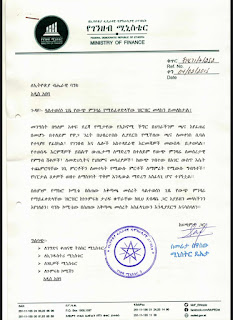
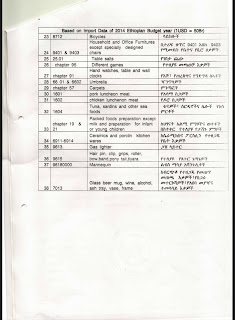
This leaves the Ministry of Finance the unenviable task of deciding the relative importance of hundreds or thousands of things, and deciding which ones should get higher priority for letters of credit, lower priority or none at all. Last October, the government decided to ban letters of credit for 38 items. 


The list includes oddly specific items like "Vimto", impossibly vague categories like "Different games", and hilarious ones like "Artificial and Human hairs" and "tiaras".  Comedy aside, some choices are really sad.  "Bicycles"! That one really broke my heart.  

Oil gets a double subsidy: first from foreign currency priority, and second from getting explicit subsidies of the price at the fuel pump.  Believe it or not, in Ethiopia which doesn't produce any oil, has a foreign currency crisis, and where less than 1% of the population has cars, the price of gasoline is half of the price in neighboring Kenya! Fuel subsidies may be one thing that is even crazier than the foreign currency nightmare, but let's leave that for another post.

Meanwhile, businesses are suffocating because they can't get foreign currency. If you make electrical equipment, you can't get the dollars to import copper, so you stop and wait. If you are constructing a building, you can't get dollars to buy steel, so you stop. Over 200 business ceased operations because of lack of foreign currencies. Manufacturers are getting less than 15% of the foreign currency they need for raw materials, according to the Ministry of Finance. A common sight around Addis Abeba is unfinished buildings, sitting half-built for months or years, a constant demonstration of wasted land, wasted capital, lost opportunities. If you talk to anybody in manufacturing, you will be overwhelmed with stories of dying companies.  Companies fail all the time of course, that's the nature of business. But the heartbreaking thing is they are not failing for business reasons. Imagine you  have the right idea, you invest lots of money, hire the right employees, make the right product, find the right customers.  You are willing to pay for inputs at market value, but, understandably, you don't want to go to the black market.  So you just sit and wait for permission to buy your inputs. And eventually close up shop. That is the tragic fate of many many businesses that could help the livelihood of  millions, dying because of this foreign currency policy.

Perhaps the starkest illustration of the failure of this central planning approach to prioritization is: "Lack of forex to import fertilizer threatens agricultural output". Nothing is more important than agricultural production, and the government understands that. So they planned ahead and allocated $1B for fertilizer,  much more than last year. But due to global market changes, the need is $1.2B. So here we are with a shortage of fertilizer.  

In short what we have is the classic "economic calculation problem" which forever plagues central planning. The problem is not that the planners have bad intentions, nor that they are not smart enough, nor that they don't have the right data, nor that they need more powerful computers. It's more fundamental. In a large economy, the full information to make the optimal allocations simply does not exist in one place at one time no matter how much you try. You cannot sit at a desk and decide for 100M people whether steel is more or less important than copper, or whether aspirin is more important than fertilizer. The information is distributed in the subjective values and decisions of thousands of different actors, and when they act locally on their specific problems, their collective intelligence is much greater than even the best possible central planner.

Inefficiency of indirect subsidies

Further, even if we assume the priorities are perfectly correct and everyone agrees, there is another basic problem. Who pays for them? The cost is of course being born by the sellers we identified above: exporters, people receiving remittances, etc. And the benefit goes to specific imports. Which raises the question: why should coffee exporters or remittances carry the cost of gasoline for car owners? Why shouldn't plumbers, teff farmers or real estate businesses share the burden? A society may decide the rich should subsidize the poor, or some things should have punitive taxes, etc. But implicitly making one sector pay for another specific sector is unfair and inefficient, and leads to many unintended consequences. If the society wants something to be subsidized, then it's better for the government to spend money directly on that thing, using money that it collects through normal explicit taxes. The optimal mix of taxes (VAT, duties, income tax, etc.) is a separate debate the society can have. But whatever the specific combination of taxes, explicit taxes are better than an implicit tax via currency controls.

Corruption

Another problem is that access to foreign currency becomes an exorbitant privilege, so there's an extreme incentive for corruption. Common sense says that when there's a magic way of doubling your money, there's bound to be some cheating. The people who are most adept at playing the privilege game will get more of it, while those who are politically naive  get less. To think otherwise is to ignore human nature.  Cronyism and corruption is rewarded and productive work is penalized. This is of course extremely damaging to the economic and moral health of the society.

The grey zone

Inevitably, many of those who can't get this privilege resort to the parallel market. Indeed, the black market has become mainstream. Increasingly this is not just individuals like Abebe and Berhane in our story above, but also in business. Research shows that prices of imported commodities are tracking the parallel market rather than the peg. Banks too are flirting with the black market, by adding transaction fees as high as 60% to bridge the gap. Even parts of government are resorting to the black market. For example, earlier this year, there was a huge public bus procurement scandal. The Addis Abeba city government paid 19 million birr per bus, which according to the peg, is about $350K. Critics screamed that those same buses cost less than $150K internationally, so surely someone pocketed the difference! But an alternative explanation soon emerged: the importer had to get their foreign currency at the parallel market rate. Using that rate, and adding the cost of shipping etc., the price seems more reasonable. Should you praise the importer for creative problem-solving (after all the city does need more public buses!), or condemn them for price gouging? You decide. It is a bit like the debate about "illegal" vs "undocumented" immigrants in the US, but much worse. Exploiter and exploited start to blur into an unhappy grey zone. Huge swaths of society are operating outside the law. The hypocrisy is staggering. People will publicly defend the peg and privately use the black market. That's not only legally risky for everyone involved, it's deeply corrosive to the rule of law. Ethiopia is becoming a mafia state.

The solution

The polite economist word for this nightmare is "distortion".  And while the consequences are very wide and complicated, there is a simple and narrow solution.  The government could simply revoke the law that says Abebe, Berhane and the banks are not allowed to exchange their USD for ETB at whatever price they agree to. That's what is meant by jargon like "float" or "unification", "liberalization",  etc.  Just let the two parties agree on a price. No other laws need to change. Any product that is illegal can remain illegal. Banking licenses don't need to change. Just decriminalize voluntary price. That's it.  

And, surprise! That is actually the current Ethiopian government's position.  Don't take my word for it. It said so in 2019:  Ethiopia: Central Bank announces floating exchange rate regime. And again in 2020: Ethiopia Plans New Key Rate, Floating Currency to Boost Economy. Even now in 2023, exchange rate unification remains the goal. But the policy is "gradual", and 4 years in, the peg remains and the gap is growing. So what are we waiting for? Why don't they just waive this magic wand today? 

The reasons for this inability to execute the change fall in two categories. First, this inefficiency benefits some special interests, even if it hurts the majority. And multi-billion dollar special interests, both within and outside government, are tough get rid of. The second set of reasons is many sincere but misguided fears, both within and outside the government, of what would happen with such a change. Let's examine them.

Inflation: the map and the territory

The most common fear is: if the currency is floated, inflation will go up. But this is due to a misunderstanding. Let's say the international price of copper is $0.10 per gram. And the local competition is such that  importers can't make more than 10% profit. If copper is a priority and importers get letters of credit allowing them to buy dollars at 55 ETB/USD, they can import it for 5.50 birr and sell it to you for 6 Birr. Ok great. But if the importers can't get foreign currency, what is the price? It's as if the price is infinity. You could go bankrupt while waiting for copper to be available. Or go to jail buying it from smugglers. Now suppose the importers can get dollars at a market rate legally, they will bring it in at a cost of 10 birr and sell it for 11. The naive academic might say there is inflation because the price went up from 6 to 11.  But people in the real world realize that 11 is less than infinity! Scarcity is a form of inflation. Focusing only on official prices while ignoring scarcity is mistaking the map for the territory, or mistaking the thermometer for the temperature. 

Of course inflation is a serious problem so it's easy to fall for this fallacy. But would you trust a doctor using a broken thermometer who says: if we fix the thermometer, you will develop a fever? No, you want a practical one who sees the thermometer is broken and that you already have a fever. So while academics and commentators talk about potential inflation, people who provide real goods and services know that the inflation they fear is already happening. 

Exchange rate

A closely related concern is that if the exchange rate is floated, then the currency will rapidly lose value. There are three versions of this worry.

Some think that, by some unexplained law of nature, the black market has to remain more expensive than the official market. So if the official market is floated and ETB/USD goes from 55 to 100, then the black market price will go to 200. That is nonsense The black market responds to supply and demand. If there is a functioning legal market, then there's no reason for anyone to pay a higher price and also take the risk of doing something illegal! It's just human nature, people prefer to pay less, and people don't like going to jail.

A more sophisticated version of this worry is the following: in the black market, both supply of and demand for foreign currency are suppressed, and if you legalize free exchange, the demand might increase more than the supply so the market price will be higher.  But this is also incorrect. Usually, when there's prohibition, supply is more suppressed than demand. Or to be technical, the elasticity of supply is greater than the elasticity of demand. Without prohibition, all else being equal, the price is lower.

Another variant of the same fear is based on historical examples. In a recent discussion on this topic this example came up: once upon a time, Sudan floated their currency. At the time of the change of policy, the USD on the black market was at 550 SDP. After the float, the market price rose to 600 SDP/USD.  So proponents of currency control claim that getting rid of it caused the SDP to lose 10% of its value. But they should note that in the preceding decade, the black market price of USD had risen 5000%! The currency was losing value very fast. And floating it, if anything, slowed it down. Similarly in the case of Ethiopia, I wouldn't say that if the exchange rate is allowed to float today, the price of foreign currency will go down tomorrow! Most likely it will continue to rise but it will slow down.  Here's a picture to illustrate the point (the dots represent real values of the black market as reported in news articles over the last 5 years): 

In short, the black market price is the free market plus a risk premium. If it is decriminalized, the risk premium goes away. So the black market is an upper bound on what the natural market price would be.  

Speculative attacks

A closely related fear is that if the currency is freely exchanged, international currency traders would swoop in and wreak havoc by "speculating". It is true that financial markets can be volatile but let's put that in perspective. That volatility is much less than the brutality of the practical forex market as currently experienced by Ethiopians today. The random shocks of getting or not getting a letter of credit are much worse. You can go for arbitrary length periods with an effective price of infinity and volume of zero! 

Sure, if the currency was freely traded, the National Bank of Ethiopia (the central bank) and the Ministry of Finance may make monetary or fiscal policy errors, reserves might run low, etc. But all that would be child's play compared to the devastation the current currency regime is inflicting on the real economy.  That said, the government can and should shore up reserves. Two obvious moves: stop fuel subsidies; sell off non-strategic and poorly-performing state enterprises (of which there are many).

Sequencing reforms

A related point often made by academics and commentators is: yes the parallel market should be decriminalized, but first the economy must be strengthened, productivity must increase etc. This argument is a bit like sitting in a burning house and saying: yes the fire is bad, but first let's invest in non-flammable furniture and curtains. It's missing the burning issue. The currency not being freely exchangeable is suffocating the very things that make the economy more productive.

Upside down tiger

Another argument given against free exchange is that some countries, like the so-called Asian Tigers and China, grew their economies while controlling their currencies. The irony is that in those cases, the control consisted of under-valuing their currencies, to promote exports and investments, while suppressing imports and domestic consumption. They essentially delayed the rise in standard of living in exchange for faster industrialization. But what we have in Ethiopia is the exact opposite: the peg over-values the currency, which subsidizes selected imports, while lowering investment, domestic production and exports! You might call this the "upside down tiger" de-industrialization strategy. No country has grown out of poverty this way. 

Brace for media impact

If the peg is abandoned, we can be almost sure that a lot of the commentariat will miss these two points:

  1. they will compare the new free market price to the old peg, instead of comparing it to the old black market price, falling for the map and territory fallacy;
  2. they will comment on the increase of foreign currency exchange rate, rather than the fact that the rate of increase declines.  

Even economics professors confuse a decline in the rate of change with an actual decline in the price! So what are the chances journalists and social media activists will be rational? Low. They will probably scream bloody murder.  And governments know that. Hence the "gradual" policy. To be blunt, the political cost of doing the right thing is very high.  

Deva!uyashun!1!?

It's amazing how many people think the strength or weakness of a currency is determined by a government simply deciding on a price. And they talk about "devaluation" as if it is a matter of just typing in a larger number. Their concept is: the bad guys will force African countries to use a larger number! Oh no, devaluation! We must fight the IMF! Neocolonialism! Bla bla bla. I'm very critical of the IMF and the current international financial order, but this conception of "devaluation" is complete nonsense. But it is political dynamite and a lot of energy is spent trying to defuse it. Here's how I would respond to it. If you think "government type big number = bad", then ask yourself do you believe that "type small number= good"? If it's that easy, do you think that, tomorrow, the Ethiopian government could set the peg at 50 ETB/USD instead of 55 ETB/USD and all imports would automatically be 10% cheaper? If they peg it at 0.01 ETB/USD would imports suddenly be 5000 times cheaper, and the average Ethiopian would afford a Ferrari? Of course not.

Root cause of currency strength or weakness

From a policy making perspective, the exchange rate is an effect not a cause. It's an output signal, not an input variable. The real price (which is approximated by the black market not the peg) is a reflection of a basic reality: how many dollars are coming, and how many dollars are going out. This is called the balance of payments. The birr gets weaker if the economy is not bringing in enough dollars. Exports and foreign investments are too little compared to the consumption of imports. And this imbalance can only improve if a) the economy produces more things the rest of the world wants, and b)  the country is more attractive for investment.

Now as we saw earlier, the first order victims of the peg overvaluing ETB are exporters, investors, and remittance recipients. The gap between the market and the peg is a de facto tax on them so it directly reduces their volume. Fewer dollars come in.  At the same time, it's a de facto subsidy of specific imports, which means more dollars go out. Which makes the currency weaker. Which increases the gap. That's the death spiral of a weakening currency.  The second order victims are manufacturers and producers more generally; even if they are not exporters, they help the balance of payments by creating products that would otherwise have to be imported. Plus they are part of making the society more productive which improves chances that the society will make stuff the rest of the world wants. Thus, by choking producers, the peg further increases the imbalance, another vicious cycle.

There is no solution that doesn't include facing reality. Recognize that 55 ETB is just not worth 1 USD. The peg doesn't make the currency stronger. A broken thermometer does not cure fever! The cure starts by getting rid of the peg, which will

  1. in the short term, eliminate the risk premium, improve availability of consumer goods, eliminate an unfair de-facto tax and subsidy, reduce corruption, and stop a major cause of socio-economic rot;
  2. and in the longer term, increase exports, foreign investments, and productivity of the society, which will help fix the structural weakness of the currency.

People voluntarily exchanging things at prices they agree on is not a neo-colonial imperialist capitalist evil that needs to be forbidden. It's what humans have always done naturally everywhere, including in Ethiopia.


2022/07/27

Nile basin mechanism design

Part 1 made the case for GERD in the short and medium term. Now for the really big picture

The human population of the Nile basin will probably double in the next century. Even if the Nile's water flow increases (some climate change scenario models indicate that rainfall could actually increase in the Nile basin over the next 50-100 years), it seems inevitable that demand will grow faster. And as mentioned in part 1, 100% of the flow is already being consumed. But this doesn't have to cause conflict. Globally, 70% of water use is for agriculture. So that's where the adjustments would have to be. From a natural resource optimization point of view, just like it doesn't make sense to grow almonds in California, or cotton in Kazakhstan, growing cotton and wheat in Egypt is probably not the most efficient use of water. 

What do we mean by efficient? Imagine for a second the whole region was one country; if an allocation of water to different uses maximizes total benefit, i.e. there is no other allocation that has a larger total benefit, then that's an efficient outcome. To achieve this efficiency, obviously some water intensive agriculture should migrate to other regions. But of course, the Nile doesn't have one owner and we don't have perfect cooperation, so we can't expect individual players (a country or a farmer or a business) to sacrifice their immediate interest and give up some water use for the greater good.  Game theory teaches us that an efficient resource allocation is useless if it is not feasible. And feasible means it's an equilibrium where each party benefits more from sticking to it than from deviating unilaterally. 

What would such an equilibrium look like? It's not as simple as dividing it equally.  For example, one issue is that if two people get the same amount of water, but one of them doesn't actually need it, that's a waste, i.e. inefficient.  Even the notion of need, beyond bare survival, is subjective: you can argue about the relative merit of washing clothes, how often people should take a shower or bath etc. 

Fortunately, there is a way to turn subjective values into an objective agreement: a price. What pricing mechanism might work in this scenario? For example, in a hypothetical v2.0 of the CFA all the countries in the basin could agree on a uniform Nile water tax. Each country would be liable to pay the tax for its total usage yearly. Of course, it would be up to each government to determine how the cost is distributed in its society: as a tax explicitly passed on to water consumers, or paid by general government revenue, or something in between. Passing the cost on is not as hard as it sounds since in most places that matter (homes and factories with running water, and farms with irrigation) water usage can easily be metered or is already. And non-consumptive uses like electricity generation would naturally be neutral. 

To keep each other honest, the countries could easily agree on verifiable data sources. Egypt doesn't have to trust the metering in Ethiopia and vice versa, they could rely on aggregate measurements of the water balance, a lot of which can be done using currently existing satellite data that is freely available from neutral sources.

The revenue from this would be collected in a common fund and automatically redistributed to member countries in pre-set proportions. The proportions are negotiated in advanced and fixed, and of course that would be the hardest part of the whole deal. One basis for this negotiation could be a share proportional to the present fraction of the total Nile basin population in that country (not the total population, obviously as countries have different fractions of territory and population falling within the basin).  

Naturally the price would have to be adjustable, say yearly, with a protocol agreed to in advance, so it regulates annual usage at sustainable levels i.e. below 100% of flow volume with a safety margin. If total usage is too high, the price goes up. If a lot of water goes unused, the price goes down. And if the total usage stays well below the sustainability level for a long time, the price would keep going down all the way to zero. This too is not as difficult as it may seem, it's basically the same idea as a carbon tax to fight climate change but much easier: the set of players that need to agree is much smaller (it's "only" 10 countries not 200), the consequences of water are immediately felt by all participants every year (unlike climate change which plays out over longer periods), and the target quantity is much easier to compute (total flow is well known, unlike the effect of different levels of greenhouse gases in the atmosphere which requires complex models with lots of uncertainty). (As an aside, the carbon tax itself is much better than cap and trade or carbon offsets, as I wrote on this blog a long time ago). With a pricing mechanism like that, no need for arguments about cotton in Egypt or irrigation in Ethiopia. Instead we would see a graceful phasing out of sub-optimal uses of water, and maximize the benefit of this shared resource. 

Finally to further solidify the positive economics and minimize the negative politics of the system, the countries should facilitate investments and trade across the region. If for example investors from each basin country were free to invest in other basin countries in farming and industry while still supplying the outputs to their domestic market, there would be less political friction around the natural geographic distribution of agriculture and industrial production. 

There are many examples of more complex cooperative agreements between countries around the world today, so it doesn't seem infeasible for the Nile basin countries to reach this kind of equilibrium. And recall we have plenty of time to achieve this long term goal, as the short term issue of GERD itself is win-win as discussed in part 1. But the chances of achieving this outcome will be greatly enhanced if in the meantime, the region's economies grow and become better diversified  across farming, industry and services.  Which brings us back to the present. Electrification is the sine qua non of developing a diversified economy. And GERD is a big step in the right direction, one which is immediately beneficial to not just Ethiopia but also Sudan and Egypt. 

2022/07/25

The case for GERD

As the third filling of the Grand Ethiopian Renaissance Dam (GERD) goes ahead, we should expect what is now becoming an annual uptick in media coverage and geopolitical controversy.  I've been thinking of writing a version of this blog post ever since the project started more than 10 years ago, but always ended up assuming this is adequately covered elsewhere. Years later, I'm still surprised by the frequency of incorrect assumptions dominating the discussion.  Not just in the media, but also in countless conversations. So it sounds like there might be some value in exposing the basic facts.

Power

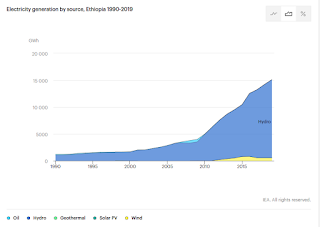
GERD will have the capacity to generate 6GW of power at peak. However, due to seasonal variations, the average is expected to be about 40% of the peak. So on average, it should generate about 80 million GJ or 20 billion kWh of energy per year. Electricity production in 2019 was about 15 billion kWh, so GERD will more than double the  country's capacity. 
Electricity generation by source, Ethiopia 1990-2019


Economic impact

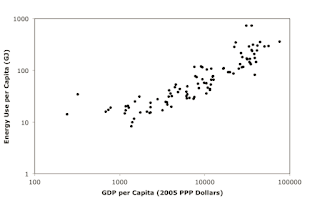
What is the economic value of this additional energy? Note that we are not asking what is the cost to produce it, nor the price at which it is sold. We are asking what is the economic value of consumer and industrial uses that it enables.  One way to estimate that is to look at the relationship between energy and GDP.  From a widely cited paper, "Energy and Economic Growth: The Stylized Facts",  we can deduce that each Gigajoule of energy corresponds to about $100 of GDP:  
Double checking with another source, "Our World in Data", gives us about $0.40 of GDP for every kWH.  This data has the added benefit that it shows a similar relationship, not just across countries but also on the same country over time: 


The two datasets are in almost perfect agreement. And they imply GERD's impact will be about $8B/year, or an increase of about 7% of GDP.[1] 

Considering the cost of the dam is about $5B, a return of $8B per year is great. Of course it will take a couple of more years for it to reach it's maximum generation capacity,  many years to develop the transmission and distribution of all this additional power to 100M consumers, and even more years for industries to grow that will take advantage of it. So the full impact is still far down the road, and depends on quite a few things happening correctly (not the least of which is finding ways to sell the "stranded" generated energy to finance the development of the distribution infrastructure, a topic which I will expand upon in the future). Still, the long term benefit is so large that there is no question the dam is a phenomenally good investment by Ethiopia.

You can also view it with a "social impact" lens if you are so inclined. Can you think of many projects where a one-time investment generates 160% return per year for many many years, increasing income by 7% for more than 100M people, most of whom are among the poorest in the world? Indeed GERD is possibly the biggest and perhaps most effective poverty reduction effort in the entire world today.


Climate impact

Of course, hydroelectric power is 100% renewable, and outside of the materials used in construction, the on-going operations have zero greenhouse gas emissions. Less obvious but also important is the fact that this electricity will displace current sources of energy which are dirtier. For example, millions of people in Ethiopia today often cook with wood charcoal, which from an emissions perspective, is worse than oil, let alone gas, or clean electricity. The amount is tiny on the scale of global emissions and climate change, but still moving from burning wood to electricity is a positive transition from dirty energy to clean energy. Further, the wood comes from cutting trees. Thus, electrification helps combat deforestation, and trees take CO2 out of the atmosphere through photosynthesis. For a good discussion on the relationship between electrification, deforestation and climate, I recommend the book "Apocalypse Never",  which explains this same point in detail using an example from the Democratic Republic of Congo. (As an aside, I also recommend my  review of that book on this blog).  So GERD not only does not emit, it reduces other carbon emissions, and saves trees which take carbon out of the atmosphere, a triple win in terms of reducing anthropogenic climate change. 


Water balance

Increased rainfall?

An additional argument, articulated by Ugandan president Museveni in this video, is that saving trees helps rainfall, which is a positive for total water balance of the overall Nile basin (water balance is a crucial point of contention as we shall see below).  
   
This particular argument is debatable since forests increase rainfall but trees also consume water. Here's a good paper on the links between forest cover and rainfall.  So it's probably a stretch to argue that water balance will increase. But hey, trees do enough for us even if they are neutral in the water balance equation. The overwhelming consensus is that preserving forests as much as possible is good, and electrification happens to help that.

No reduction in flow

The bigger question regarding water balance is of course whether the dam itself will reduce water availability downstream. This is where there is the biggest misunderstanding. Egyptians are extremely fearful that the dam will reduce the flow of the Nile, and they view it as an existential threat. But the reality is that the GERD will not reduce the amount of water that gets to Sudan and Egypt:
  1. Electricity generation doesn't consume water. As water, pulled by gravity, flows through turbines, the kinetic energy of the water becomes electric energy, and all the water comes out on the other side and flows downhill from there as always. 
  2. When there is loss of water from a dam, it is because it has a reservoir, a lake. The larger the area of the lake, the larger the loss due to evaporation. Indeed at the High Aswan Dam in Egypt, located more than a thousand kilometers downstream from the GERD in a flatter and hotter area, the reservoir (Lake Nasser) is large and shallow, causing a significant loss of water to evaporation. The GERD however is situated in a gorge, so the lake it creates is much narrower and deeper (about 1,900 km2 for GERD vs 5,250 km2 for Lake Nasser). It's also in a cooler area. Thus the evaporation impact of GERD is much less than Aswan's. Further, the purpose of the reservoir is to regulate the flow, like a battery. In theory, if you have a reservoir upstream, you can reduce the size of a reservoir downstream. So if we naively forget political boundaries for a second, and assume Egypt, Sudan and Ethiopia were 100% cooperative, to manage the total flow optimally, they would achieve the same magnitude of regulation by reducing the volume of Lake Nasser by the volume of GERD lake. Since GERD has relatively lower evaporation, this would be a net reduction in evaporation. But to keep things in perspective, evaporation accounts for less than 2 billion out of about 90 billion m3 /year of water flow on the Nile, so it's a minor issue.
  3. A much larger fear for downstream people is that the GERD might enable additional consumptive uses, like irrigation for agriculture. This is a legitimate general concern of course, and fairness and efficiency in consumptive uses is important. However, in the case of the GERD, its location at the most downstream point in Ethiopia, near the point where the river exits to Sudan, means that it would be infeasible to use any of the water from that point for agriculture, as you would have to pump it uphill to reach farms within Ethiopia. This effectively guarantees that GERD cannot physically be used for irrigation or any consumptive activity in Ethiopia.  
For more on this, see the seminar on 'The economic impacts of large dams: a comparative analysis of the Nile and Colorado Rivers' . In particular the evaporation question and non-consumptive nature of GERD are addressed at 1:09:23 in the video. 

Bottom line: GERD will not decrease the net amount of water that reaches Egypt and Sudan. Regardless of what you think about the historical sharing of water, the fear that it can harm downstream people is just not supported by facts.


Floods and drought mitigation

In fact it's actually beneficial to them. As I tweeted some time ago, this excellent paper entitled 'Understanding and managing new risks on the Nile with the Grand Ethiopian Renaissance Dam' explains it:
  1. "Sudan will clearly be better off ... because GERD operations will smooth Blue Nile flows, eliminating flood losses, increasing hydropower generation, decreasing sediment load to the reservoirs and canals, and, most importantly, increasing water for summer irrigation in the Gezira Scheme and other irrigated areas along the Blue Nile".  To get a sense of the magnitude of this benefit, consider that flooding in 2020 caused over 100,000 homes to collapse and Sudan to declare a 3-month state of emergency.
  2. During droughts, it is expected that the existence of the GERD will cause "decreased water deficits to Egypt and increased water availability". 
It is also extremely important to note that, as the paper explains, these benefits to Egypt and Sudan do not depend on generosity and goodwill from Ethiopia. Keeping the flow steady by boosting it during droughts and throttling it during floods is also necessary from the self-interested electricity generating perspective of GERD, so it's a win-win-win proposition even without explicit cooperation.  In other words, long term incentives are aligned between Ethiopia, Sudan and Egypt, which should offer the strongest reassurance to back whatever political understanding is (hopefully) reached.


Filling

Now besides the long-term incentives, there is a separate question of what happens during the initial filling of the GERD reservoir, which started in 2020 and is expected to last 4 to 7 years. Filling the reservoir obviously must temporarily decrease the downstream flow. But here two facts should be understood. First, filling takes place in the rainy season (July and August) each year, where typically there is "too much" flow, so there should be no detrimental effect downstream.  Second, by chance, the first and second fillings took place during above average rainfall years 2020 and 2021. It's almost as if nature decided to be pro-GERD at this most critical time!
It's possible that the filling has already helped reduce the severity of floods in Sudan, although that effect may be limited by the fact that filling stopped as scheduled halfway through the rainy season (the Sudanese irrigation minister even complained that the filling didn't go fast enough to help).


Geopolitics

That is not to say Egypt and Sudan don't have any legitimate concerns. Future upstream uses of the Nile water could reduce their supply. The total water flow, while abundant, is currently almost 100% consumed: no Nile water actually reaches the Mediterranean Sea, except what's needed to push back salinity. So, even though GERD itself is a win-win-win,  in the bigger picture, the Nile water use is a zero sum game.  Currently, Egypt consumes 79%, Sudan 18%, and the rest of the countries combined less than 3%.

But there is international law and precedent on how to share rivers between multiple countries. The right way to deal with this case is the Nile Basin Initiative's Cooperative Framework Agreement  (CFA) which should be able to handle the issues of the next few decades at least. Uganda, Ethiopia,  Rwanda, Tanzania, Kenya, Burundi and South Sudan are on board. Sudan and Egypt initially joined, then "froze" their participation, but from what I gathered at the aforementioned seminar, Sudan has recently rejoined.  

The main problem is the recalcitrance of the Egyptian government. Given that their country consumes 79% of the Nile's water, perhaps they feel that acceptance of any upstream change jeopardizes this entitlement. The military government of Egypt has taken a hard line and it seems like they fear any compromise abroad might weaken their political power at home. This political trap has far reaching consequences for the region's stability and peace. Very unfortunate. Let's hope reason beats politics for once and things work out rationally, since GERD itself is actually beneficial to Egypt. 

Part 2 of this post explores the longer term sharing of the Nile beyond GERD.

P.S. This post is dedicated to my dear friend Ahmed Amr. A brilliant and hyper-informed Egyptian who during a conversation last year, was surprised by some of these technical facts.  Sadly Ahmed passed away from a long illness a few months ago. Ahmed, wherever you are, I hope you enjoy this post and I look forward to chatting with you again in the afterlife!

[1]Another way of getting economic impact is to multiply production by average price to get the direct value of the energy, and then apply a GDP "multiplier" which estimates the downstream GDP impact (electricity enables goods and services, which in turn enable other goods and services etc.) The problem as you can imagine is that multipliers are very inexact. In a tweet on this topic a couple of years ago, I used the a multiplier of 1.6 which I now realize is too low. I also incorrectly used peak power instead of average. Coincidentally the two inaccuracies cancelled out and the GDP estimate was about the same.