2010/05/22

La cigale et la fourmi: CNY/USD revisited

Time to revisit the "Yin and yang of the greenback" theory.  The theory, regarding the relative value of Chinese and US currencies, is basically "La cigale et la fourmi", not as a moral story but as basic economics. China, the ant  in our parable, has spent the last 25 years working hard and, thanks to government policies that amount to forced savings, not consuming that much.  Meanwhile, the US, the cricket, has spent the last 25 years living off  its charm and beauty as the most advanced economy in the world. Its currency's status as world reserve currency gives it a free lunch in terms of being able to borrow.

At some point, the ant will be tempted  to start "cashing in", converting all that past hard work into a higher standard of living.  How? Well there are several ways the government can convert those savings it has accumulated in USD into benefits for consumers. It could subsidize imported goods like fuel for example. Or more generally, it could let the exchange rate of CNY/USD rise, which would make all foreign goods cheaper in China.  So that's the fundamental thesis, which is not at all an original point of view.  The question was (and still is) when will this play out?

The financial crisis of 2008 looked to me like it was going to be the perfect opportunity for them.  Because it added a couple of other factors (increased US deficit, and the rich world's reduced ability to import from China due to a recession) that added more pressure for the Chinese currency to rise. As it turned out,  rather than shift gears into the next phase of development, one with less reliance on exports and  increased domestic consumption, they decided to stay in the same gear and press on the accelerator instead: they maintained the exchange rate quasi-frozen and stimulated exports even more.  So the big jump in CNY/USD has been postponed.

But will it occur? I still think so. The reserves are still accumulating. Here's the picture I cited last time, Foreign Holdings of U.S. Securities


Country or category
Total
Equities
Long-term debt
Short-term
ABS
Other
debt
1
Japan
1,197
220
133
768
76
2
China (Mainland)1
922
29
217
653
23
3
United Kingdom
921
421
160
316
24
4
Cayman Islands
740
279
236
186
38
5
Luxembourg
703
235
104
320
44

And here is what we have two years later, in the latest report just released last month:


Country or category
Total
Equities
          Long-term debt
Short-term


ABS
Other
debt

1
China (Mainland)1
1,464
78
360
866
160

2
Japan
1,269
182
136
883
69

3
United Kingdom
788
279
64
422
23

4
Cayman Islands
650
227
140
210
73

5
Luxembourg
578
137
49
312
80


Even more of the same! The pressure keeps building....

Moreover, the rumours are that China might have stimulated itself into a bubble of it's own. How does that affect our theory? You face a bubble, and you had a pile of foreign reserves.... Well that's like being in the kitchen with toast almost burning and a huge reserve of nutella. Pop the toaster and enjoy the sandwich, China!

Update: Note that in the above tables, the amount of Chinese holdings of US securities increased a lot both in absolute and relative terms. Also, I should point out one more argument in the same direction: that western policy makers are increasingly calling on China to strengthen CNY.

2010/05/09

Airline fees and the unbelievable worthlessness of CNN


Earlier this week I stumbled upon a mini-editorial on CNN, wherein the anchor "Campbell" (not sure if it's his first or last name, I think they try to market them like that) went off on the topic of the airline industry charging extra fees. That is, charges that are not part of the ticket price, like the fees for luggage, or food, extra leg room etc. He was all up in arms because new data showed it was EIGHT BILLION dollars last year. He said that airlines are profiting from your discomfort, his face running the gamut of expressions from mocking to outraged. Basically he painted a picture of an industry conspiring to deceptively price gouge.

But here's the thing. In the entire piece, he failed to mention a) whether overall cost of air travel has gone up or down; b) whether the airline industry as a whole was profitable or not. Without those two additional data points, his conclusions are entirely unsupported!

What is definitely happening is a shift to more granular pricing. For example, let's say 50% of travelers have luggage and 50% don't. Say previously everyone paid $400 for a ticket and now it's $350 for the seat + $100 for luggage. Why is that bad? You can argue that it it's annoying to have the cost broken down in pieces, or you can argue that it's great to have more flexibility. I, for one, am very happy to trade a luggage quota I don't use for more leg room! Whatever your opinion, in our example, since the average cost is still $400, you can't say that they are "profiting at your expense". Yet that's exactly what CNN did, without presenting any evidence that the total cost is higher! As a matter of fact, the cost of air travel has been going down for decades and as far as I can tell that trend hasn't reversed recently.

Second, is there price gouging, i.e. excessive profits due to collusion in the industry?Actually, the airline industry "as a whole has made a cumulative loss during its 100-year history". So while it's possible for price gouging to exist in on routes without competition, it's impossible that it is occurring on the industry as a whole. Yet that is what CNN is claiming without any qualifiers.

Wow! You couldn't design a more logically flawed editorial if you tried.

This would be a perfect opportunity for a warning against Gell-Man amnesia, if I didn't already believe that CNN is completely worthless. The only time I see it is accidentally while looking for sports.

Update: many years after I originally wrote this post, I learned the CNN guy's name is Don Lemon. He became famous, but unfortunately his journalism never improved. This little episode from 2010 was predictor of what was to come.

2010/04/02

2010/03/31

Known unknowns and unknown unknowns


A lot of people made fun of poor Donald Rumsfeld for his infamous quote..

"Reports that say that something hasn't happened are always interesting to me, because as we know, there are known knowns; there are things we know we know. We also know there are known unknowns; that is to say we know there are some things we do not know. But there are also unknown unknowns -- the ones we don't know we don't know."

But actually, he had a very good point. There are things that have uncertainty but we know the shape of the uncertainty. For example, I don't know who will the lottery tomorrow, but we do know the probability of any one person winning, or the distribution of winning amounts. And by the way from that we do know that playing the lottery is one of the dumbest activities known to man, though it is a kind of stupidity that we can harness for good perhaps... but I digress. My point is the outcome of the lottery is a known unknown. Which is different type of ignorance than say, not knowing if God exists. There you don't even have a probability space to support a distribution. Once someone asked to me: What's the probability that God exists? Obviously it was a rhetorical question, and it assumed the answer is "very low" (the question came from an atheist). But then I was like: it could be 0.01% or 99.99% or anything. If you have to choose, it might as well be 42.

2010/03/20

Zen for my domain

After procrastinating about it for years I've finally switched this blog to be on my personal domain name (in case you're curious, here's how).. so adios nemozen.blogspot.com and hello nemozen.semret.org!
How long did I procrastinate? Suffice it to say, I've had that domain name since before blogger/blogspot or even the term "blogging" existed... Now maybe in another 3-4 years I will customize the templates! In the meantime, I hope this doesn't break the feedopology.

2009/11/08

Design bugs in everyday life

A long time ago, I think it was in the book "Information Rules", I read a great example of a pure inefficiency, a problem where everyone involved is worse off than they could be under a simple alternative scenario. At a deli or coffee shop, where coffee is served in disposable cups, it's better if the covers are the same size for different size cups (i.e. the circumference of the top of the cups is the same whether the cup is small, medium or large). Otherwise, people will waste time because they picked the wrong size cover and have to pick again, others will also waste time as they wait for them to get out of the way, some lids get wasted, the counter gets messier, etc. Many small problems arise from having different size lids.

It's a striking example because the difference between the right and wrong solution is so trivial. It's a design error, and if you realize it early on, the fix is virtually free but later it's very costly. Nothing new in that, that's exactly the nature of software bugs and it's not surprising that similar "bugs" exist elsewhere. But what really fascinated me in this example is that the bug, doesn't get fixed even in subsequent versions! You still have many coffee places that have different size cup covers, for decades, for no good reason.What a fascinating bug! It should have been crushed years ago and yet it continues to hang around generation after generation.

Since then, I've noticed other examples of design bugs in every day life that are surprisingly resilient. Some, like the one above, probably survive because the inefficiency occurs in such tiny increments, we don't appreciate the cumulative cost. Others survive because all they need is one chance to get into the system and then they are locked in forever. Here are a few random ones that I can think of right now:
  • Typographical Fonts where l (lower case L) and I (capital i) are hard to distinguish.... It seems like if you are designing a font, making letters distinct would be one of your first requirements, so how do these fonts survive, and even thrive? Imagine all the damage that has been done throughout history because someone misread a "l" as an "I"... it's hard to estimate but it must be huge. Maybe it caused a shipwreck at some point!
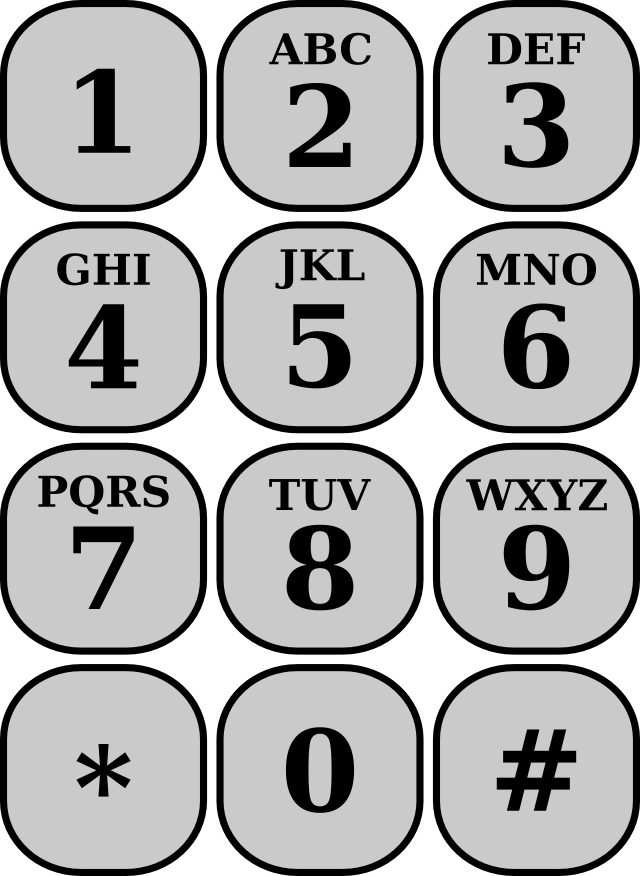
  • Alphanumeric key mapping on phones: a neat old idea which allows you to make memorable words out of phone numbers, like 1-800-FLOWERS. But let's look at that mapping on our phones We have 2: ABC, 3: DEF, 4: GHI, 5:JKL, 6: MNO, 7 : PQRS, 8:TUV, 9 : WXYZ , and 1 and 0 have no letters. This leaves a small doubt in a some cases: when you see O is it really an O which makes it a 6 or is it a zero? Similarly if I see a I, I'm not sure if I should dial a 4 or a 1. That's a bug in the design. The fix would obviously have been to assign I to 1 and O to 0, and then assign all the others alphabetically 4: GHJ, 5: KLM, 6: NPQ, .... with a nice side effect that now all the keys would have three letters on them (instead of two of them having 4 letters, or omitting Q and Z like they did in some old phones). Again a trivial fix but the design bug got locked-in, became the standard, and now it will never be fixed. Imagine.... maybe some lives were lost because someone wasted precious seconds by dialing a 4 instead of a 1!
  • Bank ATMs that give the cash before returning the card; it seems obvious that will cause a lot of people to leave their card behind which in turn is a huge cost for the bank and the customer! The fix is to design the machines to always return the card first and then proceed with the withdrawal or deposit. Fortunately this last bug seems more prevalent among older machines than newer ones, which hopefully means it's on it's way to extinction...

2009/10/29

On Optics (channeling Safire)

William Safire recently died. Even though I disagreed with most of his political opinions, I loved and will miss his columns, especially "On Language". So I want to note his passing here, with my own little post on language. Now of course I don't aspire to be as entertaining or educational as him... so I'll just rant about something I find annoying.

Politicians and journalists in the US have started using the word "optics" when they mean "perception" or "appearance" . E.g. instead of "this looks bad" they say "the optics of this are not good"..... urgh! Extremely annoying fad! Here are two quick examples I just found using my favorite search engine. The first one is from a politician in 2008:

Rep. Steve King, R-Iowa [...] said that terrorists would dance in the streets if Sen. Barack Obama, D-Illinois, is elected president [...] because Obama's middle name is "Hussein," his father's Muslim roots, and his appearance -- or "optics," as King put it. "I'll just say this that when you think about the optics of a Barack Obama potentially getting elected President of the United States -- and I mean, what does this look like to the rest of the world? What does it look like to the world of Islam? "

Well Mr. Congressman, the optics of this are that you are a pretentious buffoon who thinks that borrowing scientific sounding words makes you look smart. (Oh and it seems you are also a bigot... but that's off-topic here.) The second one is a more recent example from an actual writer this time:

"In response to the leak, the White House kicks into high damage-control mode [...], but even here shows some clumsiness, at least regarding civil-military optics: the 25 hours for the Olympics vs. 25 minutes for McChrystal optic..."

The "McChrystal optic"? To me those two words invoke a beam of light going through a solid material whose constituent atoms are arranged an orderly repeating pattern. Which of course has nothing to do with what (I think) the writer meant to communicate -- something about Gen. McChrystal and perceptions. The faddish metaphor failed, the sentence is ugly and borderline incomprehensible. Way to go, Mr. Professional Writer.

I think this usage of "optics" right now, in 2009, is just at the point where it's perfect indicator of a certain kind of pomposity. Normal people haven't started using it (and hopefully never will), but it seems to be trendy with hacks who either can't come up with better metaphors or fear that simple words would expose their paucity of meaning. Am I being to harsh ? OK, let's give that last writer the benefit of the doubt, and see what else he's written... in an even more recent post, the following:

"President Obama and his advisors seem to be wrestling with this fundamental issue in Afghanistan and the optics and the body language...."

Bingo! Optics and body language.... just horrible isn't it?

It's not that I am just a cranky conservative when it comes to language -- far from it, I love its constant evolution -- slang, jargon, lingo.. it's all great! But that doesn't mean that all neologisms are good. It doesn't mean that "any struggle against the abuse of language is a sentimental archaism, like preferring candles to electric light or hansom cabs to aeroplanes", to quote George Orwell. For a new word, usage, phrase, or expression to work, for it to be cool, in any language "what is above all needed is to let the meaning choose the word, and not the other way around."

R.I.P. William Safire
.

2009/08/16

Do you feel lucky... punk?

Here are two reasons why humanity might soon go extinct, and why it wouldn't be such a big loss. As you can see, I am in a cheerful mood today. 

Big rock from outer space 

Last year, using the example of the asteroid Apophis that might destroy the world in 27 years, I made the point that human beings are sometimes astonishingly stupid when it comes to making decisions that involve low probability events. If we were rational mathematical creatures, humanity as a whole should be willing to spend billions of dollars to insure against that 0.0023% chance that we will all be wiped out. If you don't like my argument based on the present value of future GDP, here's another way of arriving at the same point. If you are willing to spend a trillion dollars say on nuclear weapons to defend against other humans, and say there's a 1 in 50 chance that you actually need them, logically, you should be willing to spend a billion dollars on threats that have a 1/50,000 chance of happening. (I am using conservative orders of magnitude here, obviously a nuclear war has less than 1/50 chance of happening, so that makes my point even stronger). Today, in this article from Ars Technica, I found out just how stupid we are.
Congress awarded NASA a $1.6 million grant in 1999 to put towards the NEO discovery program. Unfortunately, this was the only funding Congress gave to NASA to pursue this goal.
Yup, the US government allocated $1.6 million dollars to save all of human life from extinction... Total! And just in case you are inclined to blame "the Americans" for being so short sighted, consider that all the other countries in the world are allocating.. ZERO! (Ok maybe they have a couple of telescopes pointing at the sky but we need giant laser beams or something...) At this point, I am almost rooting for the asteroid to kick human ass. We deserve it. 

Small germs from inner space 

And of course, a big stone falling from the sky is not the only threat we face. Tiny germs are threatening us too. Let's take the H1N1 virus -- the swine flu of recent fame. You'd think that at least when it comes to human health, humanity can be rational, right? Not so quick. Let's see how are favorite mammal is dealing with this problem. Consider the following article from the Guardian (great newspaper btw): "Experts warned dispersal of Tamiflu would do more harm than good" about the debate on anti-virus treatments for H1N1. Here's the scientific view, summarized by one expert quoted in the article:
"Some people wanted to take a long-term view of the risk of resistance developing and to seek to preserve the effectiveness of antivirals for the next pandemic, which may be more severe."
"If you get a resistant strain that becomes dominant in the autumn, Tamiflu will then be useless."
And here's another scientist:
"I am concerned about the vast amount of Tamiflu that is going out almost unregulated," he told the Guardian. "We are increasing the possibility that the flu will become resistant sooner or later. At the moment there is no desperate need for Tamiflu. We should be reconsidering its issue, rather than encouraging its use. "I think we should stop the national pandemic flu service. It was put there for an outbreak of far higher mortality than we have. If you get a resistant strain that becomes dominant in the autumn, Tamiflu will then be useless."
Ok, thank God for all these smart scientists who have thought it through! The politicians should logically follow their advice right? Well actually
"It was felt ... it would simply be unacceptable to the UK population to tell them we had a huge stockpile of drugs but they were not going to be made available"
So they just decided to go ahead and do the wrong thing! It's like a parent saying: "If I told my 5 year old not to play with this loaded gun, he would have been upset, so I decided to let him play with it." Mind you we're not talking about some distant threat here. The next mutation of the virus could be this autumn. Granted there's a low probability that it will mutate into a real killer, but that's my whole point. It's a low probability but high impact threat. And faced with that, the British government is willingly increasing the probability of a pandemic that could kill hundreds of millions of people, because they are afraid of being unpopular for the next two months! Seriously! If this was a movie, whose side would you be on? I would be like: Humans suck! Go H1, Go N1, it's your birthday! 

No rare events in the savanna 

None of this is original of course. Evolutionary biologists will say it's because our brain evolved in an environment where we just never had to consider small probabilities. We have no problem dealing with quantities like "if I go left, I get 1 potato, if I turn right I get 12 eggs"... Our brain can compute those things even as a toddler. But things like "1 in 50,000 chance" just don't compute in ye olde wetware. It's only after years of formal schooling, e.g. by the high-school level, that we start to get intuition on really small numbers. Because until the modern age, we didn't need to! Sure there were rare things like being hit by lightning, or having an earthquake, but since there wasn't anything we could do about them, there was no evolutionary advantage to actually being able to reason logically about really small probabilities. Good old superstition would work just as well. You could say "I got hit by lightning because Zeus is angry at me because I didn't offer animal sacrifice". If you are a hunter gatherer living in the bush, that explanation is practically speaking, just as good as the scientific one. But now, by our own hands, we have a world where we do need to reason about small probabilities... Problem is, the brain hasn't caught up! Global warming is another example. Twenty years ago, it was a low probability but high impact threat, just like our two examples above. Scientists were running around screaming "There's a 1 in 100 chance that the polar ice caps will melt! That's huge!" But humanity just couldn't deal with it. People were like: "One in a hundred chance of extincttion? Pffft. I'm feeling lucky. Let me go buy a lottery ticket." 
   
Well now global warming is in the same range of probability as 1 potato and 12 eggs, so people are dealing with it, but it may be too late. Is this the end-game of evolution? Is this what the epitaph will say:
Here lies humanity. They became really good at reproduction -- 6 billion individuals! But not quite good enough at probability.
Maybe it's all part of a master plan. A conspiracy! Apophis contains some organic molecules which are distant relatives of the H1N1 virus. Together the asteroid and the swine flu are collaborating to take us out, and recolonize the planet with a new dominant species that they like better. After all, that could be how we got here too!

2009/08/13

Gell-Mann Amnesia

Last November, I came across this piece by Michael Crichton. I found the following bit brilliant:
Media carries with it a credibility that is totally undeserved. You have all experienced this, in what I call the Murray Gell-Mann Amnesia effect. (I call it by this name because I once discussed it with Murray Gell-Mann, and by dropping a famous name I imply greater importance to myself, and to the effect, than it would otherwise have.)

Briefly stated, the Gell-Mann Amnesia effect works as follows. You open the newspaper to an article on some subject you know well. In Murray's case, physics. In mine, show business. You read the article and see the journalist has absolutely no understanding of either the facts or the issues. Often, the article is so wrong it actually presents the story backward-reversing cause and effect. I call these the "wet streets cause rain" stories. Paper's full of them.

In any case, you read with exasperation or amusement the multiple errors in a story-and then turn the page to national or international affairs, and read with renewed interest as if the rest of the newspaper was somehow more accurate about far-off Palestine than it was about the story you just read. You turn the page, and forget what you know.

That is the Gell-Mann Amnesia effect. I'd point out it does not operate in other arenas of life. In ordinary life, if somebody consistently exaggerates or lies to you, you soon discount everything they say. In court, there is the legal doctrine of falsus in uno, falsus in omnibus, which means untruthful in one part, untruthful in all.
But when it comes to the media, we believe against evidence that it is probably worth our time to read other parts of the paper. When, in fact, it almost certainly isn't. The only possible explanation for our behavior is amnesia.
Brilliant! It reminds me of my rants about the NY Times. Yet I still buy it most days.... Amnesia.

Note: when I wrote that post, in November 2007, the Times' newsstand price had just increased from $1 to $1.25. Now it's $2. 100% increase in less than two years!

2009/08/11

Mark Cuban's advice to Myspace

I made what turned out to be a rather lengthy comment on the latest post at blogmaverick.com wherein Mark Cuban gives advice to Rupert Murdoch. A quick survey of my readers (hey me!) indicated that close to 100% would like to have that insightful comment right here on their favorite blog. Hence this post.

The first part of Cuban's advice is kind of crazy. He wants news sites to block incoming links from aggregators. Block links! That's a surprising level of cluelessness from our good friend, who is getting all the flack he deserves for that idea from other people so I won't add to it.

The more interesting part of the post is on Myspace's potential future business model... I really think he's on to something. Here's what I had to say about it (Since Wave is not integrated with Blogger yet, I can only cut & paste):

Excellent advice for Myspace, Mark! I think being a music platform is the best business plan for them. They have the audience with the right demographics, and the artists. For now… But they can’t pull it off with the website they have today. So the big question is, do they have the technical capability to support that business plan?

It would take a significant breakthrough, a next generation web application. It would have streaming, download and playback, syncing with devices, all better or at least as good as todays iTunes client/server combo. It would also have to be a great authoring/publication tool for artists to easily create a good looking online presence, perhaps even some actual post-production music features to create special samples and mixes…

In short, they need a site that is as different from today’s Myspace pages as, let’s say, Gmail in 2009 is different from Hotmail of 1999. The ingredients are available and ripe: after years of stagnation, browsers and web languages are in a period of intense innovation. But can Myspace pull them together to create a cool and, as Steve Jobs would say, “insanely great” technology for the new web-based music universe? I doubt it. I just don’t see any evidence whatsoever, at Myspace or anywhere else at News corp, of the level of technical depth required to lead the world into this new — dare I say it? — “web 3.0″ music world. Still, you are right IMHO, it’s their best bet and they should at least try rather than wither away.