- Security clearance. Each piece of equipment goes through lengthy "pre-import" approval and post-arrival "import release" approval processes. But everyone involved knows that computer hardware doesn't pose any cyber-security threat. Cyber threats are generally software and network based. In fact it's difficult to think of a single example in the world of a national security problem which can be solved by controlling which computers are allowed into the country. To be blunt, it is a gigantic waste of time. The national security interest should be focused on the energy security of the country. Is the power company planning the supply and demand correctly? The current approach makes no more sense that limiting the number of light bulbs that enter the country.
- Import duty and investment incentives. Capital investments are charged lower import duties. This is an understandable objective. However, the process of qualifying is extremely onerous and often arbitrary. It requires an investment license which creates enormous complexity as I've written about before. Once you start operations you have to switch from an investment license to an expansion license, which has a new set of requirements like minimum payroll etc. Each shipment has to be gruelingly reviewed and approved by the investment commission, by the ministry of finance, as well as customs commission. Besides the inefficiency, the uncertainty is huge. Imagine importing equipment not knowing if the import duty will be 3% or 40% until after it arrives. Any misstep carries the risk of huge penalties, and at worst, the equipment can in theory be confiscated. For a data center, capex efficiency is a life or death matter, so the import risks are high enough to scare away most rational investors. It makes it very hard for a company to grow investment progressively. It would be much better to simply have a constant low import duty, say 5%, for all equipment and get rid of the investment license. The businesses would be happier, and the government would likely make more revenue from the boom.
- Customs. Besides security and investment approvals, you have to go through customs. These offices are notoriously inefficient and unfair. To make matters worse, the more they delay, the more revenue they generate. Conversely, if they clear stuff too fast and at a low price, the individual customs agent can be suspected of corruption. This creates a cruel incentive for them to become ever more inefficient. A crucial reform would be to a) introduce the following key performance indicator: total customs revenue divided by average time to clear shipments. Tie it to salaries and promotions of the customs officers and their managers. Those who get the most revenue in the least time would be rewarded. And b) create a public database of assessed value and duties paid for all shipments. (The public database shouldn't have the name of the importer, just the numbers). This combination would help eliminate unreasonable delays and corruption, as both the importer and the customs agent would be incentivized to quickly agree on the correct value.
2025/01/23
Datacenter potential in Ethiopia
2024/04/25
Bitcoin mining in Ethiopia: the good, the bad and the ugly
Full disclosure: I'm a co-founder of QRB Labs, the first company to introduce Bitcoin mining to the country. We've been quietly working since 2021 to do this the "right way" against tremendous odds. But this post is not our company's story. It's a skin-in-the-game opinion about how this industry should evolve for the benefit of the country. To highlight the good it can do. But also the risk of bad, and ugly.
The Good
First let's talk about the positive. Energy in Ethiopia and Bitcoin mining are a match made in heaven.
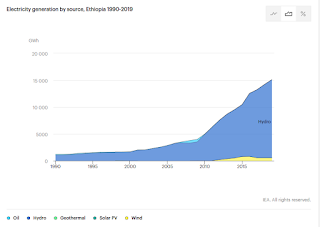
In Ethiopia, electricity generation capacity is growing very rapidly. From 2GW in 2020 to over 10GW in the next couple of years. The Grand Ethiopian Renaissance Dam (which I've written about before) is the biggest and most famous step in that growth, but there are many projects contributing to it. All of course phenomenally good. Indeed, practically nothing is better for economic growth and broadly improving lives than electrification. For comparison, the average Ethiopian has 1/50th the electricity of an American. So, until we get to 100GW at least, another 1000% growth, increasing generation is unquestionably necessary.
But there's a catch. It is extremely difficult and expensive to deliver that energy to users. In the case of Ethiopia, some estimate that $10B of investment and years of hard work are needed for transmission and distribution to catch up to generation. In the meantime, up to half of the generated energy remains unused. Which means the investment in generation takes longer to pay for itself. Meanwhile how do you finance the transmission and distribution? It's a huge chicken and egg problem, and it's unavoidable when there is rapid growth.
In more developed countries, capacity may not be doubling or quadrupling but a similar problem exists with solar and wind power. Huge investments in supply are needed, but the demand may not match up with the supply, since consumption peaks don't line up perfectly with the times when the sun shines or the wind blows. Whether caused by the difference between the time of generation and consumption, or by the distance, this is the problem of "stranded energy".
Now what if there was a way to make money from stranded energy? In Ethiopia, this revenue could help accelerate electrification! That's where Bitcoin comes in:
"the competitive dynamics of Bitcoin mining are such that it shifts in time and space to the lowest available cost of electricity. This occurs not just by deploying hardware to various locations, but also by turning miners on or off instantly. This flexible demand-side support makes mining the ideal customer to balance variable supply...." from "The Dynamics of Bitcoin Mining" by yours truly.
Thus the energy demand profile of data centers that host high energy computations makes them the perfect customer for Ethiopia's stranded energy. Bitcoin even more so than other data applications because:
- Bitcoin mining is location agnostic. It doesn't matter if it runs in Antarctica or the Sahara as long as it's connected to the Internet.
- It's also time agnostic. Each hash computation is independent of the previous one. You can mine 24 hours a day, 12 hours a day, at random times. Of course miners, in order to be profitable, must be very good at making the complex trade offs between between energy cost and hardware utilization. But they don't inherently need 24x7 power.
- Further, contrary to common perception, it doesn't actually need very much bandwidth. The entire blockchain is still barely more than half a terabyte!
- And equally importantly, it's all public data. The entire world can see all the inputs to the miners. So there's no data sovereignty, legal information jurisdiction or cyber security issue.
- Mining is purely infrastructure for running computers. There's no link between the locations of the miners and the users of Bitcoin. So Bitcoin mining doesn't depend on local regulations about money and financial services, legality of "cryptocurrencies" etc.
P.S. This post is months overdue! And it's too long. To quote Mark Twain: “I didn't have time to write a short letter, so I wrote a long one instead.”
2023/04/01
"Attention" and "Transformers" in Large Language Models
"Attention is all you need" (aka the transformer paper) published in 2017 by Vaswani et al from Google is still the mother of current LLMs, including GPT. "Effective Approaches to Attention-based Neural Machine Translation", an earlier paper by Luong et al from Stanford, was also quite important.
These are sequence-to-sequence models, i.e. their job is mapping an input sequence of text into an output sequence of text. Applications include translation from one language to another, answering questions, having a conversation, etc.
They use language embeddings (made famous by Word2vec in 2013 and later by BERT, both also from Google) as the basic encoding/decoding building blocks, i.e. mapping text to vectors of real numbers in an "embedding space".
The main new idea is in the architecture of the neural network between the input encoding and output decoding stages. The model uses the preceding terms in the current output sequence to decide which parts of the input sequence to pay more "attention" to for the next output term. A bit more precisely: the previous output is a "query" which gets used to generate a linear combination of "keys" from the input which maps to a linear combination of "values" also from the input. That in turn gets transformed into the next output term with a few more layers in a plain feed forward network (i.e. a bunch of layers of neurons, where each neuron is putting a linear combination of inputs into non-linear activation function). Each step has trainable weights.
There are also clever tricks besides "attention". One is positional encoding to represent the order so the same input term in a different position has different effects even though, unlike in recurrent neural networks, in transformers the network just sees them as bag of words that could be in any order. Another is layer normalization to sort of keep the nonlinear outputs within a reasonable area in the embedding vector space.
This architecture, as far as I know, was not derived explicitly from the way human brains work. The "attention" analogy is really useful, but there are no principles saying this architecture is more fundamental to intelligence, or more natural, than many others. It just happens to produce remarkably good results when the weights are trained properly.
So that's the basic idea of contemporary LLMs. Of course in some sense, all computer neural networks are just a bunch of matrix multiplications and ad-hoc activation functions. But you can't just connect a large number of mathematical "neurons" randomly in a network and hope it learns something. The choice of architecture, i.e. how the "neurons" are connected, is key. On top of that, there is still an enormous amount of innovation/engineering to make the real world language models, not to mention turn them into a product like ChatGPT or Google Bard.
2022/07/25
The case for GERD
Power
Economic impact
Climate impact
Water balance
Increased rainfall?
No reduction in flow
- Electricity generation doesn't consume water. As water, pulled by gravity, flows through turbines, the kinetic energy of the water becomes electric energy, and all the water comes out on the other side and flows downhill from there as always.
- When there is loss of water from a dam, it is because it has a reservoir, a lake. The larger the area of the lake, the larger the loss due to evaporation. Indeed at the High Aswan Dam in Egypt, located more than a thousand kilometers downstream from the GERD in a flatter and hotter area, the reservoir (Lake Nasser) is large and shallow, causing a significant loss of water to evaporation. The GERD however is situated in a gorge, so the lake it creates is much narrower and deeper (about 1,900 km2 for GERD vs 5,250 km2 for Lake Nasser). It's also in a cooler area. Thus the evaporation impact of GERD is much less than Aswan's. Further, the purpose of the reservoir is to regulate the flow, like a battery. In theory, if you have a reservoir upstream, you can reduce the size of a reservoir downstream. So if we naively forget political boundaries for a second, and assume Egypt, Sudan and Ethiopia were 100% cooperative, to manage the total flow optimally, they would achieve the same magnitude of regulation by reducing the volume of Lake Nasser by the volume of GERD lake. Since GERD has relatively lower evaporation, this would be a net reduction in evaporation. But to keep things in perspective, evaporation accounts for less than 2 billion out of about 90 billion m3 /year of water flow on the Nile, so it's a minor issue.
- A much larger fear for downstream people is that the GERD might enable additional consumptive uses, like irrigation for agriculture. This is a legitimate general concern of course, and fairness and efficiency in consumptive uses is important. However, in the case of the GERD, its location at the most downstream point in Ethiopia, near the point where the river exits to Sudan, means that it would be infeasible to use any of the water from that point for agriculture, as you would have to pump it uphill to reach farms within Ethiopia. This effectively guarantees that GERD cannot physically be used for irrigation or any consumptive activity in Ethiopia.
Floods and drought mitigation
- "Sudan will clearly be better off ... because GERD operations will smooth Blue Nile flows, eliminating flood losses, increasing hydropower generation, decreasing sediment load to the reservoirs and canals, and, most importantly, increasing water for summer irrigation in the Gezira Scheme and other irrigated areas along the Blue Nile". To get a sense of the magnitude of this benefit, consider that flooding in 2020 caused over 100,000 homes to collapse and Sudan to declare a 3-month state of emergency.
- During droughts, it is expected that the existence of the GERD will cause "decreased water deficits to Egypt and increased water availability".
Filling
Geopolitics
[1]Another way of getting economic impact is to multiply production by average price to get the direct value of the energy, and then apply a GDP "multiplier" which estimates the downstream GDP impact (electricity enables goods and services, which in turn enable other goods and services etc.) The problem as you can imagine is that multipliers are very inexact. In a tweet on this topic a couple of years ago, I used the a multiplier of 1.6 which I now realize is too low. I also incorrectly used peak power instead of average. Coincidentally the two inaccuracies cancelled out and the GDP estimate was about the same.
2022/06/03
The 4th wave of Bitcoin FUD
I just came across Why This Computer Scientist Says All Cryptocurrency Should “Die in a Fire”. I can't find any point in there that hasn't already been refuted many times. But it's relatively rare to find so many of them in one place, and it has been going around, so I thought I should make a little effort to rebut it.
Security
Though not the most important aspect of the article, the "computer scientist" in the title is a not-too-subtle argument from authority, so it behooves us to take a look. The computer scientist in question is Nicholas Weaver, who I haven't heard of before, though from a brief look at his publications, I recognize some of his co-authors. It seems like his expertise is network security. So his most important contribution as an expert would be if he could find an actual technical security problem in Bitcoin. But of course he hasn't, in fact no one has successfully exploited Bitcoin. This is a rarely appreciated aspect of the network. Even though it's the world's largest honey pot, with literally several hundred billion dollars there for the taking, the entire codebase is open source, and all the data is on the public blockchain, no one has actually technically been able to "crack" Bitcoin. There is plenty of theft of Bitcoin of course, because people make mistakes with their keys etc. A scary bug was luckily fixed in the early days. Still no one has exploited the system itself. For any computer scientist, or anyone who has ever written software, this is very remarkable. As a network security expert, you'd think Weaver would at least mention it.
Maybe he has motivation for not saying anything positive? Indeed, apparently he's been declaring the death of Bitcoin so many times since 2013 that Weaver has earned a place in the Bitcoin Skeptic Hall of Fame. It seems like he has dug himself into an anti-Bitcoin emotional trap which is hard to climb out of.
Bubbles
Credentialism aside, his actual criticism consists of economic arguments. He points to the price of Bitcoin in USD and "bubbles" where it rose from $10 to $100 then "crashed". Then to $1000 and crashed. Then to $20,000 and crashed. Then to $60,000 and crashed. And confidently asserts that there won't be a fifth bubble, that this time it's really dead. But this only inadvertently points to the fact that he's been wrong so many times. Without any coherent explanation of why his previous predictions have failed, it's hard to believe him this time. A more honest view is to zoom out and look at it on a log scale, and notice that each "crash" bottoms out much higher than the previous one. So if one is going to reason purely from historical prices, then a reasonable observer would not confidently say that the last peak happens to be the final one before it goes to zero forever. That's like looking at a toddler learning how to walk and after the fourth time he falls down saying the kid will never walk. A more reasonable take is that if the Bitcoin price chart tells us anything, it's more likely the story of an emergent store of value. Of course, chart analysis to predict future prices is generally a fool's errand, and even more so with this unique phenomenon. There are not many analogues in history -- we don't have exchange rates of gold from 2500 years ago. It's better to think about Bitcoin from first principles and think about long term adoption while avoiding short term price predictions.
Adjacent crypto: altcoins, blockchains etc.
To make matters more confusing, most critics (and Weaver is no exception) put Bitcoin in a bucket with all the other cryptocurrencies, ICOs, NFTs etc. But almost all of the other stuff around "crypto" is junk, much of it unethical or even fraudulent.
Leaving aside the many outright frauds, the whole "altcoin" space reminds me a bit of the history of the Internet. In the 1980s and 90s, TCP/IP had alternatives like ATM (Asynchronous Transfer Mode). A lot argued that the IP network wouldn't scale, or wouldn't offer good enough QoS, etc. They argued that the net would never be used for serious things like the phone network or television. It's true that there are various trade-offs in the design of TCP and IP, even some arbitrary choices. You can argue for different ones in hindsight. And things do evolve, albeit slowly. Witness IPv6 getting deployed in a backward compatible way over more than 2 decades, while IPv4 continues to chug along. Even ATM was absorbed as a short-lived layer 2 protocol under IP. But there's only one Internet. That's the so-called network effect. If the protocol is good enough, early enough, it becomes the standard.
And that is where proponents and critics of "altcoins" are causing confusion and driving unjustified hostility to Bitcoin. Viewing Bitcoin as one of many "cryptocurrencies" masks a basic reality: Bitcoin is like the Internet of money and it is here to stay.
That said, I'm not against all other cryptocurrencies. For example a broader smart contract platform makes sense long term, and Ethereum may be the one for the ages. But there are significant technical hurdles remaining. And it's already so bloated very few people actually run a full Ethereum node. And that's all before the much delayed eth 2.0 migration, which if it succeeds may introduce a potentially fatal governance change called proof-of-stake. Building a "world computer" as it needs to be is much harder than what has been achieved to date.
"Blockchain not Bitcoin" is another common theme among "crypto" hopefuls. But without a real reason for decentralization, a blockchain is just an expensive and slow database. Most of the envisioned applications for blockchains can be more easily achieved with traditional databases.
Bitcoin's proof-of-work ledger for sound commodity money is to date the only real world blockchain use case.
Energy and Proof-of-Work
Speaking of proof of work, energy use is the most common and dangerous vector of FUD against Bitcoin, and Weaver recycles the usual points. He claims that Bitcoin miners are "wasting tons of electricity". This topic is deep and generally misunderstood. Here's my attempt to distill it in my paper entitled "Dynamics of Bitcoin mining":
Does mining use too much energy?
This question assumes the system requires some amount of computation to be done and that it ”wants” to minimize the energy to achieve it. That is indeed how most systems work. But not Bitcoin. Proof-of-work does the reverse of that. The system ”wants” a certain value to be spent on energy, and the amount of computation adjusts to achieve it. Of course individual miners compete by being as efficient as possible, but the resulting collective behavior is to achieve a certain cost of energy with variable amounts of computation, not to perform a specific amount of computation with variable amounts of energy.
This unusual combination – individual participants being efficiency-seeking but their collective behavior being efficiency-neutral – is very counter-intuitive and probably the root cause of much misguided hostility. It’s also worth emphasizing that the amount of energy doesn’t matter, only the cost. If the price of electricity relative to everything else in the world doubles, but nothing else changes, then Bitcoin would simply use half the amount of energy to achieve the same relative cost[...] The cost of energy is a feature not a bug, and ”waste” is impossible by design. All of the energy is ”work”.
And where there’s no ”waste”, the question of energy use boils down to a moral judgement. Can you argue that heating in the winter, even if perfectly efficient, is not justified and people should move to warmer climates? What about air conditioning, or electric clothes dryers, or ice cream? When is any purposeful energy use justified? Morally, as long as access to and the price of energy is fair, what it’s used for should be accepted as a subjective choice. Bitcoin offers the possibility of inflation-resistant savings, low-cost long-distance value transfer, and censorship-resistant money. For its users, these are important benefits which are no less justified than most other uses of energy.
In the same interview, Weaver attacks the notion that Bitcoin "incentivizes green power", and goes on to misrepresent the incentives, and the supply and demand dynamics of electric power. I covered this too in the same paper:
Many sources of renewable energy are highly variable: solar and wind power depend on time of day and weather, hydroelectric power is seasonal, etc. In general, these ups and downs on the supply side do not line up perfectly with the demand for electricity. Further, even with the largest possible batteries, water reservoirs, etc., electric energy remains extremely difficult to store for later use at a large scale. Thus there is often a lot of ”stranded” energy when using renewable sources. Just like off-peak bandwidth in telecommunication networks, or empty seats on scheduled airline flights, the cost of production is already sunk, and so for the supplier, selling stranded power at any price is better than letting it go unused. [...] The competitive dynamics of Bitcoin mining are such that it shifts in time and space to the lowest available cost of electricity. This occurs not just by deploying hardware to various locations, but also by turning miners on or off instantly. This flexible demand-side support makes mining the ideal customer to balance variable supply, and as variability tends to affect renewable much more than fossil fuel sources, in effect, Bitcoin subsidizes the development of ”green” electricity.
Adoption
Finally, Weaver claims that Bitcoin will permanently fall apart Real Soon Now™, when it runs out of suckers. But there's really no basis for his claim. He doesn't give any reason why the number of suckers is a particular fraction of the world's population and why that limit has been reached now. Why didn't it run out after 1M people? Or 100M? Why not 8 billion people?
Of course, the success of Bitcoin depends on widespread adoption. Why is gold used as money? You can try to explain it based on some key properties: it's impossible to synthesize, the supply is limited, it's fungible and can be shaped easily, it doesn't degrade... Those are useful, but we don't know if they are sufficient. The emergence of a monetary good is a fascinating topic, one that most people don't understand and don't even realize that they don't know. ("The Origins of Money", an article which predates Bitcoin, is a good read). Ultimately, Bitcoin is just a Schelling point whose emergence is highly path dependent.That's just a fancy way of saying "we'll see", but every day that passes makes the ultimate success more likely, and it's been almost 5000 days already.
2012/10/30
Time lapse #2
- To get maximum depth of focus: set the aperture to be as small as possible (f/22) and let the shutter speed be automatically determined. By the last few frames, the exposure time is up to 3-4 secs.
- To compensate for the lack of trains: added a hurricane!
2012/10/29
Time lapse
It consists of:
- one photo every 5 minutes,
- 101 images which become
- a movie of 10 frames per second,
- for a speedup of 3000 x real life.
- Plug camera into laptop via USB.
- To remotely control camera: a program called EOS Utility which comes included with most Canon DSLRs. I'd never even looked at those discs that came with the camera, which is more than 3 years old. Good thing I never threw them away!
- To make the HD movie out of the JPEG images: Movie Maker tool in Picasa.
2010/10/16
Design bugs in everyday life: hall of fame
Revisiting the subject of design bugs in everyday life, there really ought to be a "Hall of Fame" for such things, which I hereby inaugurate.As first inductee, I nominate the typical North American cable TV remote control, like the one from Time Warner shown here. It's design is so atrocious it defies comprehension.
What is it about this object that I find so contemptible? Consider two operations on a TV remote that you really want to be quick and effortless. One is "mute"... When you need it, you need it fast. Another is "previous channel" -- probably the most frequently used button. In any sensible design, these two buttons would be large and as distinct as possible. Here they are the exact opposite, they are the tiny gray dots below the blue and red buttons. They are in fact the least distinct buttons on the whole thing!
This leads to the type of thing we've all experienced: you are watching TV, the phone rings, your focus shifts completely to the phone call and with the little attention that you have left ofter, you fumble with the remote, trying to find the $*@%! mute button, meanwhile the TV volume seems to get louder, the phone call becomes more urgent, stress rises.... You get the picture.
On the other hand, the two largest and most visible buttons on the remote are "list" (to access DVR), bright green one, and "on demand" (to access video on demand), the big white square. But neither of those features, by definition, requires any speed... In fact they are meant to be accessed at a leisurely pace, that's the whole point of them! Perfect candidates for attractive but discreet buttons. But no, they get to jump out the most, screaming at you.
Why does this object have exactly the opposite of what you'd want in a good design? There is not even a lock-in effect, as described in the previous post, to excuse it. Maybe there's a less naive reason. The "on demand" button generates additional revenue for the cable company, so that could be why it gets featured strongly. But really, it can't make that much difference. How many times will someone order movie just because they saw the button? Once? For that tiny bit of incremental revenue they are willing to get in the way of the most essential functionality? It's like giving limousines priority over fire trucks and ambulances on the road!
But let's apply Hanlon's razor: Never attribute to malice that which is adequately explained by stupidity. They probably just don't give much importance to design at all. Recall these cable TV folks are the same people who, as I've noted before on the subject of the mythical DVR+P2P, seem completely capable of suicidally stupid fear and paralysis in the face of potential innovation.
The essence of good design is to deliver functionality efficiently, and from that the aesthetic flows naturally. Form following function and all that. For committing the most egregious violation of that principle that I can find, I hereby induct the Time Warner cable remote control to the Design Bugs Hall of Fame.
While we're at it, I might as well give them the second induction as well. Just look at the program menu on your typical TV. Why doesn't it have your most frequently used channels, like bookmarks, easily accessible at all times? Most people watch a handful of channels vast majority of the time. Does it make sense to have them scroll around or enter numbers every single time to find the same few needles in the huge haystack of 500 channels, over and over again? Why not present an automatically generated list of your most frequently visited channels, like the Firefox and Chrome browsers do with web pages? It would be a huge time saver, enormous usability win, a no brainer. They haven't thought of doing that, in the decades that cable TV has existed? Contrast that with innovation in web browsers....
Cable TV subscribers..... which I am not one of by the way, imagine how much more I would complain if I actually used it! But I digress. Fortunately, Cable TV subscribers can now root for the brave new world of software-driven television. Tivo, Boxee, Apple TV, Google TV, Netflix, et al, whatever they end up becoming, let's hope they manage to wrest the user experience from the sclerotic grip of the cable TV monopolies and their business model demons.
2009/11/08
Design bugs in everyday life
It's a striking example because the difference between the right and wrong solution is so trivial. It's a design error, and if you realize it early on, the fix is virtually free but later it's very costly. Nothing new in that, that's exactly the nature of software bugs and it's not surprising that similar "bugs" exist elsewhere. But what really fascinated me in this example is that the bug, doesn't get fixed even in subsequent versions! You still have many coffee places that have different size cup covers, for decades, for no good reason.What a fascinating bug! It should have been crushed years ago and yet it continues to hang around generation after generation.
Since then, I've noticed other examples of design bugs in every day life that are surprisingly resilient. Some, like the one above, probably survive because the inefficiency occurs in such tiny increments, we don't appreciate the cumulative cost. Others survive because all they need is one chance to get into the system and then they are locked in forever. Here are a few random ones that I can think of right now:
- Typographical Fonts where l (lower case L) and I (capital i) are hard to distinguish.... It seems like if you are designing a font, making letters distinct would be one of your first requirements, so how do these fonts survive, and even thrive? Imagine all the damage that has been done throughout history because someone misread a "l" as an "I"... it's hard to estimate but it must be huge. Maybe it caused a shipwreck at some point!
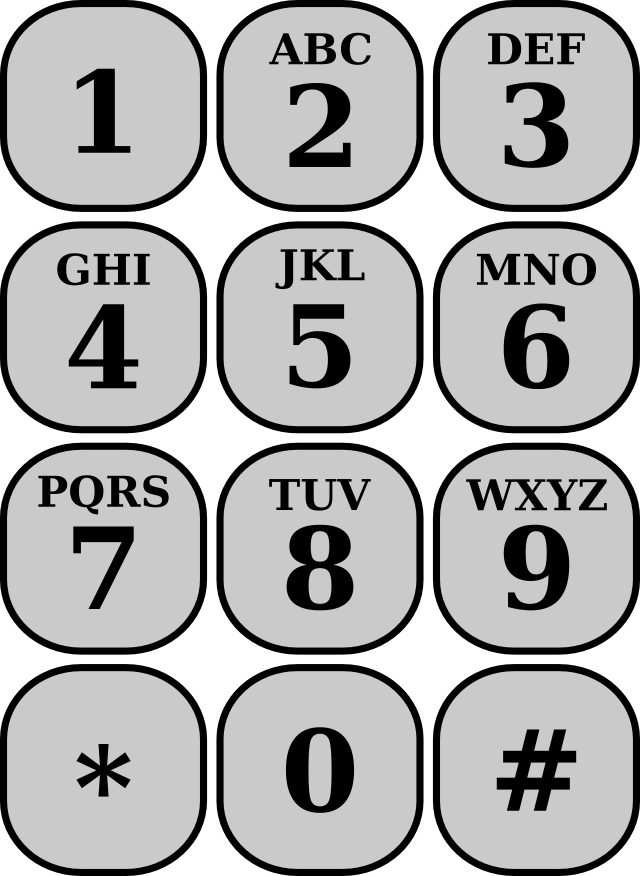
- Alphanumeric key mapping on phones: a neat old idea which allows you to make memorable words out of phone numbers, like 1-800-FLOWERS. But let's look at that mapping on our phones
We have 2: ABC, 3: DEF, 4: GHI, 5:JKL, 6: MNO, 7 : PQRS, 8:TUV, 9 : WXYZ , and 1 and 0 have no letters. This leaves a small doubt in a some cases: when you see O is it really an O which makes it a 6 or is it a zero? Similarly if I see a I, I'm not sure if I should dial a 4 or a 1. That's a bug in the design. The fix would obviously have been to assign I to 1 and O to 0, and then assign all the others alphabetically 4: GHJ, 5: KLM, 6: NPQ, .... with a nice side effect that now all the keys would have three letters on them (instead of two of them having 4 letters, or omitting Q and Z like they did in some old phones). Again a trivial fix but the design bug got locked-in, became the standard, and now it will never be fixed. Imagine.... maybe some lives were lost because someone wasted precious seconds by dialing a 4 instead of a 1!
- Bank ATMs that give the cash before returning the card; it seems obvious that will cause a lot of people to leave their card behind which in turn is a huge cost for the bank and the customer! The fix is to design the machines to always return the card first and then proceed with the withdrawal or deposit. Fortunately this last bug seems more prevalent among older machines than newer ones, which hopefully means it's on it's way to extinction...
2009/08/11
Mark Cuban's advice to Myspace
It would take a significant breakthrough, a next generation web application. It would have streaming, download and playback, syncing with devices, all better or at least as good as todays iTunes client/server combo. It would also have to be a great authoring/publication tool for artists to easily create a good looking online presence, perhaps even some actual post-production music features to create special samples and mixes…
In short, they need a site that is as different from today’s Myspace pages as, let’s say, Gmail in 2009 is different from Hotmail of 1999. The ingredients are available and ripe: after years of stagnation, browsers and web languages are in a period of intense innovation. But can Myspace pull them together to create a cool and, as Steve Jobs would say, “insanely great” technology for the new web-based music universe? I doubt it. I just don’t see any evidence whatsoever, at Myspace or anywhere else at News corp, of the level of technical depth required to lead the world into this new — dare I say it? — “web 3.0″ music world. Still, you are right IMHO, it’s their best bet and they should at least try rather than wither away.
2009/07/29
Chronicle of a death foretold
- When you receive a message on Facebook, it sends you a notification by email. Great. But then you can't reply! Why? Why don't they just set the reply-to in the email header to an address that will send it back to the person's inbox in Facebook? That way you and your friend are still communicating through Facebook but with the added convenience of email e.g. on your mobile. But no, they force you to login to the Facebook website to reply.
- Similarly, suppose you are logged in to Facebook, and you want to email your friend. You go to you friends profile, and guess what, you can't click on the email address to send them email! Why? Why can't they just make it a mailto link?
- So ok, you decide to just copy and paste the address, of course. But you can't -- it's an image! Why? Whyyyyy? Why can't they just leave it in plain text, why do they want to go through the extra expense of converting everyone's email into an image?
The title of this post by the way is from a novel by one my favorite authors. Not his best novel, but a great title. And a pretty good movie too.
2009/05/06
100% wireless
![]() |
This past weekend, I finally completed the last step of a very gradual evolution... to H. s. sapiens radionsis i.e. the all-wireless man. It started with giving up the telephone landline years ago and just using the cell phone. Then, after a recent move, I could get many high-def digital TV channels completely free... via good old fashioned broadcast.
2009/03/14
Trouble in (AAPL) paradise?
Last year my beloved blackberry was stolen... at gunpoint! That was the single most lopsided cost and benefit equation (for all involved) I have ever been a part of in my life... but that's not today's story. The story is, I decided to replace it with a second generation iPhone (with 3G and GPS), which had just come out. I'm not about to write a product review, God knows enough has been written about the iPhone. I'll just sya it's a really cool device.
But there's one aspect that doesn't seem to be talked about at all. A few weeks later I went to Ethiopia, and coincidentally again, I got one of the very first 3G SIM cards in the country. Amazing, the coolest phone and the fastest wireless network, woohoo. Except... there was no crack to unlock the 3G iPhone! So I had to carry two phones, one to make calls, and the iPhone for my address book etc. Second, my MacBook pro doesn't have a modem! And of course, who remembers to take an extra modem with them? Thankfully I had an old IBM Thinkpad, which has a built-in modem, so I could get on the Internet. The point is that the two Apple products I had were unusable in the third world. Whereas their competitors products (IBM and Blackberry in this case) are perfectly usable in those same conditions.
When I came back, a few weeks later, I was given an HTC G1 Android. Again many people have written comparing the two, but the thing that immediately struck me as the most important in comparing the two is a very basic point. The Android doesn't assume you have a computer. Everything is over the air, your contacts, applications, OS updates etc. are all updated/synced wirelessly. Whereas the iPhone requires that you have a computer, and a pretty powerful one at that (it has to be able to run iTunes on Windows or Mac OS X). To use an iPhone, you have to not only buy the phone, you must also already have a $1,000-$2,000 computer at home. If you live in the first world, that's a perfectly valid assumption, no problem. But it means that Apple's total market is a few hundred million people in the first world. This is true of Apple products in general, but is even more true of the iPhone which is a hugely important piece of that company's future. For comparison, Android's market is those people, plus the other 3 billion people in the world who can afford a $200 phone but not a $2,000 computer.
Then few months ago I read a great blog post (unfortunately I can't find the url to link) which argued that because Apple's marketing has been based on "coolness" and "exclusivity", once a device reaches a critical mass of users, the marketing starts defeating itself. Same psychology which limits the lifespan new fashion or of "hip" nightclubs: exclusivity is key to success, and eventually when the B & T crowd can get in, it's no longer cool.
Add to that the phenomenal success of iPhone sales so far, and you can only conclude that pretty soon, it might, just might saturate its potential market, much sooner than you would expect. There's some evidence this is already happening with the iPod. And the iPhone has more formidable competitors and more complicated market dynamics than the iPod.
Recall what happened with personal computers, Apple invented the category and dominated it with a unique approach until the mid 80s. But as the overall market grew from millions to billions of users, they peaked and ended up stuck at well under 5% market share, as cheaper and uglier IBM PC clones took the other 95+%. On the other hand, in the last 10 years, Apple has pulled off several bet-the-farm miracles. Not just the invention of the iPhone, and the iPod, but also two earlier huge gambles: switching from PowerPC to Intel CPUs in the Mac, and switching from the old Mac OS to Unix-based OS-X, both were incredible successes of business and engineering that defied the conventional wisdom completely.
So this is a tricky one. It could go either way. But I'm going to go out and a limb and predict that 2008 was the year of Apple's peak. Short AAPL.
2009/02/14
What happened to Kavo, Tizaa?
I want my
I want my DVRP2P
From the first time I heard about Tivo, I expected the obvious next step, which would be gargantuan, the biggest thing since the web browser. It was obvious; Tivo + Napster! But Napster was already dead so I started saying: Tivo + Kazaa! Kazaa just happened to be the hot P2P file sharing network at the time (circa 2002). It's not necessarily Tivo anymore either, now it's DVR a whole category. So to update the idea let's call it DVR+P2P.
It's obvious. The DVR is basically a computer with a big hard drive, and a fancy video decoder/tuner card. Tivo is essentially an application that runs on Linux, I believe. Moreover DVRs connect to the Internet. So if they just added a P2P software client on it, boom! Suddenly not only can you record your own TV programs, you can also search every other user's recorded programs. This means almost anything that has ever been on TV on any channel is accessible for viewing on demand by everyone! The benefit to users would be ... I can't find a strong enough superlative. It'd obviously be HUGE. And incredibly easy to do.
So why hasn't it happened yet?
- Copyright infringement? This is running on a closed device so they could easily restrict the software to only search "legal" videos from the same cable or satellite provider only.
- Advertising? They already allow fast-forwarding through commercials, it doesn't seem to have killed the ad revenue. In any case they could disable ffwd if they wanted to.
- Revenue? DVR+P2P would be so great they could charge any price for the service everyone would still sign-up for it.
Are they just extremely paranoid?
Here's what AFAIK is the conventional theory about this: Traditional laws relied on the physical form of books, records etc. to control the amount of copying, and now with digital media + data networks making copying exponentially easier the laws just don't fit anymore, and so there will be some major adjustments in the coming decades. In the meantime content owners are paranoid and are just blocking every new distribution method even if it's beneficial to them, like they tried to do when VCRs first came about. Scrounging through some links on my old homepage, I found a link to the first article I first read on this: "Who will own your next good idea?".
Today, I stumbled across a brilliant presentation by Laurence Lessig from 2002 entitled "Free Culture". In fact this post was supposed to be a quick link to that preso but it has released years of pent-up frustration on this subject in me. Anyway, "Free Culture" augurs a much darker cloud over the same field. He makes the point that digitization is expanding the scope of regulated use dramatically to the point of suffocating unregulated use. Which seems upside down because we are so conditioned to think of digitization as threatening regulated use. But when you think about it, it's absolutely true! Brilliant!
<irony>
That link on the word Brilliant which I've used before was to the hilarious Guinness commercial where they keep saying "Brilliant!" Now it says "This video has been removed due to terms of use violation." What a perfect example of legal protection of creativity!
</irony>
The more I think about it, the more amazed I am by the truth, simplicity, and importance of that fact: digitization is expanding the scope of regulated use. Unregulated use which used to be 90% of the activity, like simply reading a book or lending it to a friend, is being replaced by regulated use: reading a web page is technically a regulated activity, there are restrictions on what you can or can't do with those bits of content whether they are in your computer's RAM or HD, or pixels. "Fair use" is just a minor sideshow. Unregulated use is the 800lb gorilla. I don't think most people realize that and they really should. Lessig is a giant.